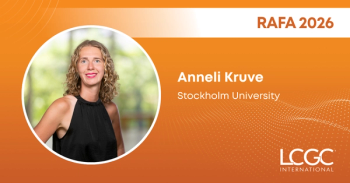
Anneli Kruve reports that toxicity predictions from MS2-derived molecular fingerprints outperform spectral-similarity methods in nontarget screening of food.
At analytica 2026, Gert Desmet of Vrije Universiteit Brussel compares the main fabrication approaches across micro-pillar arrays, 3D-printed supports, and multi-capillary channel columns, weighing each against factors such as scalability, cost, and the degree of structural control they offer.
At analytica 2026 in Munich, Germany, LCGC International spoke to Gert Desmet from the Vrije Universiteit Brussel about his talk entitled: “Next-Gen HPLC: A Column Technology Deep Dive.”1
In this video interview clip, Desmet answers the following question:
Column technology continues to drive chromatographic performance, and this lecture examines three transformative innovations. Micro-pillar array columns use precisely engineered microstructures to deliver superior separation efficiency, reduced backpressure, and enhanced reproducibility, making them well-suited to miniaturized and high-throughput workflows. 3D-printed chromatographic supports bring additive manufacturing to stationary phase design, enabling unprecedented control over geometry and porosity to improve mass transfer, reduce eddy diffusion, and open new stationary phase chemistries. Multi-capillary channel columns take a parallel approach, achieving faster analyses without sacrificing resolution, with strong potential for ultrafast separations. Together, these advances can help to address the growing analytical demands for speed, sensitivity, and sustainability.
Gert Desmet has a master’s degree in chemical engineering and obtained his PhD in chemical engineering (fermentation technology) from the Vrije Universiteit Brussel (VUB), Brussels, Belgium, where he is currently a full professor in chemical engineering and where he was the head of the Department of Chemical Engineering from 2008 until 2020. In 2012-2015, he was the vice-dean of the Faculty of Sciences and Bioengineering. His research focuses on the miniaturization of separation methods and on the investigation and modeling of flow effects in chromatographic systems. He recently guest-edited an LCGC International supplement on Advances in (U)HPLC.2