

The panel closes with a shared message: define your question first, and remember every result is an estimate.

Bryan Vining is the technical director for Ultratrace Services at Onterris Laboratories. He is a 26-year veteran of the laboratory industry. He worked in various laboratory roles for 16 years before joining Onterris in 2016. Vining has deep experience in the application of isotope dilution technology to the measurement of persistent organic pollutants, such as PFAS, at very low (ultratrace) levels in the environment. He has contributed to the revision of multiple EPA methods that use isotope dilution technology. Vining graduated with a B.A. in chemistry from Huntingdon College before earning a Ph.D. from Florida State University and an M.B.A. from the University of North Carolina at Chapel Hill.
The panel closes with a shared message: define your question first, and remember every result is an estimate.
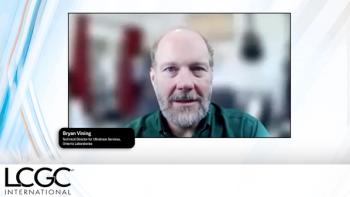
Asked for one change to ease PFAS analysis, the panel points to better communication and smarter use of AI tools.
The experts compare direct injection and solid-phase extraction for handling PFAS in complex matrices.

The panel tackles the paradox of background contamination: the lower detection limits go, the more PFAS turn up everywhere.

Bryan Vining, David Megson, and Pasquale Avino examine why ultrashort-chain PFAS like TFA are reshaping analytical priorities.
The panel weighs non-targeted screening against total PFAS measurement to catch the compounds routine targeted methods may miss entirely.
The panelists debate how to harmonize PFAS methods across a rapidly expanding, poorly standardized universe of compounds.
The panel unpacks the defining challenge of PFAS analysis: a chemical class so vast and diverse it pushes current methods to their limits.
Meet the expert panel exploring the analytical challenges of environmental PFAS detection in this LCGC International Peer Exchange®.

June 30th 2026