Sponsored Content - NA
See the advantage in optimizing your solvent evaporation for maximum accuracy and precision to comply with U.S. EPA Method 625.1
Sponsored Content - NA
See the advantage in optimizing your solvent evaporation for maximum accuracy and precision to comply with U.S. EPA Method 625.1


Special Issues
This application note will present the data collected as part of the demonstration of disk solid phase extraction validation for US EPA method 625.1.
Special Issues
The US EPA monitors a variety of chemicals in water that may cause harm to humans or wildlife to minimize exposure.
Special Issues
Drinking water is an important part of environmental exposure, especially for small children. Countries around the world have put regulations in place to monitor drinking water quality for a wide range of hazardous compounds.


Special Issues
This work will demonstrate a simple methodology using automated solid-phase extraction (SPE) and HPLC coupled with mass spectrometric detection. This work will demonstrate a simple methodology using automated solid-phase extraction (SPE) and HPLC coupled with mass spectrometric detection. This work will demonstrate a simple methodology using automated solid-phase extraction (SPE) and HPLC coupled with mass spectrometric detection.

The Application Notebook
Initial precision was demonstrated by spiking four 1-L volumes with one Snip and Pour pre-measured standard, each (40 mg). The data for four replicates was collected for 47 mm Disks and 100 mm Disks. The average percent recovery is excellent and meets the criterion specified of 83–101% HEM recovery for both size disks. The standard deviation is better than the criterion specified of 11% for HEM.

Special Issues
This automated SPE methodology is a solution that will reduce analyst labor, solvent usage, and turn-around-time while maintaining the high quality results required within today's laboratories.

Special Issues
The US EPA has implemented an exposure research program aimed at conducting drinking water research on methods as part of the Microbiological and Chemical Exposure Assessment. This research is aimed at evaluating the chemical pollutants and their role and levels in which there is an unacceptable risk to either humans or wildlife, as well as evaluating the methodologies currently being used to determine levels of chemical pollutants.

The Application Notebook
Mycotoxin testing awareness has increased as countries involved in world trade of raw agriculture and processed consumer products rely on a safe global food supply

The Application Notebook
The global demand for fish as a natural source of fresh animal protein, essential fats, minerals, and vitamins continues to rise with the human population.


The Application Notebook
Horizon Technology, Inc.

The Application Notebook
This application note will demonstrate the extraction of 1,4-dioxane from an aqueous matrix using option 1 of EPA Method 522 for 500 mL initial volume sample. It will make use of the SmartPrep Cartridge Extraction system to produce a valid initial demonstration of precision (IDP) and initial demonstration of accuracy (IDA).

The Application Notebook
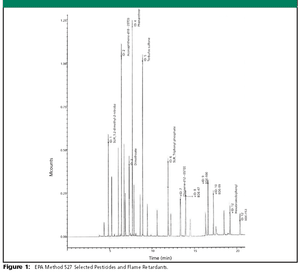
The second unregulated contaminant monitoring regulation (UCMR2) program was developed to monitor US drinking water sources for currently unregulated compounds. EPA Method 527 is categorized under List 1; Assessment Monitoring in the UCMR2 program. EPA Method 527 focuses on a wide range of semi volatile organic contaminants, including pesticides that were deferred during the first UCMR, flame retardants, and pyrethroid pesticides. This application for EPA Method 527 employs SPE with analysis by gas chromatography–mass spectrometry (GC–MS).

The Application Notebook
EPA Method 525.2 describes the procedure to determine low ppb levels of semi-volatile organic material in drinking water using solid phase extraction (SPE) or liquid-solid extraction (LSE) techniques. The City of Fort Worth, Water Department implemented an automated SPE process for the analysis of semi-volatiles by EPA Method 525.2, using the Atlantic "Certified for Automation" SPE Disk for EPA Method 525.2. Ethyl acetate, methanol, and water were used to condition the Atlantic disk prior to the extraction step. The extraction solvents used were a 1:1 mixture of methylene chloride and ethyle acetate. Extracts were then analyzed by GC–MS using a splitless injection technique.