


John W. Dolan
Advertisement

John Dolan has been writing "LC Troubleshooting" for LCGC for over 25 years. One of the industry's most respected professionals, John is currently a principal instructor for LC Resources, Walnut Creek, California He is also a member of LCGC's editorial advisory board.
Articles by John W. Dolan

LCGC North America
At the beginning of the year, it is good to look back in time- are there things that we can learn from the past? After a series of troubleshooting and method development seminars in Istanbul, Turkey, and Amman, Jordan, John Dolan looks back.
LCGC Europe
I regularly receive e-mails from readers with a wide variety of questions. Some of these blossom into full-blown columns, but many are answered with just a short response. As I cleaned out my inbox recently, I chose a few of these to share. There is no central theme this month, but hopefully you will pick up some useful information from these topics related to practical operation of the liquid chromatography (LC) system.
LCGC Europe
Another precaution I recommend is not to shut off the LC system for more than an hour or so if it or the column contains buffer.
LCGC North America
This month's "LC Troubleshooting" installment will take a look at the design of these durable pumps and also examine some of the potential weaknesses and how to overcome them.
LCGC North America
All the buzz lately about LC columns packed with particles smaller than 3 mm often comes with warnings about extracolumn effects. This month's installment will take a look at what these effects are and more.

LCGC North America
This "LC Troubleshooting" installment marks the beginning of the 26th year that John Dolan has written this column.

LCGC North America
John Dolan regularly receive e-mails from readers with a wide variety of questions. As he cleans out his inbox, he chooses a few of these to share.

LCGC North America
After returning from Israel, John Dolan dedicates this month's column discussion to three problems that know no international boundaries: how to condition a new column, the effect of washing a column with water, and ...
LCGC North America
This month's column will consider two problem areas; peaks that have severely tailing peaks, or split or doubled peaks, and the peaks that front badly.
LCGC Europe
I remember reading a study on learning in the all-day short-course format. Because teaching liquid chromatography (LC) classes is a significant part of my work, my attention was captured. The writers claimed that in a 6–8 h class, only three points would be remembered. One of my LC troubleshooting classes has approximately 200 slides - what does this say about how effective a short course is at conveying critical knowledge? As the saying goes, I have tried to make lemonade out of these lemons, and use the "only three things" concept to help reinforce what I think are the key points. So, this month's "LC Troubleshooting" instalment will use these points to form the core of a preventive maintenance programme for your LC system.
LCGC Europe
What do you do when the method can't be reproduced?
LCGC Europe
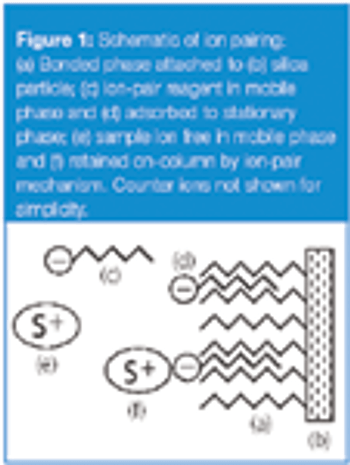
Ion-pair chromatography can be your best friend or your worst enemy.
LCGC North America
For this month's discussion, John Dolan shares some of the key resources that he recommends using when you have one of those "How do I?" questions.

LCGC North America
After taking a course on learning that stated most people only remember three main points from an eight-hour training class, John Dolan decided to use three points to form the core of a preventive maintenance program for your LC system.

LCGC Europe
If the problem source cannot be found or if found, cannot be corrected, an adjustment in flow-rate is justified.

LCGC Europe
A very efficient way to start an isocratic method development project is to make the first run as a scouting gradient run.

LCGC North America
After teaching a training class in China, John Dolan was reminded of how chromatographers worldwide encounter the same types of problems, such as method transfer. This month's column is dedicated to method transfer problems.

LCGC Europe
Trade extra resolution for speed.
LCGC North America
Reversed-phase liquid chromatography (LC) is a simple and easy-to-use technique that will give satisfactory separations for the samples that most of us encounter. Here, John Dolan examines the pros and cons of this technique.
LCGC North America
This month's "LC Troubleshooting" installment examines the possible reasons your retention times could have changed. If the root cause can be identified and corrected, no adjustment in flow rate will be necessary.

LCGC Europe
How to avoid an expensive shot in the dark.
LCGC North America
For the last six months, "LC Troubleshooting" has been concentrating on the process for the development of isocratic methods (those for which the mobile phase composition is constant throughout the run). The use of a gradient scouting run to speed isocratic method development is the subject of this month?s "LC Troubleshooting."
LCGC Asia Pacific
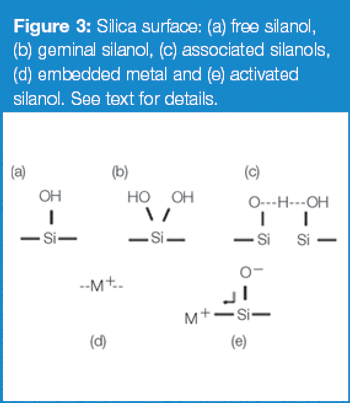
The various surface characteristics have different capacities and equilibration rates, which can affect the appearance of the chromatograms.

LCGC Europe
How do I get the most out of my efforts?

LCGC North America
In the previous installments of this series on efficient development of LC methods (1?5), we have concentrated on improving resolution by modifying the mobile phase, choosing a different stationary phase, or changing some other condition, such as column temperature. In this month?s "LC Troubleshooting" installment, we take a look at trading some of that resolution for a faster separation.

LCGC Europe
Faster isn't always better.
Advertisement
Advertisement
Advertisement
Trending on LCGC International
1
HPLC Method Measures Fiber's Cholesterol Uptake
2
The LCGC Blog: NIST Reference Materials
3
Challenges and Solutions in Oligonucleotide Analysis, Part V: Troubles with Phosphorothioate Oligonucleotides
4
Women in Chromatography: Being the Only Woman in the Room
5