


LCGC North America
Some possible solutions to the ubiquitous paek-tailing problem are presented by the author.

John Dolan has been writing "LC Troubleshooting" for LCGC for over 25 years. One of the industry's most respected professionals, John is currently a principal instructor for LC Resources, Walnut Creek, California He is also a member of LCGC's editorial advisory board.
LCGC North America
Some possible solutions to the ubiquitous paek-tailing problem are presented by the author.

LCGC Europe
This month, John Dolan turns his attention to the unexplained forces that seem to inhabit laboratories in spite of the most ardent troubleshooting efforts.
LCGC Europe
In this month’s column, John Dolan addresses a reader’s peak-splitting problem and suggests ways to avoid such occurrences in the future.

LCGC Europe
In the first part of this series, the authors look at method modification from a scientific and regulatory standpoint with regard to changing a column and the operating parameters.
LCGC Europe
John Dolan concentrates on the impact plumbing can have on column performance and offers his advice on tubing selection.

LCGC North America
Case studies are good ways to look at specific examples of common liquid chromatography (LC) problems and to draw general conclusions that can be applied to prevent similar problems from happening for other workers. The example in this month's installment of "LC Troubleshooting" comes from a reader who works in the pharmaceutical industry. The sample is a cold-cough syrup analyzed with an ion-pairing LC method. I have disguised the details somewhat to protect the proprietary nature of the method, but there should be sufficient information to help us gain some knowledge of the peak-splitting problem experienced by the user.
LCGC Europe
This month, John Dolan underlines the importance of building safety factors into laboratory methods so that costly and frustrating problems that can arise during routine operation can be avoided.
LCGC North America
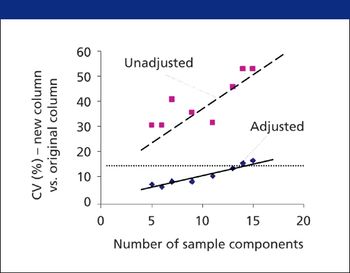
When a column is replaced with a new or "equivalent" column, sometimes the chromatogram can change so much that it is no longer suitable for its intended use. In such cases, method adjustment is necessary to correct the change. How much can the chromatographic variables be changed before revalidation is required? What do the regulatory agencies have to say about method adjustment? The authors discuss these issues and propose a technique that can be used to speed selection of new operating conditions.

LCGC North America
When you look at the manufacturer's literature or examine the performance sheet included with a new column, you'll see a list of column specifications, including the column plate number N. For a 5-?m particle size, column N generally will be 80,000 plates/m or more, whereas a 3-?m column will exhibit 100,000 or more theoretical plates. Your first response might be, "Get real!" After all, when real samples are analyzed on typical liquid chromatographic (LC) systems, rarely do we observe plate numbers anywhere near the manufacturer's claim.
LCGC Europe
This month, John Dolan looks at how changes in retention time can help to identify the source of some LC problems and demonstrates what can be learned from observing how the retention varies.
LCGC North America
LCGC Europe
In this month's column, John Dolan reveals a number of simple and useful shortcuts or rules of thumb that he has acquired over the years that allow quick estimates to guide method development or help solve a problem.
LCGC North America
While some variation in retention is normal, larger changes from run to run are generally indicative of a problem. Here, the auther discusses how the retention time of a peak in an LC separation can be a useful diagnostic tool to identify problems with a separation.
LCGC Europe
In this month's column the authors present a case study to outline several gradient quality checks that can be performed periodically to ensure proper performance of LC instrumentation. The example shows how by taking the time to perform such tests, potential problems can be identified before they reach a critical point.
LCGC North America
A detailed look at some helpful shortcuts for estimating chromatographic parameters.
LCGC Europe
Are you guilty of strange troubleshooting and maintenance habits that have been passed on to you from predecessors? John Dolan looks at some such practices, which were once acceptable, but don’t make sense in today’s lab.
LCGC Europe
Column author, John Dolan, presents a simple but powerful isolation technique for identifying problems with LC methods and equipment.
LCGC Europe
Dolan addresses the problems associated with transfering a validated method from one laboratory to another and considers what changes are permissable.
LCGC Europe
In this month's column, John Dolan addresses some of the guidelines regarding system suitability tests and comments on their significance for those developing chromatographic methods.
LCGC Europe
In this month's instalment, the authors cover the topics of column-switching techniques and parallel chromatography for LC?MS?MS methods, and describe the time benefits that can be achieved using such systems. An example set-up is presented and the authors outline the various steps required to perform such analyses routinely.
LCGC Europe
Following on from a previous instalment, this month's column assesses evaporative light-scattering detection as a complementary detection mode and builds upon the previous discussion in terms of detector applications.
LCGC Europe
In this month's column, the authors present a relatively simple method for selecting the appropriate curve-fitting function and thus ensure that the requirements of current guidelines can be met.
LCGC Europe
Peaks that are too broad can mean that analysts are not using their LC columns very efficiently. In this month's column, John Dolan describes how to determine if peaks are broader than they should be and highlights some of the common system-related causes of peak broadening.
LCGC Europe
This month's column examines several possible causes of peak splitting and presents some guidelines for isolating the problem source.
LCGC North America
This month's column looks at several possible causes of peak splitting and presents some guidelines for isolating its source.
LCGC North America
The authors show how several factors can contribute to a chromatogram's appearance.
LCGC North America
Dolan presents two situations in which experimental evidence is used to determine the best operating conditions.
LCGC North America
Dolan responds to reader comments and questions in celebration of the 20th anniversary of "LC Troubleshooting."
LCGC North America
John Dolan discusses the causes of peak tailing, how to measure it, preventive measures, and why newer column types are less prone to tailing problems.