John W. Dolan

John W. Dolan

John Dolan has been writing "LC Troubleshooting" for LCGC for over 25 years. One of the industry's most respected professionals, John is currently a principal instructor for LC Resources, Walnut Creek, California He is also a member of LCGC's editorial advisory board.

Articles by John W. Dolan

i4-371550-1408686791551.jpg

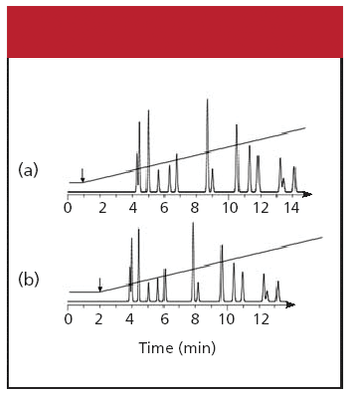
The gradient linearity and step tests are two of the most useful performance tests that can be made for a liquid chromatography (LC) system. These check the linearity of gradient generation and the accuracy of mobile phase proportioning. These tests, and examples of problems detected as a result of these tests, have been the subject of at least seven "LC Troubleshooting" columns over the last 18 years.1–7 We strongly recommend that every LC system undergo these tests at least on an annual basis, and preferably semiannually. When a new and different example of a problem detected by these tests is discovered, it is hard to bypass the opportunity to share it with our readers. So this month, you get yet another example of how an LC system can fail.

Carryover is the appearance of an analyte in a run when a clank containing no analyte is injected. In this month's "LC Troubleshooting," John Dolan shows us how to measure it, and some ways to reduce carryover.

i4-357954-1408688139065.gif

After you have worked with liquid chromatography (LC) for several years, adjustment of the mobile phase to move peaks around comes almost as second nature. To the newcomer, however, such changes border on magic. One of the rules of thumb that I teach in my short courses is "nothing's magic". This is meant to remind us that chromatography is a very systematic process - study it carefully and you will minimize your surprises. In this month's instalment of "LC Troubleshooting," we'll look at solvent strength and see how we can use it to make predictable changes in the peak movement for reversed-phase LC separations. Hopefully, you will be able to make some practical use out of the principles presented here the next time you need to develop or adjust a method.

In this month's installment of "LC Troubleshooting," John Dolan takes a look at solvent strength and sees how we can use it to make predictable changes in the peak movement for reversed-phase LC separations.

Testing helps you identify the soft spots in the method, select the best conditions for operation and develop troubleshooting strategies to correct problems when they do occur.

John Dolan ponders te question of whether or not you will be prepared when that method eventually fails.

i2-311442-1416915040194.gif

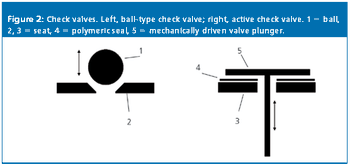
Check valves can be replaced with new ones, but often a simple cleaning procedure is sufficient to restore normal operation.

i4-283448-1408688963538.gif

LCGC North America and its companion publication, LCGC Europe, are targeted for chromatographers in the United States and Europe, respectively. Sometimes I wonder whether or not the same types of problems are encountered by workers in liquid chromatography (LC) on both sides of the Atlantic. As I write this installment of "LC Troubleshooting," I have just completed three weeks of teaching LC short courses in Europe. I can assure you that the content of the questions I get in these classes is the same, no matter where they are taught. This column is based upon questions gleaned from the most recent courses - you can see that there are no national borders for LC problems.

No column lasts forever, but in this month's installment of "LC Troubleshooting," John Dolan offers some tricks to help extend a column's life.

i4-183843-1408680207743.gif

Broad Peaks

A problem that is encountered occasionally in liquid chromatography (LC) separations is the presence of unusually broad peaks in the chromatogram. This problem is seen most often in isocratic separations, but it can occur with gradients as well. This month's instalment of "LC Troubleshooting" will cover some techniques to help determine the reason these wide peaks are seen.

This month's "LC Troubleshooting" is aimed at those who are just starting out in the liquid chromatography business, as John Dolan presents some helpful tips.

A Baker's Dozen

Some simple practices will help to make problems with gradient methods rare rather than frequent. this month's installment of "LC Troubleshooting" presents a baker's dozen of these tips.

Broad Peaks

The author takes a look at the problem of usually broad peaks and covers some techniques that will help determine the reasons behind them.