Articles by Peter Schoemakers

The International Symposium on the Separation and Characterization of Natural and Synthetic Macromolecules (SCM-X) will take place virtually, from 27 to 29 January 2021, with the live event potentially taking place in 2023. This preview offers a flavour of what visitors can look forward to from SCM-X’s “Zoomposium”.
Some members of the separation science community are still not yet convinced of the value of comprehensive two‑dimensional liquid chromatography (LC×LC). They feel that the large increase in separation power (that is, in peak capacity: the number of component peaks that may possibly be separated) may be compromised by losses in sensitivity and robustness of the separation. However, the chairmen of HPLC 2017 will have seen a great number of abstracts come their way from scientists who want to change this perception.

This is the second in a series of articles exploring current topics in separation science that will be addressed at the HPLC 2017 conference in Prague, Czech Republic, from 18–22 June.

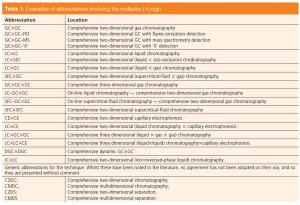
A review of nomenclature and conventions used in comprehensive multidimensional chromatography. An update of the popular paper on this topic from 2003.

An optimization strategy to obtain the best possible performance in the shortest analysis time for comprehensive off-line 2D-LC.

Guest Editor Peter Schoenmakers provides an introduction to LCxLC, and then goes on to talk about peak capacity, sample dimensionality, phase orthogonality, and some of the successes of the technique and the obstacles yet to be overcome.

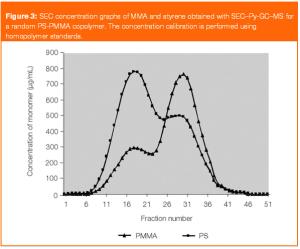
The pyrolysis fragments are first refocused on the top of the GC column, then separated and finally detected by the MS. At the end of the GC run the SEC flow is resumed again and the entire process is repeated.

Size-exclusion chromatography (SEC) and pyrolysis-gas chromatography (Py-GC) are commonly used to characterize copolymers. SEC is a powerful method to determine the molecular-weight distribution of polymers whereas Py-GC provides valuable information on their chemical composition. The combination of these two techniques could yield combined size and composition information for copolymers or polymer mixtures. A fully automated system was constructed to perform these two-dimensional (2D) characterizations. Several examples of the use of this new technique to comprehensively characterize polymers are described.