

LCGC North America
Ron Majors provides an unbiased look at this present crisis and gives alternative solutions.
LCGC North America
Ron Majors provides an unbiased look at this present crisis and gives alternative solutions.

LCGC North America
Ron Majors brings readers the second part of his yearly review of all that was new and innovative at the annual Pittsburgh Conference.
LCGC North America
Ron Majors brings readers his yearly review of all that was new and innovative at the annual Pittsburgh Conference.

LCGC North America
Guest authors show how mixed modes can be used successfully in the optimization of protein purification, and discuss how various experimental parameters can be used to regulate the binding of proteins to mixed-mode sorbents.
LCGC North America
A variety of chromatographic sorbents are commercially available for reversed-phase liquid chromatography (RPLC) and while many of these columns are nominally similar, in practice the columns may provide significantly different separations.
LCGC North America
Ron Majors continues his summary of the technical highlights of HPLC 2008, discussing more hot topics from the show.
LCGC North America
HPLC 2008 was held in Baltimore in May. Columnist Ron Majors covers the highlights of this major symposium, held in the U.S. every two years.
LCGC North America
Guest Editor Peter Schoenmakers provides an introduction to LCxLC, and then goes on to talk about peak capacity, sample dimensionality, phase orthogonality, and some of the successes of the technique and the obstacles yet to be overcome.
LCGC North America
Guest columnsist and LCGC Emerging Leader award recipient Gert Desmet considers the different methods that can be used to compare the performance of LC columns.

LCGC Europe
In this instalment of "Column Watch", columnist Ron Majors examines the role of pressure in high performance liquid chromatography (HPLC) from two viewpoints: the impact of the ultrahigh pressures encountered in ultrahigh-pressure liquid chromatography (UHPLC) on chromatographic parameters and increases in column pressure encountered in normal daily use. The latter is of more practical consequence to HPLC users because increased back pressure usually implies that something has gone wrong with the column. Pressure increases as a result of physical and chemical contamination are explored and practical approaches to solve these problems are suggested.

LCGC North America
This month's installment of "Column Watch" is the second part of a two-part series in which columnist Ron Majors examines the trends and highlights in columns and consumables at Pittcon 2008.
LCGC North America
This month's installment of "Column Watch" is the first of a two-part series in which columnist Ron Majors examines the trends and highlights in columns and consumables at Pittcon 2008.
LCGC North America
In 2001, the second glossary of common and not-so-common terms and "buzz words" for reference to HPLC columns and column technology was published. It is time for an update since new terms have arisen or, in some cases, their original meanings have expanded or changed.
LCGC North America
In this installment of "Column Watch," Ron Majors examines the various approaches to increasing the speed of high performance liquid chromatography (HPLC) separations.

LCGC North America
In this installment of "Column Watch," columnist Ron Majors examines the role of pressure in high performance liquid chromatography (HPLC) from two viewpoints: the impact of the ultrahigh pressures encountered in ultrahigh-pressure liquid chromatography (UHPLC) on chromatographic parameters and increases in column pressure encountered in normal daily use. The latter is of more practical consequence to HPLC users since increased back pressure usually implies that something has gone wrong with the column. Pressure increases due to physical and chemical contamination are explored and practical approaches to solve these problems are suggested.
LCGC North America
HPLC 2007 was held in Ghent, Belgium in June. Last month, columnist Ron Majors summarized some the important column developments as well as other Symposium highlights. This month, he winds up coverage with additional highlights in the areas of technology and applications. Among the topics covered are stationary phase preparation and characterization, multi-dimensional and comprehensive LC, temperature studies, detectors and an application overview.
LCGC North America
Columnist Ron Majors covers some of the highlights of HPLC 2007 including honorary sessions, best poster awards, and the latest developments in HPLC column technology.

LCGC North America
In this installment of "Column Watch" columnist Ron Majors revisits expert predictions from a survey conducted in 1987. A cross section of column experts of the time were asked a series of questions on the future directions in high performance liquid chromatography (HPLC) column technology. Now, 20 years later, these predictions are contrasted against current column technology. In many cases, the experts were entirely correct, while in other cases, they were dead wrong. Some current trends were not even considered 20 years ago. The author backs up his analysis with current survey information.
LCGC Europe
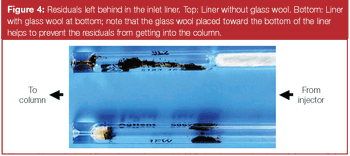
Modern gas chromatography (GC) capillary columns are rugged and forgiving but some care should be taken when handling and using these high-efficiency columns. In this instalment of "Column Watch", the authors discuss the issues surrounding avoiding column breakage, stationary phase damage and column contamination. Prolonging the life of a column by keeping an oxygen-free system, providing a cleaner sample and not exceeding the upper temperature limit of the stationary phase are highlighted in this practical discussion.
LCGC North America
In this month's issue, columnist Ron Majors and coauthors discuss the important steps in the successful production of fused-silica gas chromatography (GC) capillary columns.
LCGC North America
In early 2007, a web-based HPLC columns survey was conducted. Current usage was compared to a 1997 survey.

Special Issues
In 1983, the brainchild of Ed Aster, President of Aster Publishing, and Tom Hager, an editor, a publication called LC-Liquid Chromatography and HPLC Magazine was christened.
LCGC North America
This month's installment of "Column Watch" is the conclusion of a two-part series in which columnist Ron Majors examines trends in column and sample prep introductions at Pittcon 2007.
LCGC North America
This month's installment of "Column Watch" is the first of a two-part series in which Ron Majors examines the trends and highlights in columns and consumables at Pittcon 2007.

LCGC Europe
In any field there are often "misconceptions" or "myths" that are perpetuated and passed on to the next generation. These myths are often driven by a lack of understanding by practitioners of the real issues. In this instalment of "Column Watch", the 10 most popular myths around high performance liquid chromatography (HPLC) column technology will be demystified by discussing the issues at hand. Among some of the popular myths that will be dispelled are that "All C18 (L1) columns are the same", "You can't reverse an HPLC column", "High temperature always leads to better separations" and "The higher the carbon load the better the reversed-phase column".
LCGC North America
In any field there are often "misconceptions" or "myths" that are perpetuated and passed on to the next generation.
LCGC North America
October 2006. This brief review introduces the GCxGC technique and its advantages, hich primarily lie in the area of ncreased separation power for volatile chemical analysis.
LCGC North America
The popular HPLC 2006 Symposium was held in June in San Francisco, California. It is the premier annual meeting in liquid phase separations technology.

LCGC North America
In this installment of "Column Watch," Ron Majors traces the developments in modern column design in analytical and preparative configurations and speculates on future directions.

LCGC North America
Guest columnist Walter Jennings reflects on the early days of capillary gas chromatography (GC) and how chromatographers become experts in the technology by constructing their own columns, thereby achieving a more thorough understanding of the chromatographic process.