

LCGC North America
This month's installment of "Column Watch" is the conclusion of a two part series in which Ron Majors examines the trends in columns and sample preparation at Pittcon 2006.
LCGC North America
This month's installment of "Column Watch" is the conclusion of a two part series in which Ron Majors examines the trends in columns and sample preparation at Pittcon 2006.

LCGC North America
This month's installment of "Column Watch" is the first of a two-part series in which Ron Majors examines the trends and highlights in columns and consumables at Pittcon 2006.

LCGC Europe
Capillary gas chromatography (GC) is a well-established separation technique. Rick Parmely reviews some of the capillary column basics by investigating a standard test mixture and observing some of the chromatographic effects that can affect peak response, peak shape and column bleed. He provides guidelines for obtaining the best performance from a capillary column. He discusses peak tailing, column overload, ghost peaks and column bleed and speculates on "when to give up." He concludes with a set of fundamental steps to be used in achieving better GC analyses.
LCGC North America
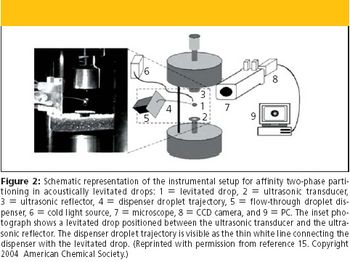
Liquid-liquid extraction (LLE) is among the most widely used sample preparation methods. In this month's installment of "Sample Prep Perspectives," Ron Majors discusses newer LLE approaches that offer significant advantages over classical methods. The miniaturization of LLE has resulted in solvent and time savings, improved automation possibilities, and faster sample preparation. The techniques of single-drop microextraction, extraction in levitated droplets, flow injection-, membrane-based-, and solid-supported extractions are reviewed. Often, these techniques use the same immiscible solvent pairs of conventional LLE.

LCGC North America
Higher productivity and faster analyses are two of the driving forces for continued improvement in high performance liquid chromatography (HPLC) column technology.

LCGC North America
guest Columnist Rick Parmely takes a look at some capillary column basics of a well-established separation technique. He discusses peak tailing, column overload, ghost peaks, and column bleed, and speculates on "when to give up."
LCGC North America
Ron Majors discusses advances in multidimensional chromatography and comprehensive multidimensional chromatography.

LCGC North America
HPLC 2005 was held in Stockholm, Sweden, June 26-30. In this month's installment of "Column Watch," Ron Majors covers this year's hot topics including proteomics, column technology - especially monoliths - microfluidics, and multidimensional and high-throughput separations.

LCGC Europe
In the last part of this series, the authors provide a technical review of the means for method adjustment and the pertinent regulations concerning the required validation of adjusted methods.
LCGC North America
Guest columnist Matt Przybyciel reviews the structure, behavior, and applications of both alkyl- and phenyl-fluorinated phases in HPLC.
LCGC Europe
This month’s column provides an overview of green chemistry issues relating to preparative chiral SFC chromatography in support of preclinical development in the pharmaceutical industry.
LCGC North America
The authors provide the latest information on new stationary phases for modern TLC and high performance TLC (HPTLC), along with helpful hints on how to get the most out of this flexible form of chromatography.
LCGC North America
This month's installment of "Column Watch" is the conclusion of a two-part series in which Ron Majors examines the trends in column introductions at Pittcon 2005. Here, he discusses gas chromatography columns, sample preparation products, hardware, and accessories.
LCGC Europe
In the first part of this series, the authors look at method modification from a scientific and regulatory standpoint with regard to changing a column and the operating parameters.
LCGC North America
Pittcon 2005 - the 56th Pittsburgh Conference on Analytical Chemistry and Applied Spectroscopy - returned to the Orange County Convention Center, Orlando, Florida, 27 February-4 March 2005. This year's event hosted more than 900 instrument manufacturers and 1aboratory suppliers in more than 2300 booths. In addition to attending the exposition, the conferees were able to listen to numerous oral presentations, view more than 900 posters, check out 38 seminar rooms, or attend one of 150 short courses.
LCGC North America
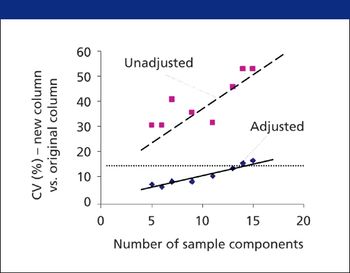
When a column is replaced with a new or "equivalent" column, sometimes the chromatogram can change so much that it is no longer suitable for its intended use. In such cases, method adjustment is necessary to correct the change. How much can the chromatographic variables be changed before revalidation is required? What do the regulatory agencies have to say about method adjustment? The authors discuss these issues and propose a technique that can be used to speed selection of new operating conditions.
LCGC Europe
This column focuses on some of the latest developments in preparative-scale columns, bulk packing materials and column hardware designs. Silica, polymeric and other packings are discussed together with the newest monolithic columns.
LCGC North America
The authors look at two types of method modification from a scientific and regulatory standpoint: a change of column and a change in the operating system. Both are difficult to avoid if a method is used for several years.
LCGC North America
The author focuses on some key considerations in the manufacture and use of microplates, particularly the 96-well plate.
LCGC Europe
Column Editor Ron Majors turns his attention to preparative chromatography. He focuses on the columns used in preparative chromatography, including how to select the appropriate mode, mobile-phase system and operating conditions.
LCGC North America
A look at the latest developments in preparative-scale columns, bulk packing materials, and column hardware designs.
LCGC Europe
In the final of this two-part series examining trends in column introductions at the recent Pittcon 2004, Ron Majors looks at gas chromatography columns, sample preparation products, hardware, accessories and kits for chromatography and sample preparation.
LCGC North America
The second part of a two-part series examining new column introductions at Pittcon 2004.
LCGC Europe
In the first of a two-part series, Ron Majors examines new column introductions at Pittcon with special attention to high performance liquid chromatography columns and packings for reversed-, normal- and bonded-phase; ion exchange; ion and size-exclusion chromatography. He also considers speciality HPLC columns.
LCGC North America
This month'ss "Column Watch" is the first of a two-part series that examines new column introductions at Pittcon 2004.
LCGC North America
Majors discusses low-dispersion columns, describes how to modify HPLC systems to work with the small-volume columns, and provides guidance about obtaining the optimum capabilities from these columns.
LCGC North America
Majors analyzes results from LCGC's GC user survey, which was conducted in January 2003.