

Mixed-mode chromatography columns are on the rise. We review recent fundamental research, stationary phase development and design, and areas of application.
Mixed-mode chromatography columns are on the rise. We review recent fundamental research, stationary phase development and design, and areas of application.

Recombinant adeno-associated viral therapy (rAAV) products are particularly complex. Are liquid chromatography and LC–MS the right tools for their characterization?

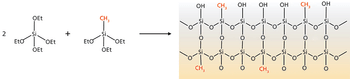
This article will review historical bonding techniques still in use for manufacturing high performance liquid chromatography (HPLC) stationary phases today, and also examine some emerging technologies that may be able to tackle unmet needs in novel platforms and phase construction.

The traditional bonding techniques used to manufacture silica-particle-based HPLC stationary phases provide many benefits, but can emerging technologies tackle unmet needs? We assess current approaches and the potential for improvements.

LCGC North America
The strategies described here can improve the efficiency and analyte recovery of chromatographic methods used to characterize monoclonal antibodies and antibody– drug conjugates.

LCGC North America
We explore what’s new in the liquid chromatography columns and accessories commercially released over the past year.
LCGC North America
At the 43rd International Symposium on Capillary Chromatography (ISCC 2019) in Fort Worth, Texas, a panel addressed the current challenges and potential future directions in capillary liquid chromatography. How can their vision be achieved?
LCGC North America
This “Column Watch” installment reports on highlights from the 48th International Symposium on High Performance Liquid Phase Separations and Related Techniques (HPLC 2019), held June 16 to 20 in Milan, Italy.
LCGC North America
Superficially porous particles have demonstrated separation efficiency gains compared to totally porous particles. The total pore blocking technique provides the purest possible measure of column packing quality. Here, we explain this technique and show what it has revealed.
LCGC North America
We examine the evolution of hybrid particle columns, highlighting examples of separations enabled by this technology.
LCGC North America
With SEC, special care is required to achieve in practice the chromatographic efficiency that is expected from theory.
LCGC North America
Our annual review of new liquid chromatography columns and accessories.
LCGC North America
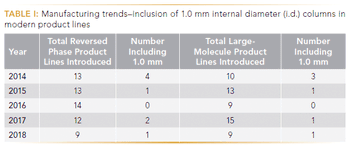
We assess the advantages and disadvantages of 1.0-mm diameter columns.

LCGC North America
New strategies for “bottom-up” analysis of therapeutic proteins, using faster enzymes, new buffer systems, and optimal column chemistries, enable analysts to perform these studies much faster and with fewer artifacts.

LCGC North America
Topics that stood out at HPLC 2018 include advances in large-molecule separations, multidimensional separations, 3D printing, chiral separations, and HILIC. Also, many speakers addressed separation fundamentals, including ways to increase speed, generate higher throughput, and add selectivity.
LCGC North America
Various strategies to improve LC-MS sensitivity in order to enhance signal-to-noise ratio, and help you realize the hidden potential of this method are discussed.
LCGC North America
Many manufacturers now offer columns using superficially porous particles that are 2-µm and smaller. When should you use them?
LCGC North America
What can metal–organic frameworks offer for liquid chromatography?
LCGC North America
Our annual review of new liquid chromatography columns and accessories, including columns for reversed-phase, HILIC, chiral, SEC, GPC, ion-exchange, and SFC separations of small and large molecules.
LCGC North America
Despite the theoretical promise of reduced plate heights (h) < 1, most modern UHPLC columns can only deliver plate heights in the range from 1.4 to 2.5. However, improved packing procedures, a better understanding of the colloidal properties of particle suspensions, and the study of the rheological behavior of packed beds and the final bed structure should lead us to practical solutions that can double the column efficiencies.
LCGC North America
A number of approaches for peak shape measurement are available in modern chromatography software. We discuss the advantages and drawbacks of those approaches, and present a new concept, “total peak shape analysis.”
LCGC North America
To resolve and quantitate monoclonal antibodies and antibody–drug conjugates, analytical scientists need various chromatographic modes, such as sizeexclusion, ion-exchange, hydrophobic interaction, and hydrophilic interaction chromatography. Here, we provide advice for making the most of each mode.
LCGC North America
Topics that stood out at HPLC 2017 include advances in large-molecule separations, multidimensional chromatography, HILIC, and chiral separations.
LCGC North America
A model set of analytes and selected applications are used to demonstrate the effects that buffers can have on the selectivity of a separation and the sensitivity of a reversed-phase analysis when using MS detection.
LCGC North America
In biphenyl phases, the surface chemistry often makes it possible to separate compounds not well resolved by C18 or phenyl phases.
LCGC North America
Our annual review of new liquid chromatography (LC) columns and accessories introduced at Pittcon and throughout the previous year.
LCGC North America
The carotenoid test allows one to build a simple classification map of stationary phases used in reversed-phase liquid chromatography, on the basis of the shape recognition(plotted on the x axis) the polar surface activity(plotted on the y axis) and the phase hydrophobicity (related by the bubble size).
LCGC North America
Interest in chromatography using hydrophilic interaction liquid chromatography (HILIC) has continued to build in recent years. Adoption of the technique has been slowed by experiences of poor reproducibility. In particular, re-equilibration times in HILIC have been reported as being exceptionally long as compared to reversed-phase chromatography. In this study, re-equilibration times in HILIC, for both aqueous–organic gradients and buffer gradients are systematically explored. The results not only promise to improve method development practices, but also provide insight into HILIC retention mechanisms across mechanistically differing polar stationary phases.
LCGC North America
Cartenoid compounds can be used as probes for studying the stationary bonded phases devoted for reversed-phase liquid chromatography, that is, C18, phenyl-hexyl, and cholester. From one analysis achieved in supercritical fluid chromatography (SFC) that favors the chromatographic behaviors due to the stationary phase properties, bonding density, ligand type (monomeric or polymeric), and endcapping treatment, two separation factors are calculated allowing us to build a bi-dimentional map. These two axes are related either to the shape selectivity or the polar surface activity (residual silalnos). Each point on the map corresponds to a column. The retention factor of beta-carotene, which describes the phase hydrophobicity, is indicated by the size of the point. More than 200 stationary phases were studied, including small particle sizes and superficially porous ones. Moreover, the results are now available on a website, allowing you to check and compare, by selecting the required tabs, columns, manufacturer brands, and ligand nature.
LCGC North America
HPLC 2016, chaired by Professor Robert Kennedy, was held June 19–24 in San Francisco, California, at the Marriott San Francisco Marquis. This installment of "Column Watch" covers some of the highlights observed at the symposium including stationary-phase developments, particle technology, and areas of growing application of HPLC. In addition, trends and perspectives on future developments in HPLC noted from the conference are presented.