

LCGC North America
After nearly 10 years of writing "Milestones in Chromatography," resident historian Leslie Ettre will step down from his position as an LCGC columnist.
LCGC North America
After nearly 10 years of writing "Milestones in Chromatography," resident historian Leslie Ettre will step down from his position as an LCGC columnist.
Special Issues
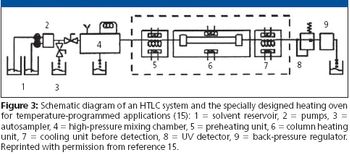
The use of high temperature is playing an increasingly important role in high performance liquid chromatography (HPLC) method development and optimization. Major advantages of high-temperature LC (HTLC) include shortened separation time, increased efficiency, and reduction in the use of organic solvent, but the accompanying decrease in mobile phase viscosity provides a lowering of column back pressure, allowing even faster separations, use of longer columns, and use of smaller particles. Here the author summarizes some of the latest findings in HTLC and addresses issues raised when columns and analytes are heated beyond the "normal" operating conditions.

Special Issues
An ever-increasing need for chiral separations has led to a more generic approach for screening a variety of chiral stationary phases. These new screening methodologies have been supported by new instrument development, new chiral product performance, and a new level of user knowledge. Supercritical fluid chromatography has continued to grow, supported by published applications from the separations industry. An expanded field of polysaccharide phases has been made available from a variety of sources with some unique variants of the most common cellulose and amylose derivatives.

Special Issues
In the leadoff article, columnist Ron Majors provides an overview of column developments. He looks at various alternatives to high-throughput separations including small porous particles, monoliths and superficially-porous particles. Microfluidics and parallel column systems provide further alternatives. An alternative approach to isocratic method development uses optimized stationary phase combinations. Brief coverage of new phases for hydrophilic interaction chromatography, high temperature operation, chiral and mixed mode columns and finally supercritical fluid chromatography columns round out the overview. At the conclusion, Majors speculates on future directions in column technology.

LCGC North America
Scientists Arlin Gyberg, Clayton McNeff, and Ben Yan developed the Mcgyan process for manufacturing biodiesel.

Special Issues
In this article, silica-based monolithic columns are compared and contrasted to packed microparticulate columns. Some of the challenges developing commercial silica rods and encapsulated monolith columns are described, including the development of a 2-mm i.d. column. A study of wall effects in these monolith columns was performed. Future trends and challenges in improving the performance of silica-based monolith columns are described.
LCGC North America
Father Joseph Michael Levy, Ph.D, passed away suddenly on March 6, 2008.

Special Issues
Based upon early theoretical predictions of thought leaders in the beginnings of high performance liquid chromatography (HPLC), the continuous evolution of a reduction of particle sizes in HPLC column technology along with improvements in instrumentation has led to the increased use of particles in the sub-2-mm range, which places certain constraints on operating conditions. In this article, Gerard Rozing puts theory and practice into perspective when using small particles at increased operating pressure and, in particular, looks at thermal effects that can affect overall performance.

LCGC Europe
The 32nd International Symposium on Capillary Chromatography and the 5th GCXGC Symposium will be held at the Palazzo dei Congressi, Riva del Garda, Italy, in May.

LCGC Europe
They may come with a hefty price tag but these earphones reportedly take sound onto a new level. Denon's latest AH-C751 earphones cost ?150 but the "Metal Bullet" design uses ultra-rigid machined aluminum that does not resonate, unlike plastic housings used in less expensive products. Denon's "Acoustic Optimiser" balances the sound pressure before and behind the diaphragm to reportedly give greater dynamics and fast transient response. All the contacts are made of gold, as is the 3.5 mm plug. They come with three pairs of ear adapters, a 0.8 m extension cord and rigid travel case.
LCGC Europe
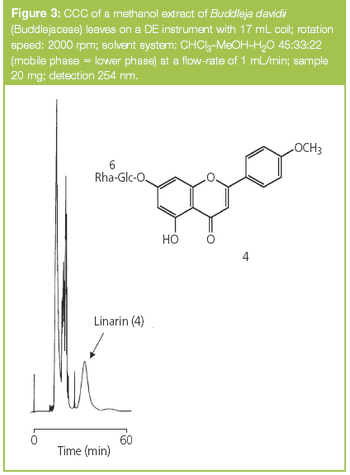
CCC is an excellent alternative to avoid the problems associated with solid-phase adsorbents, which include irreversible adsorption of sample and the need to replace expensive columns. As a result, CCC is gaining popularity as a purification tool.
E-Separation Solutions
CCC is an excellent alternative to avoid the problems associated with solid-phase adsorbents, which include irreversible adsorption of sample and the need to replace expensive columns. As a result, CCC is gaining popularity as a purification tool.
The Column
Piccaro, Inc. announced an ultra-trace gas analyzer for precisely measuring isotopic CO2, a marker of the type of CO2, and its origin. The instrument is based upon cavity ring down spectroscopy (CRDS) technology, exclusively licensed from Stanford University, Stanford, California and further enhanced at Piccaro.
The Column
Father Joseph Michael Levy, Ph.D, passed away suddenly on March 6, 2008. He earned the B.S. and M.S. degrees in chemistry from Cleveland State University, Cleveland, Ohio, and later went on to earn two doctorates, one in organic chemistry and one in analytical chemistry from Case Western Reserve University, Cleveland, Ohio. Dr. Levy worked as an analytical chemist for the Standard Oil Company and was well known in the GC community for his many articles and presentations at national and international meetings.
LCGC December 2007 BPA Statement
E-Separation Solutions
What is centrifugal partition chromatography, and what are its main applications? Steve Brown: Briefly, in centrifugal partition chromatography (CPC) one liquid acts as the stationary phase and a second solvent, containing the analytes, passes through it. Separation is achieved by partition of the solute between the two immiscible solvents comprising the mobile and stationary phases.
E-Separation Solutions
Polymer
The Column
HPLC analysis of Lysozyme in different types of wine. Claudio Riponi, Fabio Chinnici and Regina Roemling. A holistic approach to increasing analytical throughput on a modern gas chromatograph Andrew Tipler, PerkinElmer Inc. If it's broke, fix it Paul Heere of NLISIS Chromatography spoke to The Column about the launch of a new tool that aims to take the heartache out of connecting capillary columns. News All the news for March 2008. Zosimus Zosimus questions the scientific benefits of "Fast HPLC" in the real world and asks whether it is all it's cracked up to be? Market trends & analysis Glenn Cudiamat takes a look at the mass spectrometry market and examines the popularity of the related techniques amongst industry users.

LCGC Europe
The home user can now have 1 TB of storage at the touch of a button.

LCGC North America
This month's installment of "Column Watch" is the first of a two-part series in which columnist Ron Majors examines the trends and highlights in columns and consumables at Pittcon 2008.
LCGC North America
Researchers at Swansea University (Swansea, Wales, United Kingdom) are using GC-MS-TD technology to analyze the concentrations of volatile organic compounds (VOCs) in breath.

LCGC Europe
The meeting, being held 21–22 May, will review the latest developments in stationary phase technologies for liquid chromatography. It will also include lectures on emerging stationary phase chemistries, specialised functional phases and small particle size packings The event will be of interest to all practitioners of separation science, but in particular those using liquid chromatography for problem solving and method development.
LCGC North America
Engineers at the Massachusetts Institute of Technology (MIT), Cambridge, Massachusetts, are designing a tiny sensor that can detect minute quantities of hazardous gases more efficiently and quickly than current devices on the market.

LCGC Europe
Research Group: Professor Gert Desmet, Transport Modelling & Analytical Separation Science, Vrije Universiteit Brussels, Brussels.
LCGC Europe
The four eyes approach is a cornerstone of any quality system (GMP, GLP or ISO 17025): a first person performs a task and a second person checks it.


Special Issues
Beta-blockers are basic compounds that contain a secondary amino group in their structure. The amino substituents are typically an isopropyl group and a larger chain with a hydroxyl group in the beta position from the nitrogen atom (Table I). The simultaneous analysis of ?-blockers in biological samples is meaningful, and is made possible by the similarities in their structure. Gas chromatography (GC)–mass spectrometry (MS) has been the most used technique for their identification and quantification (4–6). However, most ?-blockers are nonvolatile and thus require derivatization via a cumbersome and time-consuming process before GC–MS analysis. In recent years, liquid chromatography (LC) coupled with mass spectrometric detection has evolved as the method of choice for drug analysis in the pharmaceutical, clinical, and forensic toxicology areas (4–8). In contrast to GC–MS, LC–MS-MS generally does not require derivatization and offers superior sensitivity. Moreover, due to the high specificity offered by LC–MS-MS, baseline chromatographic resolution often is not required, allowing for fast analysis in high-throughput environments.