

The current issue (2008.1) of Restek?s e-newsletter, ?The Restek Buzz,? includes an article that summarizes the key advantages of thermal desorption versus solvent extraction in air monitoring applications.
The current issue (2008.1) of Restek?s e-newsletter, ?The Restek Buzz,? includes an article that summarizes the key advantages of thermal desorption versus solvent extraction in air monitoring applications.
Thermo Fisher Scientific (Waltham, Massachusetts) has acquired the Analytical Technologies and Environment Instrumentation divisions of Chemito Technologies Pvt. Ltd. (Mumbai, India).
The Pittsburgh Conference announces the launch of its 2009 website, www.pittcon.org, containing relevant information for conferees and exhibitors about Pittcon 2009 which will be in Chicago, Illinois, McCormick Place, March 8 -13, 2009.
College graduates receiving chemistry and chemical engineering degrees between July 2006 and June 2007 entered a still strong job market, the best since 2000.
Alexander Makarov, Thermo Fisher Scientific?s (Waltham, Massachusetts) director of global research for life sciences mass spectrometry (MS), received the 2008 ASMS Distinguished Contribution in Mass Spectrometry award from the American Society for Mass Spectrometry at the 56th ASMS Conference on Mass Spectrometry and Allied Topics.
Agilent Technologies Inc. (Palo, Alto, California) announced it has acquired substantially all of the assets of Taiwan-based Escort Instruments Corp., an established supplier of low-cost test and measurement instruments and a subsidiary of Unitech Printed Circuit Board Corp.

E-Separation Solutions
This technical note from Phenomenex discusses the use of mobile phase pH to control analyte ionization states (pH-LC) in RP-HPLC as a highly effective way to change selectivity. The ionized species of an analyte is shown to have higher polarity (less hydrophobicity) than the neutral species, which results in a loss of expected retention for that analyte. With the use of mobile phase pH in conjunction with a pH-stable column, powerful selectivity manipulation can be achieved.
E-Separation Solutions
In the last few decades, the novel functions of polysaccharides have provided a major impetus for increasing scientific attention. Among the most promising aspects are their immunomodulatory and antitumor effects, thickening agents and stabilizer effects.
E-Separation Solutions
Q: We currently use a glass filtration setup attached to a pump using 0.45-?m membrane filters. The flask contains a magnetic stirrer. As the solution passes the membrane filter, gas bubbles appear on its surface. As soon as the solution has completely passed through the filter the vacuum pump is turned off and the solution is poured from this setup into another bottle and stoppered until use (up to 3?4 days time). The HPLC equipment has inline degassers that are routinely used. Besides filtering is this setup degassing? To effectively degas a solution should the solution remain under vacuum for a longer period than the time it takes to filter? Should we be using this setup to filter?degas HPLC-grade solvents or commercial mobile phases?
E-Separation Solutions
Polymer Standards Service-USA Inc. has published an Application Note on GPC/SEC analysis of Mono-, Di-, Tri-acylglyceride's and Glycerol according to European Pharmacopoeia. A PSS SECcurity GPC1200 System with refractive index detector was used in this analysis. The use of a single PSS SDV gel, 5?m, 100?, 8x600 mm GPC column aids in maximizing separation efficiencies. The use of PSS WInGPC Unity software for data collection and processing allows for rapid analysis and reporting. Polymer Standards Service-USA Inc. Warwick, Rhode Island.
app notes
The Column
Sensory quality control of food and packaging products Marion Bonnefille. Analysis of macromolecular branching by triple detection GPC/SEC Paul Clarke Tips and tricks: How do I calibrate a GPC/SEC system? Daniela Held. News All the news for June 2008. Incognito With the changing nature of conferences and exhibitions, Incognito questions their true value today. Market trends & analysis Glenn Cudiamat provides a market profile of continuous flow analysis and discrete analysers.

LCGC North America
This article investigates the different methods that can be used to compare the performance of liquid chromatography (LC) columns to assess the advantage of using them at high pressures and/or high temperatures. The main focus is on the kinetic plot method. This method, which is based on two simple equations, allows the user to transform the more common Van Deemter curve into a curve describing the ultimate separation speed as a function of the required plate number, or the required peak capacity or the required resolution.

LCGC Europe
Many HPLC analyses could be performed at lower expenditure. This could involve a combination of reducing the analysis time, reducing the resolution between critical peaks, and lowering the consumption of mobile phase. Successfully optimizing the method in such instances - as well as in situations where it is necessary to transfer the method to another laboratory that lacks the same selection of columns - can save the analyst time and money.

LCGC Europe
Add-on instrument control available; Software for mass spectrometry imaging; GC–MS reprocessing software; Software for multi-channel pipette calibration process

LCGC Europe
You may work in a chromatography laboratory to quality standards but do you work to Good Laboratory Practice? Probably not...
LCGC North America
Separations Systems Inc. Honored at White House
LCGC North America
Northeastern University Researcher Receives International Honors
The Application Notebook
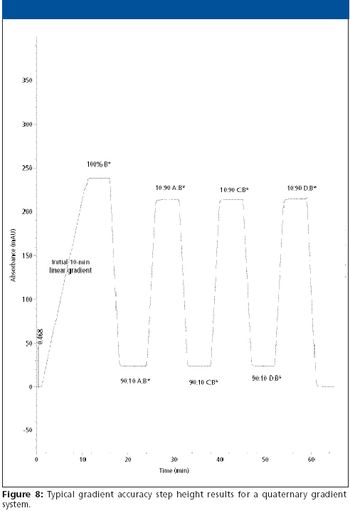
With the forthcoming USP monograph <1058>, many laboratories are in the process of reexamining their high performance liquid chromatography (HPLC) instrumentation qualification practices. This article demystifies the qualification procedures and proposes a well designed, easy and simple set of experiments upon which to establish internal standard operating procedures (SOPs) for the complete qualification of HPLC instruments. A key concept is the development of a consistent test system, comprised of premade test solutions, a prequalified HPLC column, standardized protocols, and validated software that can be prepared in-house or purchased commercially as a kit. This system can be applied to any HPLC system worldwide, to produce comparable test results under uniform conditions. The test system is designed to be rapid, with a comprehensive performance qualification being completed in about 2 h for isocratic, and 3 h for quaternary gradient systems.

The Application Notebook
Like any other segment of the world economy, current events and the realities of the world around us go a long way toward shaping the direction of chromatographic research and development, and consequently, the financial trends that have a direct impact on the industry in which we all live and work. In this sense, the LCGC Application Notebook has become something of a market barometer over the years.
Fiberguide Industries, Inc. (Stirling, New Jersey) has been recognized by Lawrence Livermore National Laboratory (Livermore, California), for their participation and contributions in the National Ignition Facility (NIF) program with the presentation of a plaque at the Fiberguide Idaho facility.
Thermo Fisher Scientific Inc., the world leader in serving science, announced that they have been presented with two 2008 Frost & Sullivan Best Practices awards for Market Leadership and Competitive Strategy Leadership in Informatics.
In the first reported study of skeletal muscles in hibernating creatures by two-dimensional gel electrophoresis (2-DE), scientists from Korea have attempted to shed some light on the molecular processes behind atrophy prevention.
Scientists in China have devised a GC-ECD procedure that involves bromination of acrylamide to give a derivative that is more easily detected at low levels than acrylamide itself. Their research comes in response to the discovery of acrylamide in many types of cooked food in 2002. This discovery made news due to the link between acrylamide and cancer. From a scientific point of view, the acrylamide discovery ensured the creation of a new generation of research grants, many of which involve mass spectrometry, using GC?MS or LC?MS.
The Column
Separations Systems Inc. (Gulf Breeze, Florida), a gas chromatography manufacturer, has been given the President's E Award in recognition of exceptional success in exporting their products to other countries.
The Column
Dr. Barry L. Karger, the James L. Waters Chair in Analytical Chemistry, Director of the Barnett Institute of Chemical and Biological Analysis at Northeastern University, and internationally recognized expert on separation science, has been elected into the Hungarian Academy of Sciences as an honorary member. Dr. Karger has also been awarded the Csaba Horvath Medal of Innsbuck, Austria, for his contributions to the field of separation science and bioanalytical chemistry.
The Column
Varian, Inc. (Palo Alto, California) has acquired the assets and products of Precision Detectors, Inc., a privately owned company based in Bellingham, Massachusetts.
Advion Biosciences Inc. (Ithaca, New York), a developer of microfluidic sampling technology for mass spectrometry (MS) has bought almost all assets of its production supplier, Washburn Manufacturing Technologies Inc. (Trumansburg, New York) for an undisclosed amount.