

News|Videos|October 7, 2026
2D-LC and Orthogonal Separation in Practice for GLP-1 Analysis
Advertisement
Episodes in this series



Picking up on the two-dimensional liquid chromatography (2D-LC) reference from the previous segment, Sam Whitmarsh asks Piotr Alvarez to explain more broadly where and why his team deploys 2D-LC for GLP-1 agonist analysis. Alvarez identifies two primary use cases. The first addresses a practical, often client-driven problem: many organizations have validated legacy methods that cannot easily be modified but that use mobile-phase conditions incompatible with mass spectrometry (MS). Rather than redeveloping the method from scratch, 2D-LC can sample the peak of interest from the first dimension and recondition it under MS-compatible mobile-phase conditions in the second, preserving the validated first-dimension separation while still enabling MS characterization.
The second use case is about verification rather than compatibility: confirming true peak purity. Alvarez describes cases where a peak appears sharp and pure under standard reversed-phase (RP)LC conditions, giving no visual indication of coeluting species, only for a second, orthogonal high-performance separation to reveal additional impurities hiding underneath. He cautions that mass spectrometry alone can be misleading here, since isomers produce identical MS data to the parent peak and won't show up as a separate compound by mass alone–only an orthogonal chromatographic separation can resolve them.
Alvarez then walks through a concrete example of building orthogonality between dimensions: running the first dimension under acidic conditions with a non-MS-compatible additive such as phosphoric acid, then switching to a second dimension using a different acid (like trifluoroacetic acid) that is more MS-friendly, or further adjusting pH to change the analyte's ionization and net charge; since GLP-1 peptides are zwitterionic, pH manipulation offers substantial control over their separation behavior. Alvarez closes by noting how much flexibility this gives method developers, calling the ability to manipulate peptide separation chemistry in this way genuinely elegant from a chromatographic standpoint.
Advertisement
Related to this article

The panel considers how AI and automation could reshape peptide method development, and why scientific judgment will remain essential.

A two-dimensional gas chromatography (GC×GC) study of 43 volatiles shows hexanal alone cannot gauge hazelnut aging.

In this eighth part of " Conversations with Michael Dong," a series on fundamentals of HPLC in pharmaceutical analysis, LCGC International’s "Perspectives in HPLC" column editor discusses why ultraviolet detection dominates pharmaceutical analysis and quality control.

High-performance liquid chromatography–tandem mass spectrometry (HPLC-MS/MS) was used in a reverse triiodothyronine (rT3) test to separate canine hypothyroidism from illness.
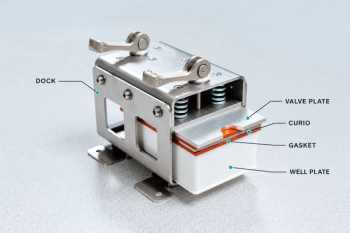
Quantera Analytical’s Terry Bates discusses parallel headspace extraction for gas chromatography-mass spectrometry (GC–MS) and direct analysis in real time–mass spectrometry (DART–MS) analysis.

Amandaa Brewer warns a shortage of large-molecule chromatography experts, as practitioners retire, could leave the next generation without the fundamentals.

Christopher Chouinard of Clemson University discusses with LCGC International how derivatization reshapes steroid mass for sharper liquid chromatography-ion mobility-mass spectrometry (LC-IM-MS) separations.
Gas chromatography (GC) tests show spoilage yeasts alter flavor and raise alcohol in NoLo beer.
Advertisement
Advertisement