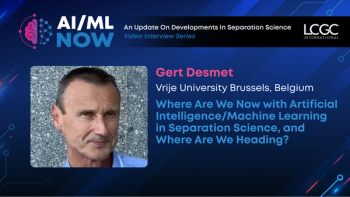
Gert Desmet offers his insights on the potential benefits AI/ML could offer the separation science community in the future.
Hans-Gerd Janssen highlights the important innovations and challenges remaining using hyphenated separation science techniques in food analysis.
At HTC-19 in Leuven, Belgium, LCGC International spoke with Hans-Gerd Janssen from Unilever R and D, The Netherlands on his presentation Hyphenated Methods in Chromatography: Innovations Realised and Challenges Remaining.1
In this video interview Janssen answers the following question:
• In your experience, what has been the most transformative innovation in hyphenated chromatographic methods for food analysis over the past decade?
In his presentation, Janssen discussed key developments and challenges in hyphenated chromatographic methods for food analysis and the broader field of separation science and highlighted advances in mass spectrometry and data processing as major drivers of analytical progress over the past decade, while also addressing ongoing concerns about the accuracy of peak annotation and integration. Emerging approaches such as machine learning, improved spectral databases, and automated quality-control workflows were identified as promising solutions for enhancing data reliability.
He also expanded on the difficulty of linking LC–MS liquid chromatography mass spectrometry (LC–MS) peptide identification data with sensory perception, emphasizing the complexity of taste mechanisms and food matrices.2 Practical considerations surrounding the shift from fully integrated on-line systems to more reliable at-line approaches were also discussed. Looking to the future, Janssen highlighted developments in sensor technologies, artificial intelligence (AI), and rapid analytical platforms as the key to enabling real-time process monitoring. Throughout the interview , the increasing integration of advanced instrumentation, data science, and interdisciplinary research emerges as an exciting evolution in modern separation science.
View the full video interview series here:
1. Janssen H G. Hyphenated Methods in Chromatography: Innovations Realised and Challenges Remaining. Presented at HTC-19 2026, in Leuven, Belgium.
2. Hollebrands, B.; Thong, G.; Janssen, H.-G. Integrated Targeted and Untargeted Analysis of Polar Peptides in Foods Using Hydrophilic Interaction Liquid Chromatography–Data-Independent Acquisition–Mass Spectrometry. Anal. Bioanal. Chem. 2026, 418 (10), 3013–3024. DOI: https://doi.org/10.1007/s00216-026-06322-7
Hans-Gerd Janssen is senior scientist Analytical Chemistry at Unilever R&D Wageningen and part-time professor ‘Recognition-based Analytical Chemistry’ at WUR. Janssen obtained his PhD at the Eindhoven University of Technology in 1991. After a career at that university as assistant- and associated professor he joined Unilever in 1999 to become senior scientist compositional analysis. In 2004 he also became extraordinary professor at Amsterdam University, focusing on research and development of systems for the analysis of (bio)macro-molecules. In 2019 he left Amsterdam University and joined the Laboratory for Organic Chemistry of the WUR as a part-time professor next to his position at Unilever. Janssen has been secretary of the working group Separation Methods of the Royal Dutch Chemical Society and board member of TI-COAST, the Dutch public-private partnership on analytical science and technology. Janssen (co-)authored more than 200 peer-reviewed papers covering a wide range of analytical technologies, including mass spectrometry, chromatography and hyphenated analyzers. His specific focus area is food quality analysis.