

Sponsored Content
Daicel Chiral Technologies' unique HPLC and SFC chiral stationary phases are capable of separating the most challenging compounds, like the atropisomers of Sotorasib.
Sponsored Content
Daicel Chiral Technologies' unique HPLC and SFC chiral stationary phases are capable of separating the most challenging compounds, like the atropisomers of Sotorasib.
Sponsored Content
Application note demonstrating the improved chiral separation of herbicide mecoprop by use of an immobilized column that allows usage of a wider range of solvents
Sponsored Content
This application note demonstrates how the use of DCM in particular had a dramatic effect on the separation and afforded conditions that could be further adapted to a preparative scale application.

Mirtazapine is an approved antidepressant, with other studies exploring its use to treat sleep apnea, substance abuse withdrawal symptoms, and as an antihistamine.
Sponsored Content
Discover a reliable and robust HPLC method to separate Δ10-THC and Δ6a,10a-THC isomers produced from Δ9-THC degradation using a chiral HPLC stationary phase.
Daicel’s CHIRALPAK® IJ gives access to an expanded range of solvents, which yields new separations not previously achievable on the coated CHIRALCEL® OJ.
This application note demonstrates the ability of Daicel’s CHIRALPAK® IA-3 to perform both chiral and achiral separations using SFC and hydrobenzoin as a test compound.
Sponsored Content
DAICEL’s CHIRALPAK® sub-2 µm columns yield sub 30-second chiral separations of Thalidomide and Naproxen under SFC conditions.
Sponsored Content - NA
Multi-attribute analysis combines protein A affinity chromatography, SEC, and LC/MS in a 3D setup for assessment of features including mAb titer and size variants.
Sponsored Content - EU
Multi-attribute analysis combines protein A affinity chromatography, SEC, and LC/MS in a 3D setup for assessment of features including mAb titer and size variants.
Sponsored Content - EU
This application note demonstrates the ability of Daicel’s CHIRALPAK® IA-3 to perform both chiral and achiral separations using SFC and Hydrobenzoin as a test compound.
Sponsored Content - NA
Daicel’s CHIRALPAK® IF proven to perform the difficult separations of cannabinoids Δ8-THC and Δ9-THC.
Sponsored Content - EU
Amyloid β proteins are highly hydrophobic and can form aggregates. The analysis of 4 Aβ using YMC-Triart Bio C4 with larger pore and lower hydrophobicity is presented.
LCGC North America
Successful separations of the enantiomers of 3,3’-substituted BINOLs and their corresponding protected derivatives were obtained on the RegisPack® chiral stationary phase (CSP) from Regis Technologies, Inc.
LCGC Europe
A CHIRALPAK IG column (immobilized meta selector) was used to develop the enantioselective separation of methylclothiazide. Meta-substituted immobilized chiral selectors have been shown to have remarkable affinity for resolution of chiral compounds from different types of molecules. Available in 3 and 5 micron.
LCGC North America
A CHIRALPAK IG column (immobilized meta selector) was used to develop the enantioselective separation of methylclothiazide. Meta-substituted immobilized chiral selectors have been shown to have remarkable affinity for resolution of chiral compounds from different types of molecules. Available in 3 and 5 micron.
LCGC Europe
A CHIRALPAK IG column (immobilized meta selector) was used to develop the enantioselective separation of methylclothiazide. Meta-substituted immobilized chiral selectors have been shown to have remarkable affinity for resolution of chiral compounds from different types of molecules.
LCGC North America
A CHIRALPAK IG column (immobilized meta selector) was used to develop the enantioselective separation of methylclothiazide. Meta-substituted immobilized chiral selectors have been shown to have remarkable affinity for resolution of chiral compounds from different types of molecules.
LCGC Europe
A CHIRALPAK IG column (immobilized meta selector) was used to develop the enantioselective separation of methylclothiazide. Meta-substituted immobilized chiral selectors have been shown to have remarkable affinity for resolution of chiral compounds from different types of molecules.
LCGC North America
In new drug development, the number of diverse chiral compounds is increasing and sensitive chiral methods are often needed quickly. Many new CSPs are available on the market making it challenging to select the most important ones for the initial screening stages and expedite method development. The focus of this study is to evaluate high selectivity CSPs and to suggest the best screening method with a limited number of high success rate chiral columns.

The Application Notebook
Supercritical fluid chromatography (SFC) is an evolutionary technology and a powerful tool for enantiomer separation when used in combination with chiral stationary phases (CSPs).

The Application Notebook
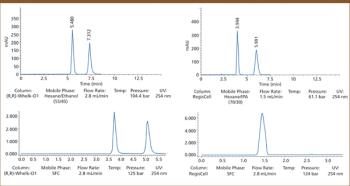
Chiral separations of multi-component natural product mixtures comprised of enantiomers, diastereomers, and unrelated molecules are often difficult to resolve in a single isocratic method.
Special Issues
Chiral chromatography has a wide range of applications in the food, biochemical, and pharmaceutical industries.

The Application Notebook
Regis Technologies, Inc.

The Application Notebook
Regis Technologies, Inc.

Special Issues
Regis Technologies, Inc.

The Application Notebook
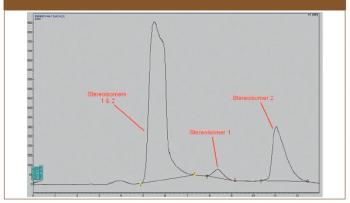
Typical chiral stationary phase (CSP) screening paradigms utilize a single alcohol component as co-solvent in its mobile phase. Recent unexpected observations have demonstrated that mixed-alcohol mobile phases can enhance or even introduce peak resolution when none existed in a mono-alcohol system.

The Application Notebook
Typical chiral stationary phase (CSP) screening paradigms utilize a single alcohol component as co-solvent in its mobile phase. Recent unexpected observations have demonstrated that mixed-alcohol mobile phases can enhance or even introduce peak resolution when none existed in a mono-alcohol system.
The Application Notebook
Basic compounds often require basic additives in the modifier to improve peak shape and resolution in SFC (1). These additives can be difficult to remove post-purification (2).

The Application Notebook
Chiral method development and chiral separations have been the main contributors to the popularity of supercritical fluid chromatography (SFC). The low viscosity and high diffusivity of the mobile phase in SFC allows for low pressure drops and fast chromatography, making it an attractive alternative to LC, especially for pharmaceutical applications. SFC is often 3–5 times faster than HPLC and often produces higher efficiency. SFC is now regarded as a standard separation support tool for chemical synthesis and development.