

The Application Notebook
The determination of enantiomeric purity is crucial in new drug development.
The Application Notebook
The determination of enantiomeric purity is crucial in new drug development.
The Application Notebook
The Chirosil RCA(+) and SCA(–) chiral stationary phases (CSPs) are specialized chiral phases very effective in separating various natural and unnatural amino acids as well as compounds containing primary amines.

The Application Notebook
The optical isomers of flavanone have been separated using the EpitomizeTM CSP-1 series of chiral stationary phases.

The Application Notebook
Polysaccharide-based chiral stationary phases (CSPs) and Pirkle-type CSPs are often successful in achieving a majority of analytical and preparative chiral separations.

The Application Notebook
The RegisPack® chiral stationary phase allows for the enantiomeric separations of a wide variety of racemate classes.

The Application Notebook
Excellent reversed-phase separations using a protein-based column, CHIRAL-AGP, with volatile LC–MS compatible buffer systems have been obtained for a range of basic solutes.

The Application Notebook
The Epitomizeâ„¢ CSP-1C chiral stationary phase uses cellulose tris-(3,5-dimethylphenylcarbamate) as the chiral receptor and is offered in a variety of particle sizes including 1.7, 3, 5, 10, 20, 50, 100, and 300 microns.
The Application Notebook
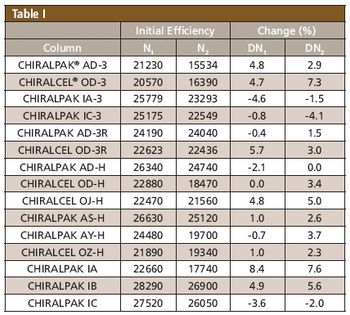
Analytical columns packed with both 3- and 5- μm polysaccharide-based wide-pore chiral stationary phases (CSP) are shown to be stable to high operating pressures over a prolonged period.

The Application Notebook
The Pirkle Type Whelk-O®1 CSP was used several years ago to solve a challenging chiral separation for early phase drug development.
The Application Notebook
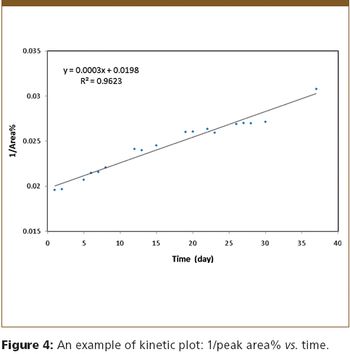
In the past few decades, single enantiomers and stereoisomers have overtaken achiral molecules in the percentage of approved drugs in the market. Because isomers can have different biological/pharmacological/toxicological properties, authorities, such as the European Pharmacopoeia and the FDA, have asserted escalated emphasis on controlling isomer content in drug compounds and require that stereoisomers, "be treated as separate drugs and developed accordingly" with rare exception. The separation and quantification of stereoisomers is therefore of great importance, especially when considering pharmaceutical compounds (1).

The Application Notebook
Polysaccharide-based chiral stationary phases (CSP) are successfully employed to achieve the majority of analytical and preparative enantioselective separations. However, there are a number of separations where significant modification or enhancement of selectivity is necessary. Two new columns, CHIRALPAK AY-H and CHIRALCEL OZ-H, have been introduced to meet these needs.

The Application Notebook
To meet the growing need for fast reversed-phase enantiomer separations, two new 3-μm reversed-phase columns, CHIRALCEL® OD® -3R and CHIRALPAK® AD® -3R, have been introduced. High column performance and column stability under a wide range of conditions, including aqueous solvent systems suited to LC–MS, have been

The Application Notebook
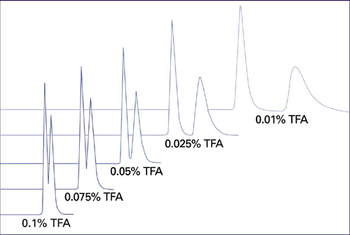
The Pirkle - Type Whelk-O®1 CSP is a synthetically made chiral selector covalently bonded to a silica support. This phase is well known in the industry for its broad degree of generality, mobile phase compatibility, and ability to invert elution order. Most commonly used polysaccharide coated CSP's are sensitive to the presence of certain mobile phase modifiers such as DEA, TEA, and TFA. Retained memory effects can adversely affect a separation resulting in broad and tailing peaks, no peak elution, and reduced or loss of separation altogether. To remove these unwanted memory effects, the column must be rinsed with an alcohol, such as methanol or ethanol. This is a time consuming and costly process. The Whelk-O®1 CSP does not exhibit any such retained memory behavior.
The Application Notebook
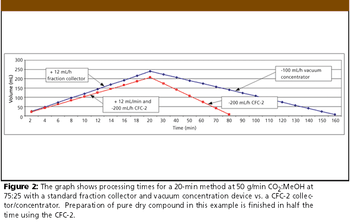
A novel centrifugal fraction collector CFCâ„¢ enables SFC users to simultaneously collect and concentrate fractions. The technique is particularly useful for chiral separations where large volumes of enantiomers are being purified by stacked injection methods.

The Application Notebook
A new, immobilized chiral stationary phase (CSP) based on a novel chiral selector for HPLC and SFC is described. Its unique selectivity as a complement to Daicel's other commercial immobilized polysaccharide CSPs is demonstrated.
The Application Notebook
Supercritical Fluid Chromatography (SFC) is quickly becoming a popular choice by chromatographers for analytical and preparative separations.
The Application Notebook
A large percentage of commercial and investigational pharmaceutical compounds are enantiomers and many of them show significant enantioselective differences in their pharmacokinetics and pharmacodynamics. The importance of chirality of drugs has been increasingly recognized, and the consequences of using them as racemates or as enantiomers have been frequently discussed in the pharmaceutical literature during recent years. With increasing evidence of problems related to stereoselectivity in drug action, enantioselective analysis by chromatographic methods has become the focus of intensive research of separation scientists. Most of the pharmaceutical and pharmacological studies of stereoselectivity of chiral drugs before the mid eighties involved pre-column derivatization of the enantiomers with chiral reagents forming diastereomers.

The Application Notebook
Supercritical Fluid Chromatography (SFC) is quickly becoming a popular choice by chromatographers for analytical and preparative separations.

The Application Notebook
The continuing and growing trend toward high-speed analysis in all fields of chromatography is also reflected in enantiomer separations. A variety of new 3-μm columns has been designed to meet this need. Applications of CHIRALCEL® OD-3 and CHIRALPAK® AD-3 in some enantiomer separations demonstrate the benefits of transitioning to such media.

The Application Notebook

LCGC Asia Pacific