


LCGC Europe
Rising stars interview leading figures in the world of chromatography. Gert Desmet talks to John Knox.
Gert Desmet
Full Professor, Vrije Universiteit Brussel, Belgium, and member of the EAB for LCGC Europe
LCGC Europe
Rising stars interview leading figures in the world of chromatography. Gert Desmet talks to John Knox.

LCGC Europe
The first in a series of interviews where rising research stars interview important figures from the world of chromatography kicks off with Gert Desmet from the Free University of Brussels talking to John Knox.

LCGC Europe
Using a fixed length-variant of the kinetic plot method, it is illustrated how an analysis that is performed near the optimal flow-rate of a given commercial column can, in many cases, be performed between 50–200% faster by switching to a longer column and operating it at a higher pressure - at least, if the available instrument pressure admits so. The present article aims to show that short columns are not always the best choice to get the fastest separation.

LCGC North America
This article investigates the different methods that can be used to compare the performance of liquid chromatography (LC) columns to assess the advantage of using them at high pressures and/or high temperatures. The main focus is on the kinetic plot method. This method, which is based on two simple equations, allows the user to transform the more common Van Deemter curve into a curve describing the ultimate separation speed as a function of the required plate number, or the required peak capacity or the required resolution.
LCGC Europe
This article investigates the different methods that can be used to compare the performance of liquid chromatography (LC) columns to assess the advantage of using them at high pressures and/or high temperatures. The main focus is on the kinetic plot method. This method, which is based on two simple equations, allows the user to transform the more common Van Deemter curve into a curve describing the ultimate separation speed as a function of the required plate number, or the required peak capacity or the required resolution.

LCGC North America
Guest columnsist and LCGC Emerging Leader award recipient Gert Desmet considers the different methods that can be used to compare the performance of LC columns.
LCGC Europe
his article reveals the first liquid chromatography (LC) separations performed on a microfabricated pillar array column under pressure-driven conditions. The pillars were non-porous and produced using a Bosch-type deep reactive ion etch (DRIE) to pattern the surface of a silicon wafer and had a diameter of approximately 5 μm. Two different packing densities were compared: one similar to the packing density of a packed bed (external porosity of approximately 49%) and one similar to the packing density of monolithic columns (external porosity of approximately 70%).

LCGC Europe
The established kinetic plots clearly show that monolithic columns are suited for large plate number separations whereas in the small plate number range the 3 ?m packed bed system is to be preferred.

LCGC Europe
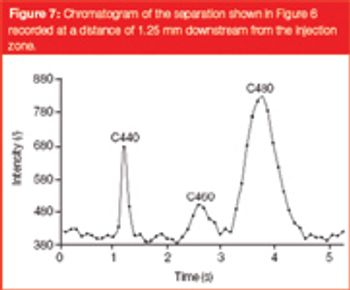
The authors discuss the application of shear-driven chromatography, a technique that depends on viscous drag to propel mobile phase in high-resolution/high-speed liquid chromatography. This method, it is claimed, overcomes the pressure- and voltage-drop limitations of both HPLC and CEC. Early development of the technique is reviewed and updated with the current status of the group's work. Also covered are the challenges faced and opportunities available to interface such systems to MS and UV/vis absorption detectors.