Summary: A preview of 2026 separation science trends, from PFAS and SFC to metabolomics, next-generation HPLC columns, oligonucleotides, and ADC analysis.
Gert Desmet
Full Professor, Vrije Universiteit Brussel, Belgium, and member of the EAB for LCGC Europe
Summary: A preview of 2026 separation science trends, from PFAS and SFC to metabolomics, next-generation HPLC columns, oligonucleotides, and ADC analysis.

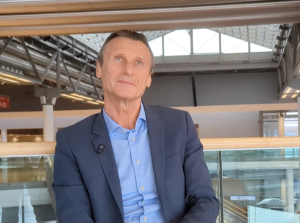
At analytica 2026, Gert Desmet of Vrije Universiteit Brussel mulls over the ways these next-generation columns deliver environmental or resource-use benefits over conventional packed beds.
At analytica 2026, Gert Desmet of Vrije Universiteit Brussel dicusses the key barriers to routine industrial or clinical adoption of these technologies, and how far away widespread use is.
At analytica 2026, Gert Desmet of Vrije Universiteit Brussel compares the main fabrication approaches across micro-pillar arrays, 3D-printed supports, and multi-capillary channel columns, weighing each against factors such as scalability, cost, and the degree of structural control they offer.
At analytica 2026, Gert Desmet of Vrije Universiteit Brussel discusses the drive toward perfectly ordered column structures in HPLC — from micro-pillar arrays to 3D-printed supports — and the fundamental theoretical gains in chromatographic performance that make this pursuit worthwhile.

Gert Desmet details the technical articles in this special supplement, featuring keynote speakers from HPLC 2025.

The 54th International Symposium on High Performance Liquid Phase Separations and Related Techniques (HPLC 2025) will be held from Sunday through Thursday, 15–19 June, 2025, in Bruges, Belgium.
Here's a taster of what to look forward to at the 54th International Symposium on High Performance Liquid Phase Separations and Related Techniques (HPLC 2025), which will be held from Sunday through Thursday, 15–19 June, 2025, in Bruges, Belgium.
The 54th International Symposium on High Performance Liquid Phase Separations and Related Techniques (HPLC 2025) will be held from Sunday through Thursday, June 15-19, 2025, in Bruges, Belgium.

An introduction from guest editor, Gert Desmet from Vrije Universiteit Brussel, Belgium

In this extended special feature to celebrate the 35th anniversary edition of LCGC Europe, leading figures from the separation science community explore contemporary trends in separation science and identify possible future developments.

In this extended special feature to celebrate the 35th anniversary edition of LCGC Europe, key opinion leaders from the separation science community explore contemporary trends in separation science and identify possible future developments.

Special Issues
An introduction from the guest editor of this special supplement from LCGC Europe revealing recent developments in high performance liquid chromatography (HPLC) and ultrahigh-pressure liquid chromatography (UHPLC).

Special Issues
The structural complexity of monoclonal antibodies (mAbs) challenges the capabilities of even the most advanced chromatography and mass spectrometry techniques. This study examines the use of micro-pillar array columns in combination with mass spectrometry for peptide mapping of both mAbs and antibody–drug conjugates (ADCs).

LCGC Asia Pacific
The last decade has witnessed how liquid chromatography columns and instruments changed from long bulky columns with relatively large fully porous particles operated at modest pressures (100Ð200 bar), to short compact columns with small superficially porous particles operated at ultrahigh pressures (1200Ð1500 bar). This (r)evolution has resulted in a tremendous increase in achievable separation performance or decrease in analysis time, but requires a good knowledge of optimal chromatographic conditions for each separation problem and, concomitant, the right instrument configuration.

LCGC Europe
Monoclonal antibodies are becoming a core aspect of the pharmaceutical industry. Together with a huge therapeutic potential, these molecules come with a structural complexity that drives state-of-the-art chromatography and mass spectrometry (MS) to its limits. This article discusses the use of micro-pillar array columns in combination with mass spectrometry for peptide mapping of monoclonal antibodies (mAbs) and antibodyÐdrug conjugates (ADCs). Micro-pillar array columns are produced by a lithographic etching process creating a perfectly ordered separation bed on a silicon chip. As a result of the order existing in these columns, peak dispersion is minimized and highly efficient peptide maps are generated, providing enormous structural detail. Using examples from the author’s laboratory, the performance of these columns is illustrated.

LCGC Europe
In this extended special feature to celebrate the 30th anniversary edition of LCGC Europe, leading figures from the separation science community explore contemporary trends in separation science and identify possible future developments. We asked key opinion leaders in the field to discuss the current state of the art in liquid chromatography column technology, gas chromatography, sample preparation, and liquid chromatography instruments. They also describe the latest practical developments in supercritical fluid chromatography, 3D printing, capillary electrophoresis, data handling, comprehensive two‑dimensional liquid chromatography, and multidimensional gas chromatography.

LCGC Europe
The last decade has witnessed how liquid chromatography columns and instruments changed from long bulky columns with relatively large fully porous particles operated at modest pressures (100–200 bar), to short compact columns with small superficially porous particles operated at ultrahigh pressures (1200–1500 bar). This (r)evolution has resulted in a tremendous increase in achievable separation performance or decrease in analysis time, but requires a good knowledge of optimal chromatographic conditions for each separation problem and, concomitant, the right instrument configuration.

LCGC Europe
Some 50 years after Giddings’s iconic comparison of the separation speed of gas chromatography (GC) and liquid chromatography (LC), the authors revisit this comparison using kinetic plots of the current state‑of‑the-art systems in LC, supercritical fluid chromatography (SFC), and GC. It is found that, despite the major progress LC has made in the past decade (sub-2-µm particles, pressures up to 1500 bar, core–shell particles), a fully optimized ultrahigh-pressure liquid chromatography (UHPLC) separation is still at least one order of magnitude slower than capillary GC. The speed limits of packed bed SFC are situated in between.

Special Issues
In the 21st century, numerous advances have been made in liquid chromatography (LC) column technology. The best known are columns packed with sub-2-µm porous particles or sub-3-µm superficially particles, and monolithic columns. Another very novel and original development is micro-pillar array columns (µPAC). µPACs are produced by a lithographic etching process to create a perfectly ordered separation bed on a silicon chip. Although the performance in terms of efficiency has been illustrated, the applicability for analysis of real complex samples has yet to be fully demonstrated. This article illustrates that state‑of‑the‑art µPAC columns coated with octadecyl are applicable for a challenging application such as lipidomics. The performance is illustrated with the analysis of human blood plasma lipids.

LCGC Europe
A recent argument was raised in the scientific press that in pursuit of greater speed and separation resolution, ultrahigh performance liquid chromatography (UHPLC) is faced with practical limitations and will struggle with its own version of Moore’s law.

This is the third article in a series exploring current topics in separation science that will be addressed at the HPLC 2017 conference in Prague, Czech Republic, from 18–22 June.

LCGC North America
There is increasing demand to analyze samples with a wide range of polarities, in fields such as environmental analysis and proteomics.
LCGC Asia Pacific
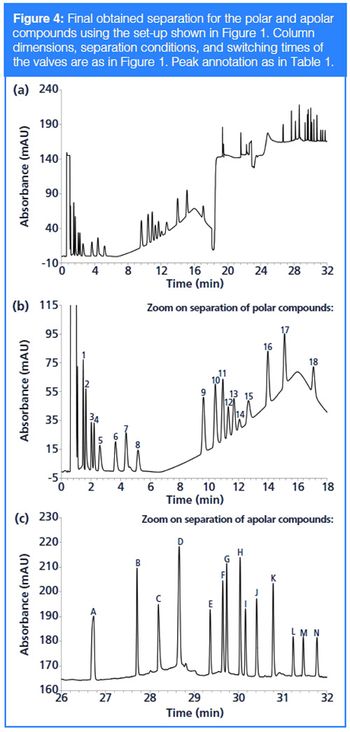
Appropriate analytical methods are required to evaluate the presence, metabolism, degradation, and removal of specific compounds in complex mixtures. There is an increasing demand to analyze samples with a wide range of polarities in a variety of applications, including environmental analysis, biomarker discovery, and proteomics. Multiple analyses on complementary columns are often needed to cover the separation of all compounds with a large difference in polarity. This article describes a generic method involving an ultrahigh‑pressure liquid chromatography (UHPLC) system equipped with two external switching valves to connect hydrophilic interaction liquid chromatography (HILIC) and reversed-phase LC columns in series for the sequential analysis of polar and apolar compounds.

LCGC Europe
Appropriate analytical methods are required to evaluate the presence, metabolism, degradation, and removal of specific compounds in complex mixtures. There is an increasing demand to analyze samples with a wide range of polarities in a variety of applications, including environmental analysis, biomarker discovery, and proteomics. Multiple analyses on complementary columns are often needed to cover the separation of all compounds with a large difference in polarity. This article describes a generic method involving an ultrahigh-pressure liquid chromatography (UHPLC) system equipped with two external switching valves to connect hydrophilic interaction liquid chromatography (HILIC) and reversed-phase LC columns in series for the sequential analysis of polar and apolar compounds. The method was successfully applied to separate 32 pharmaceutical compounds with a wide range of polarities, which could be useful for analyzing pharmaceutical compounds in the environment.

LCGC North America
An interview with Jack Kirkland on his pioneering career in HPLC

LCGC Europe
"HPLC Particle Pioneer" Joseph Jack Kirkland answers questions from Gert Desmet on his pioneering career in chromatography and his interest in superfi cially porous particles (SPPs).
LCGC North America
Analysis time can be reduced 10–30% by switching from constant-flow-rate mode to a constant-pressure gradient-elution mode.

LCGC North America
An interview with John Knox, who brought us the Knox equation, porous graphite carbon, and other critical advances in both liquid and gas chromatography.

LCGC Europe
The throughput of a lab can be optimized with the optimum particle diameter and column length for a specific stationary phase.
March 27th 2026
March 30th 2026

May 1st 2023

August 1st 2013