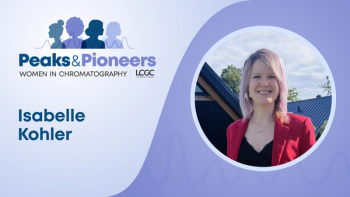
Isabelle Kohler traces her unplanned path from pharmacy to bioanalysis, and why the same career struggles cut across gender lines in her PhD coaching.

Isabelle Kohler is an assistant professor, Division of Bioanalytical Chemistry, Department of Chemistry and Pharmaceutical Sciences, Amsterdam Institute of Molecular and Life Sciences, at Vrije Universiteit Amsterdam in the Netherlands. She is also the CEO and founder of NextMinds.
Isabelle Kohler traces her unplanned path from pharmacy to bioanalysis, and why the same career struggles cut across gender lines in her PhD coaching.

This article explores the diverse career paths where analytical sciences PhDs create impact in fundamentally different ways than traditional research roles, and provides practical guidance on how to pursue them.

How to take ownership of your next career steps
How to take ownership of your next career steps
What’s the next step in your career?

In the second part of this review article, the recent progress in SFC for enantiomeric separations is evaluated. Several applications reported on the enantioselective separation of drugs and pharmaceutical compounds using chiral SFC are discussed, including pharmaceutical applications, clinical research, forensic toxicology, and environmental sciences.

With the substantial developments carried out over the past years in instrumentation, columns, and detector hyphenation, the interest in chiral supercritical fluid chromatography (SFC) has been steadily growing in various fields. In the first part of this review article, the theoretical advantages, technological developments, and common practices in chiral SFC are discussed.

Reversed-phase LC–MS has limitations in numerous analytical applications. Alternative MS-compatible chromatographic techniques separate analytes in the liquid phase based on different retention mechanisms compared with reversed-phase LC. This article describes these alternative chromatographic approaches, relevant applications, and the future of these techniques.

In many applications, LC–MS approaches using HILIC, SFC, SEC, IEC, and HIC offer advantages over conventional reversed-phase LC–MS. The examples presented here should inspire you to consider these options for your analyses.

LCGC North America
Clinical metabolomics requires analytical methods that provide both high resolution and high throughput. In this review, we assess the promise of a variety of techniques-including HILIC, SFC, multidimensional LC, ion-mobility mass spectrometry, and data-independent acquisition mass spectrometry methods-to meet those needs.
LCGC Europe
This review article discusses the novel separation and detection strategies that are considered promising in clinical metabolomics to enhance the metabolome coverage. It includes hydrophilic interaction chromatography (HILIC), supercritical fluid chromatography (SFC), multidimensional LC approaches, as well as ion-mobility mass spectrometry (IM-MS) and data-independent acquisition (DIA) analysis methods.

LCGC Europe
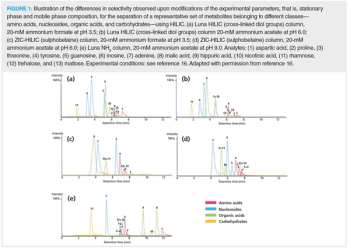
Hydrophilic interaction chromatography (HILIC) was introduced more than two decades ago and has garnered much attention. Characterized by a hydrophilic stationary phase used in combination with an aqueous organic mobile phase, numerous improvements have been achieved and HILIC is now considered as an attractive alternative to reversed-phase phase liquid chromatography (LC) for many applications. HILIC provides several advantages over reversed-phase LC for the analysis of polar compounds, including higher retention of polar metabolites, enhanced mass spectrometric sensitivity, moderate back-pressure - even at high flow rates, or when used with sub-2-µm particle size - and orthogonal selectivity. Several important technical developments have been proposed during the last decade that foster its use in metabolomics. This review presents an overview of the most recent technical improvements and applications of HILIC analysis in untargeted clinical metabolomics and discusses important practical considerations, including the selection of the optimal column chemistry, appropriate eluents, sample preparation, and data analysis.

Special Issues
Hydrophilic interaction liquid chromatography (HILIC) has recently become more important, particularly for the analysis of polar drugs, metabolites and biologically relevant compounds in glycomics, proteomics, metabolomics and clinical analysis. HILIC makes it possible to increase the retention of polar compounds, achieve orthogonal selectivity and increase mass spectrometry (MS) sensitivity, compared with reversed-phase liquid chromatography. This article discusses the advantages and limitations of HILIC in a variety of practical applications in the pharmaceutical industry.

September 1st 2020