We will discover how to find the “sweet spot” in terms of retention for a liquid chromatographic separation as well as how much retention change can be expected for a selected change in organic mobile-phase percentage or column temperature.

John Dolan has been writing "LC Troubleshooting" for LCGC for over 25 years. One of the industry's most respected professionals, John is currently a principal instructor for LC Resources, Walnut Creek, California He is also a member of LCGC's editorial advisory board.

We will discover how to find the “sweet spot” in terms of retention for a liquid chromatographic separation as well as how much retention change can be expected for a selected change in organic mobile-phase percentage or column temperature.

When considering column efficiency, more is not always better. We look at some ways to quickly estimate the effects of changes in column length and particle diameter rather than trying the experiments in the laboratory.

When considering column efficiency, more is not always better. We look at some ways to quickly estimate the effects of changes in column length and particle diameter rather than trying the experiments in the laboratory.

The mobile-phase pH can be a powerful tool to control retention and selectivity, but it can also get you in trouble if it is not controlled properly.

The mobile phase pH can be a powerful tool to control retention and selectivity, but it can also get you in trouble if not controlled properly.

A reader’s problem of a method that fails the repeatability of the system suitability test serves as an example of how to approach LC method troubleshooting.

A reader’s problem of a method that fails the repeatability requirement of the system suitability test serves as an example of how to approach liquid chromatography (LC) method troubleshooting.

What could be causing a peak to be eluted before the column dead time? In last month’s “LC Troubleshooting” (1) we looked at problems two readers had with ghost peaks in gradient runs. This month, we’ll continue looking at submitted questions and examine one submitted by another reader of this column.

What could be causing a peak to be eluted before the column dead time?

What could be causing a peak to be eluted before the column dead time?

Interfering peaks or high baseline background can compromise the results of gradient LC separations.

Interfering peaks or high baseline background can compromise the results of gradient liquid chromatography (LC) separations.

Fluorescence detection can be a strong alternative to ultraviolet or other detectors for some compounds.

Reversed-phase liquid chromatographic columns can be compared quantitatively for differences in selectivity by means of the hydrophobic-subtraction model. This allows selection of columns that are either equivalent or different in selectivity. The present paper both presents a summary of this approach and shows in detail how to use it in practice.

Detectors based on ultraviolet absorbance are the most common detectors in use for liquid chromatography.

The principal aim of this work was to provide a perspective with practical utility in streamlining the chromatographic method development in pharmaceutical industries based upon predicting the chromatographic retention times from molecular structures. Workflows were suggested with a focus on reversed-phase LC, IC, and HILIC as the three major techniques. Unlike HILIC, retention prediction in both reversed-phase LC and IC can benefit from the maturity of these techniques and the transparency of their retention mechanisms. In reversed-phase LC the solute coefficients in the hydrophobic subtraction model and in IC the a and b values in the linear solvent strength model can be the subject of modelling with their subsequent use in retention prediction. A workflow for HILIC can be based on the design of experiments approach, to account for all major contributors to the retention mechanism, and direct correlation of experimental retention times to the molecular descriptors.

Detectors based on ultraviolet absorbance are the most common detectors in use for liquid chromatography.

A reliable autosampler is one key requirement for unattended operation of a liquid chromatograph.

A reliable autosampler is one key requirement for unattended operation of a liquid chromatograph.

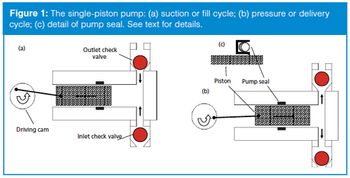
Understanding how liquid chromatography pumps operate can help streamline solving pump problems.

Different techniques of LC mobile phase mixing can give different results… and have different problems.

Different techniques of liquid chromatography (LC) mobile-phase mixing can give different results and have different problems.

Understanding how liquid chromatography pumps operate can help streamline solving pump problems.

Understanding how liquid chromatographic pumps operate can help streamline solving pump problems.

What should you do if your retention times drop from one injection to the next? A systematic approach to troubleshooting can help to quickly identify the problem source.

Retention times drop from one injection to the next. A systematic approach to troubleshooting can help to quickly identify the problem source.

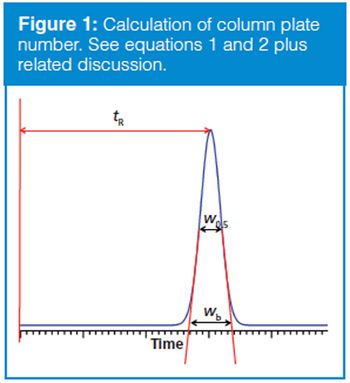
How suitable is the column plate number for system suitability testing?

How suitable is the column plate number for system suitability testing?

How suitable is the column plate number for system suitability testing?

The silica-based packing in reversed-phase columns is not inert. Here we consider what happens when the mobile phase pH is too high or too low.