


The Application Notebook
Traditionally, simple analytical characteristics (for example, content of epoxy groups, chlorine, α-glycol groups, viscosity or softening point) are used to identify epoxy resins.
The Application Notebook
Traditionally, simple analytical characteristics (for example, content of epoxy groups, chlorine, α-glycol groups, viscosity or softening point) are used to identify epoxy resins.

The Application Notebook
Membrane proteins - together with lipids - make up biological membranes that are essential for life. In order to understand the role of membrane proteins in assisting membranes to carry out many different functions, it is of great importance to understand the structure of those proteins.

The Application Notebook
Heparin is a polydisperse, heterogeneous polysaccharide derived from animal tissue. Heparin has been used as an anticoagulant for over 60 years and one of the fundamental parameters for characterizing unfractionated heparin (UFH) is its molecular weight (MW) and MW distribution. The molecular weight of heparin ranges from 3 to 50 kDa, but, typically falls within the 10 to 20 kDa range for unfractionated heparins used in medical applications. In light of heparin contamination issues in 2008, USP has proposed to include heparin molecular weight determination for the stage 3 heparin monograph revisions.

LCGC North America
To characterize biopharmaceuticals, particularly monoclonal antibodies and antibody–drug conjugates (ADCs), you need a complete toolbox of powerful tools. You are probably familiar with LC–MS methods. But have you seen what light-scattering detection can do?

The Application Notebook
Poly(lactic-co-glycolic acid) (PLGA) is a copolymer based on glycolic acid and lactic acid. The two monomer units are linked together by ester linkages and form linear polyester chains

Special Issues
Multi-angle light scattering (MALS) represents a uniquely powerful technique to determine the absolute molar masses and sizes of proteins in solution. MALS detectors cover a wide detection range of sizes and masses and enable the characterization of protein molecules as monomers, dimers, or higher order aggregates.

Special Issues
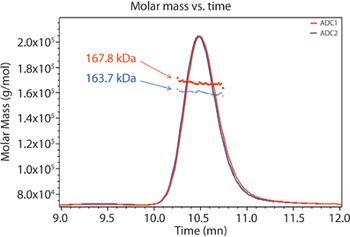
There has been a significant resurgence in the development of antibody-drug conjugates (ADC) as target-directed therapeutic agents for cancer treatment.
LCGC Europe
Ultra-high performance liquid chromatography (UHPLC) enables fast, efficient separation of biomolec-ular samples. Compared to standard SEC, UHP-SEC provides improved resolution, higher throughput, less solvent and smaller sample consumption for analysis of precious biological samples.
The Application Notebook
Wyatt Technology Corporation
The Application Notebook
Wyatt Technology Corporation

The Application Notebook
Wyatt Technology Corporation
The Application Notebook
Wyatt Technology Corporation
The Application Notebook
Wyatt Technology Corporation
LCGC Asia Pacific
Wyatt Technology Application Note

The Application Notebook
Wyatt Technology Corporation

The Application Notebook
Wyatt Technology Corporation
The Application Notebook
Wyatt Technology Corporation
The Application Notebook
Wyatt Technology Corporation

LCGC Asia Pacific
Application Note
The Application Notebook
Wyatt Technology corporation
The Application Notebook
Wyatt Technology corporation
LCGC Asia Pacific
Wyatt Technology Note

The Application Notebook
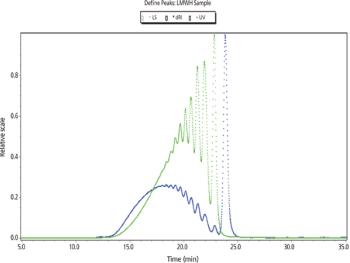
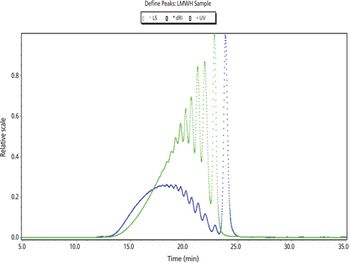
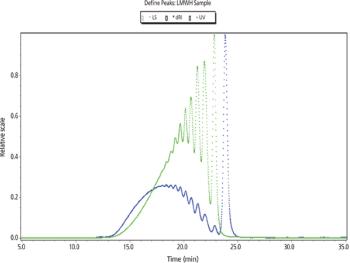
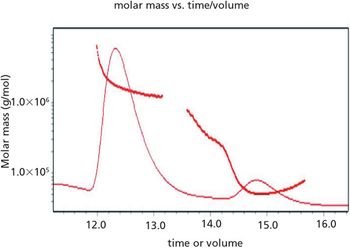
Low-molecular-weight heparins (LMWHs) are obtained by fractionation or depolymerization of natural heparins. They are defined as having a mass-average molecular weight of less than 8000 and for which at least 60% of the total weight has a molecular mass less than 8000.
The Application Notebook
Malaria remains one of the world's most deadly diseases, killing a child under five years of age every 30 s. Our branch aims to produce and characterize recombinant protein vaccines for Phase I and II human trials.

The Application Notebook
Liposomes are made of lipid bilayers and are often used in drug delivery by encapsulating the core with therapeutic drugs. During liposome research, formulation, manufacturing, and quality control, it is of great importance to monitor liposome size and encapsulation.

The Application Notebook
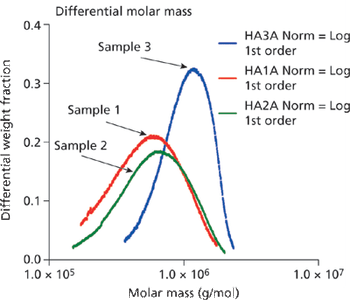
Agarose is a polysaccharide produced from seaweed that forms a gel at room temperature. The characteristics of agarose gels depend on the agarose concentration, solvent, weight-average molar mass, and molar mass distribution.
The Application Notebook
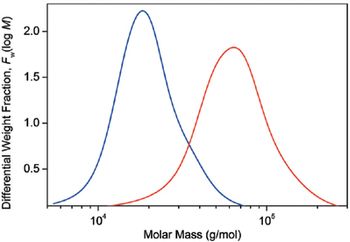
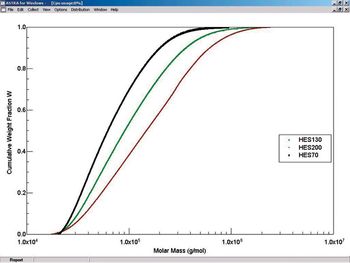
Hydroxyethylstarches (HES) are used increasingly as plasma expanders in medical applications. The HES's circulation time in the blood depends strongly on its molar mass distributions.
The Application Notebook
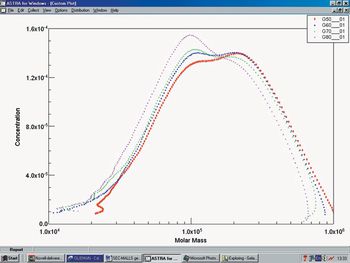
Gelatin is the denatured form of collagen, the main component of skin, bone, and connective tissues of animals. Its special properties are a sharp sol-gel transition, low sol viscosity, and high effectiveness as a protective colloid.

The Application Notebook
Over-expression of recombinant proteins is commonly used for the production of protein reagents in industry and academia. Problems often occur relating to the stress put on the cells to deal with this huge increase in synthesis.
The Application Notebook
Recent technological advances in macromolecular crystallography led to focus on the study of more and more sophisticated biological systems, such as protein–protein complexes. Nevertheless, they represent one of the most challenging areas in modern structural biology.