Wyatt Technology Corporation
Articles by Wyatt Technology Corporation

In this application note, two commercially available samples were analyzed in the ASTRA® software by SEC coupled to a multi-angle light scattering (MALS) detector (DAWN®), a refractive index detector (Optilab®), and a differential viscosity detector (ViscoStar®).

FFF-MALS-DLS is valuable for characterizing liposomes and solid lipid nanoparticles, determining detailed size distributions, particle shape, concentration and more.
FFF-MALS-DLS is valuable for characterizing liposomes and solid lipid nanoparticles, determining detailed size distributions, particle shape, concentration and more.
Linear? Branched? Rings? What molecular architecture do my polymers have? How can I apply SEC for my analysis? Why is this of practical importance?
Live Tuesday, Jul. 30, 2019 at 11am EDT | 8am PDT | 4pm BST | 5pm CEST
On demand available after airing until Jul. 30, 2020
Register free

Eliminating laborious sample preparation, field-flow fractionation greatly facilitates the absolute characterization of lignosulfonates by multi-angle light scattering.

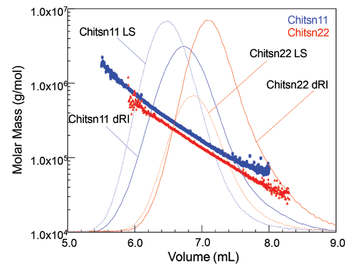
Chitosans are analyzed by SEC-MALS to determine molar mass moments and distributions.
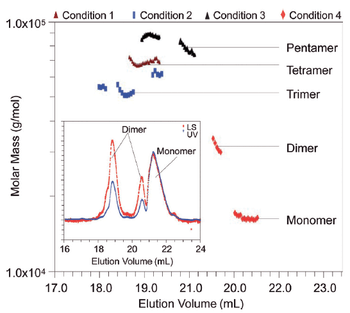

Quantifies affinity, stoichiometry of biomolecular assemblies, helping understand the mechanism of interaction and develop therapeutics that target and modulate them.
Quantifies affinity, stoichiometry of biomolecular assemblies, helping understand the mechanism of interaction and develop therapeutics that target and modulate them.

Drug-antibody ratio (DAR) is a critical attribute of antibody–drug conjugates (ADCs). DAR may often be determined quickly and effectively by combining SEC with three online detectors: MALS, UV, and dRI.





This application note shows how the combination of column chromatography (SEC/GPC) with Multi-Angle Light Scattering (MALS), Dynamic Light Scattering (DLS) and RI detection can be applied as a powerful tool to identify monomers, dimers, hexamers and higher aggregates of insulin.
This application note shows how the combination of column chromatography (SEC/GPC) with Multi-Angle Light Scattering (MALS), Dynamic Light Scattering (DLS) and RI detection can be applied as a powerful tool to identify monomers, dimers, hexamers and higher aggregates of insulin.
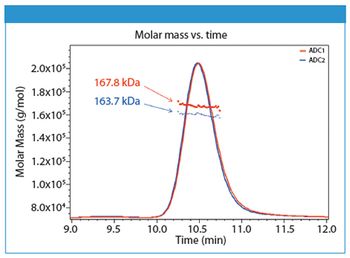
There has been a significant resurgence in the development of antibody-drug conjugates (ADC) as target-directed therapeutic agents for cancer treatment. Among the factors critical to effective ADC design is the Drug Antibody Ratio (DAR). The DAR describes the degree of drug addition that directly impacts both potency and potential toxicity of the therapeutic, and can have significant effects on properties such as stability and aggregation. Determination of DAR is, therefore, of critical importance in the development of novel ADC therapeutics.
Starch is used for a variety of industrial and nu¬tritional purposes. Its functional properties are influenced by the ratio and molar masses of its mac¬romolecular constituents, which vary with source, crop year, and climate. Starch contains large homopolymers of amylose (AMY) and amylopectin (AMP).
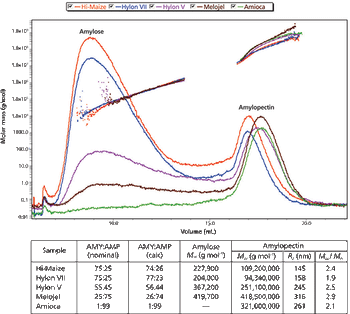
Integration of RI peak areas enabled calculation of the AMY:AMP ratios, in excellent agreement with the nominal values. The values for Mw and Rz fall within the generally accepted limits found in the literature. Conformational plots for the AMP component verify its branched nature.

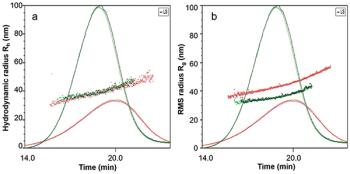
In addition to the weight-average molar mass and the polydispersity, the DAWN can also determine the shape of the polymer by measuring the rms radius directly at each elution volume. It is well-known that butadiene forms highly branched polymers and that styrene forms linear polymers-and this is revealed by the DAWN.
Size exclusion chromatography (SEC) is widely used for detecting aggregates, fragments, and other impurities in a biotherapeutic sample. When coupled with multi-angle light scattering (MALS), SEC enables researchers to quantify the true solution molar mass of each species in a sample, in addition to the mass fraction of each spe-cies.
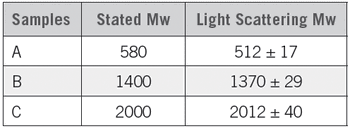
Multi-angle light scattering (MALS) is primarily used to determine molecular weight, size-and shape-related parameters of macromolecules or nanoparticles as they elute from a separation device. In batch (unfractionated) mode, MALS provides the weight-average molecular weight wand the z-average mean square radius z. The DAWNHELEOSIIis particularly well suited for these tasks owing to its flow cell design, holding a mere ~67µl and readily connecting toa fluid line through HPLC-type fittings.