The Application Notebook
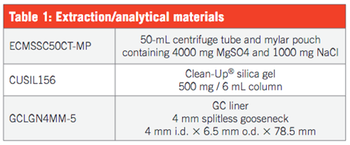
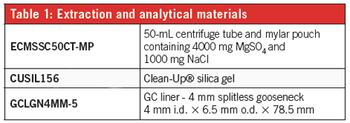
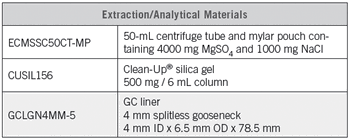
This application note details an optimized method for the extraction and cleanup of pesticide residues from coffee using a QuEChERS extraction procedure followed by a silica gel SPE cleanup.
The Application Notebook
This application note details an optimized method for the extraction and cleanup of pesticide residues from coffee using a QuEChERS extraction procedure followed by a silica gel SPE cleanup.

Special Issues
As a result of the rapid growth of the cannabis industry, many testing laboratories are looking for efficient, reliable, and cost-effective analytical methods to analyze chemical residues, such as pesticides, mycotoxins, solvent residues, terpenes, and heavy metals, as well as cannabinoid concentration in cannabis-infused edibles and beverages. In this article, QuEChERS (quick, easy, cheap, effective, rugged, and safe), a sample preparation technique widely adopted in the food testing industry, is introduced to the discipline of forensic testing as a viable method for the extraction of pesticides and cannabinoids in various complex sample matrices. The claimed amounts of cannabinoids versus the actual amounts are compared, as well as the pesticide residue levels in edible and beverage samples.
The Application Notebook
Coffee is one of the most widely consumed beverages in the world, partly because of the stimulating effect of its caffeine content. Like most crops, the application of pesticides in coffee cultivation is a common practice to increase production yields. This application note details an optimized method for the extraction and cleanup of pesticide residues from coffee using a QuEChERS extraction procedure followed by a silica gel solid-phase extraction (SPE) cleanup.
The Application Notebook
Special Issues
As a result of the rapidly growing cannabis industry, many testing laboratories are looking for efficient, reliable, and cost-effective analytical methods to analyze chemical residues, such as pesticides, mycotoxins, solvent residues, terpenes, and heavy metals, as well as cannabinoid concentration in cannabis-infused edibles and beverages. In this article, QuEChERS (quick, easy, cheap, effective, rugged and safe), a sample preparation technique widely adopted in the food testing industry, is introduced to the discipline of forensic testing as a viable method for the extraction of pesticides and cannabinoids in various complex sample matrices. Comparison of the claimed amounts of cannabinoids versus the actual amounts as well as the pesticide residue levels in edible and beverage samples is discussed.

The Application Notebook

LCGC Europe
11-nor-9-Carboxy-THC, also known as THCA or carboxy-THC, is the main secondary metabolite of THC (the active component of marijuana) formed in the human body [1]. THCA is excreted in urine in the form of glucuronide conjugates. THCA is not psychoactive but has a long half-life of up to several days or even weeks in very heavy users, thus determination of THCA in urine plays an important role in confirmation of marijuana consumption. The Substance Abuse and Mental Health Services Administration (SAMHSA) has set the THCA cutoff concentration of confirmatory testing at 15 ng/mL. Typical sample preparation methods for THCA in urine include liquid-liquid extraction (LLE) and solid phase extraction (SPE). This application utilizes a novel sample preparation technique, QuEChERS to effectively quantitate THCA levels in human urine.
LCGC North America
Recently the US EPA published a list of 30 UCMR4 (the 4th Unregulated Contaminant Monitoring Rule) analytes which may potentially be present in tap water but are not yet subject to EPA’s drinking water standards set under the Safety Drinking Water Act. Four among the 30 UCMR4 compounds, including o-toluidine, quinoline, butylated hydroxyanisole (BHA), and dimethipin, are determined by EPA method 530 using solid phase extraction (SPE) and GC/MS detection. In this study, analytes were extracted using UCT’s divinylbenzene based sorbent (HLDVB). GC/MS SIM method with solvent standard calibration was carried out for data acquisition and analyte quantitation.
LCGC North America
The EPA has updated methods 8270 (8270E) and 625 (625.1) to both now permit the use of solid phase extraction (SPE) to analyze for semi-volatile organic compounds (SVOCs) in aqueous samples and TCLP leachates. As a result of new advancements in instrumental sensitivity, smaller sample sizes can now be utilized to obtain required method detection limits, reducing solvent and standard consumptions and overall sample preparation time. This application note describes a reliable, efficient, and cost-effective SPE method utilizing two stacked cartridges for the extraction of 100 mL water samples or less.
The Application Notebook
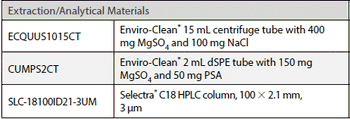
This application utilizes the original, non-buffered QuEChERS (acronym for quick, easy, cheap, effective, rugged, and safe) technique to quantify anabolic steroids in human whole blood

The Application Notebook
Organochlorine (OC) pesticides are hydrocarbons with multiple chlorine substitutions primarily used as insecticides. OC pesticides do not break down easily as the chlorine-carbon bonds are very strong.

The Application Notebook
UCT, LLC

LCGC Asia Pacific
UCT Application Note
The Application Notebook
UCT, LLC

The Application Notebook
UCT, LLC
LCGC Asia Pacific
A novel, simple, rapid and effective method to determine pesticide residues in red wine samples is described.

LCGC Asia Pacific
Application Note

LCGC Europe
A novel, simple, rapid and effective method to determine pesticide residues in red wine samples is descibed.

LCGC North America
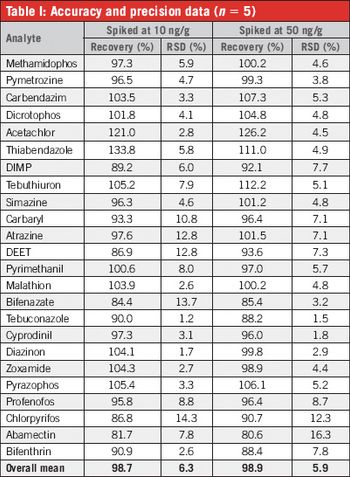
Sample preparation in this study involved QuEChERS extraction followed by a filter-based cleanup method that is easier and faster than dispersive solid-phase extraction.
The Application Notebook
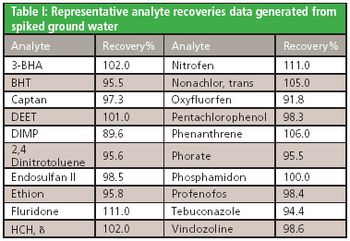
EPA is updating method 525.2. The CCL3 includes 104 analytes. UCT has evaluated the recoveries of these compounds, including the current list, using proposed changes to the method with the C18-based UCT ENVIRO-CLEAN? 83 mL Extraction Cartridge ECUNI525.