

LCGC Europe
Click the title above to open the LCGC Europe September 2019 regular issue, Volume 32, Number 9, in an interactive PDF format.
LCGC Europe
Click the title above to open the LCGC Europe September 2019 regular issue, Volume 32, Number 9, in an interactive PDF format.
LCGC Europe
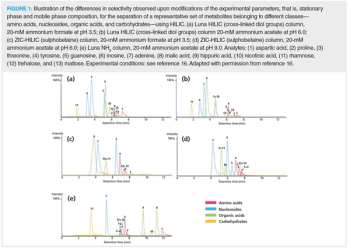
This review article discusses the novel separation and detection strategies that are considered promising in clinical metabolomics to enhance the metabolome coverage. It includes hydrophilic interaction chromatography (HILIC), supercritical fluid chromatography (SFC), multidimensional LC approaches, as well as ion-mobility mass spectrometry (IM-MS) and data-independent acquisition (DIA) analysis methods.

LCGC Europe
The sample solvent can have a big impact on peak shape in both reversed-phase and hydrophilic interaction liquid chromatography (HILIC) separations, especially when large volumes are injected. Diluting the sample with weak solvent can be an effective solution to mitigate this problem, but we have to be careful to not lose analytes of interest to precipitation or phase separation.
LCGC Europe
Most manufacturers ship gas chromatographs with a small collection of consumable parts and accessories, such as extra ferrules, inlet liners, or septa, and a few instrument-specific tools. In earlier times, some convenience items might have been included as well, like a bubble flow meter or a small set of tools, but now it’s rare to find such things in the shipping boxes. This edition of “GC Connections” lists a number of essential items that should be on hand in every gas chromatography (GC) laboratory, their function, and how to use them effectively.

LCGC Europe
The 9th International Symposium on Recent Advances in Food Analysis (RAFA 2019) will take place in Prague, Czech Republic, on 5–8 November 2019.