

Chromatide has announced a partnership with Kromasil, a brand of Akzo Nobel, to develop improved chromatography media for chiral purification.
Chromatide has announced a partnership with Kromasil, a brand of Akzo Nobel, to develop improved chromatography media for chiral purification.
Seegene, Inc. (Rockville, Maryland) and Shimadzu Corporation (Columbia, Maryland) announced that they had formed a strategic partnership to combine Seegene's Seeplex multipathogen tests with Shimadzu's MultiNA high-speed electrophoresis system.
The College of William and Mary (Williamsburg, Virginia) unveiled its Integrated Science Center for the fall semester.
Researchers from the Helmholtz Centre for Environmental Research (Leipzig, Germany) used the Chemcatcher aquatic passive sampling device to collect samples from a 1-day pulse contamination with the pesticide thiacloprid.
Scientists from the USDA';s Eastern Regional Research Center (Wyndmoor, Pennsylvania) analyzed 11 beta-lactam antibiotics in bovine kidney using a sample preparation method consisting of an acetonitrile-water extraction followed by a dispersive solid-phase extraction with a C18 sorbent, extract concentration, and filtration with syringeless filter vials.
E-Separation Solutions
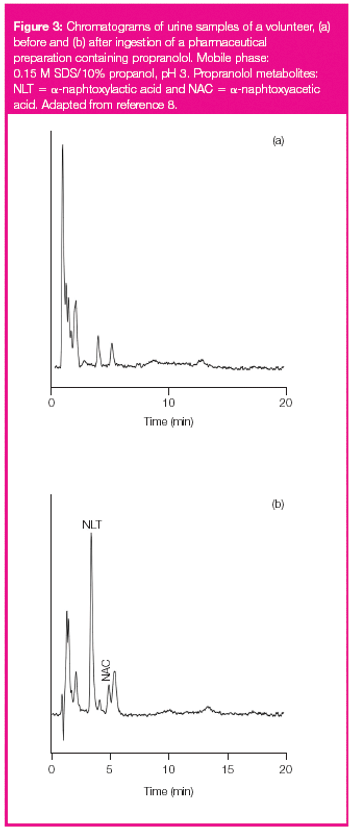
Micellar liquid chromatography (MLC) is a reversed-phase liquid chromatographic mode with a solution of surfactant forming micelles as the mobile phase. The interaction of solutes with the stationary phase coated with surfactant monomers, combined with the increased solubilization capability of micelles, have profound implications with regard to retention, selectivity and efficiency. Practical steps that a chromatographer involved in MLC should consider when developing an analytical procedure are described, including mobile phase preparation, column conditioning and cleaning.
Scientists from Kangwon National University in South Korea undertook a comprehensive study to identify the types of compounds in vehicle AC unit emissions, using gas chromatography with four types of detection: olfactometry, flame ionisation detection (FID), mass spectrometry (MS) and atomic emission detection (AED). It was conducted on a lab-scale model unit that contained a rogue AC evaporator from a vehicle that was associated with unpleasant odours and had only 4000 km on the clock.
Researchers from the Monell Center (Philadelphia, Pennsylvania) used GC-MS techniques to sample air above basal cell tumors and found a different profile of chemical compounds compared to the skin in healthy people. Human skin has many airborne chemical molecules known as VOCs, many of which have odors.
Scientists from Jacobs University (Bremen, Germany) used orthogonal proteomic methods to study the behavior of proteins in ion-exchange chromatography.

LCGC North America
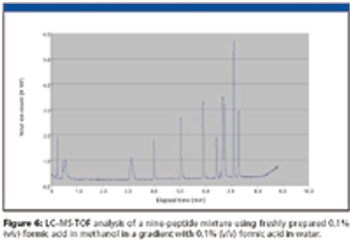
Dilute formic acid solutions in methanol were found to decline in acid content with time, the extent of the decline depending upon the initial amount of water present in these solutions. The effect of the formic acid concentration change upon the separation of peptides using high performance liquid chromatography (HPLC) is examined briefly.
LCGC North America
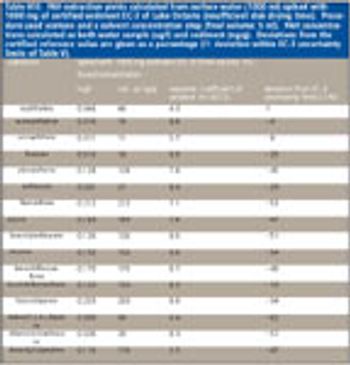
When water samples are extracted and analyzed for PAH's, many methods require the sample to be filtered to remove particulate matter. This helps reduce SPE cartridges 'plugging' or emulsions forming, as can happen with conventional liquid-liquid extraction. But, filtration of the suspended particulate matter may reduce the effectiveness of the extraction for PAHs. Therefore, to determine the actual concentration of PAHs, the "whole" watersample, with the suspended particulate matter, needs to be processed. In this study, SPE using a 47mm "disk" format, with an automated extractor system, is proven as a successful, reproducible, analytical extraction method for particulate laden water samples for PAHs.
The Column
Torion Technologies, Inc. (American Fork, Utah), a manufacturer of automated miniaturized, hand-portable GC and toroidal ion trap mass spectrometry (TMS) technology, has announced a partnership with Smiths Detection (Danbury, Connecticut), part of the global technology business, Smiths Group and a technology developer and manufacturer of sensors that detect and identify explosives, chemical and biological agents, weapons, and contraband.
The Column
Thermo Fisher Scientific (Waltham, Massachusetts) has received a Microsoft Corporation 2008 Pharmaceutical and Life Sciences Innovation Award in the Discovery and Product Innovation category.
The Column
Agilent Technologies (Santa Clara, California) and the University of Technology Sydney (UTS, Sydney, Australia) have established the UTS Elemental Bio-Imaging Facility to study trace metals and other elements in tissue and their effects on health.
The Column
When water samples are extracted and analyzed for PAH's, many methods require the sample to be filtered to remove particulate matter. This helps reduce SPE cartridges 'plugging' or emulsions forming, as can happen with conventional liquid-liquid extraction.
The Column
The Pittsburgh Conference (Pittsburgh, Pennsylvania) has announced that George M. Whitesides, the Woodford L. and Ann A. Flowers University Professor of the Department of Chemistry and Chemical Biology at Harvard University (Cambridge, Massachusetts), will be the Plenary Speaker at Pittcon 2009 on March 8, 2009.
The Column
Perchlorate recently has received attention as an environmental pollutant. Perchlorate can affect human health by interfering with iodide uptake by the thyroid gland and disrupting thyroid function. Perchlorate-free purified water is needed by laboratories analyzing samples for the presence of perchlorates.
LCGC Europe eNews Example
LCGC Asia eNews Example
Agilent Technologies (Santa Clara, California) and the University of Technology Sydney (UTS, Sydney, Australia) have established the UTS Elemental Bio-Imaging Facility to study trace metals and other elements in tissue and their effects on health.
A research group at Lund University (Lund, Sweden) fused a multifunctional peptide tag to the N-terminal ends of green fluorescent protein, lactate dehydrogenase, and human hemoglobin in preparation for separation via ion-exchange chromatography, immobilized metal-ion affinity chromatography, and hydrophobic interaction chromatography.
Researchers from Waterloo University (Waterloo, Ontario, Canada) developed a fast method for extracting and analyzing volatile organic compounds (VOCs) and disinfection by-products in drinking water.
Shimadzu Corporation (Columbia, Maryland) and Seegene, Inc. (Rockville, Maryland) have entered into a partnership in which Seegene's polymerase chain reaction-based Seeplex tests will be combined with Shimadzu's MultiNA high-speed electrophoresis system for multipathogen analysis and detection.
Chemists from Wuhan University (Wuhan, China) used a headspace sorptive extraction technique based on a coated glass bar to determine volatile organic sulfur compounds in water.
LEAP Technologies (Carrboro, North Carolina) and Quantum Analytics (Foster City, California) have announced a co-marketing partnership designed to improve chromatography and mass spectrometer systems, including new developments in front-end automation.
The Pittsburgh Conference (Pittsburgh, Pennsylvania) has announced that George M. Whitesides, the Woodford L. and Ann A. Flowers University Professor of the Department of Chemistry and Chemical Biology at Harvard University (Cambridge, Massachusetts), will be the Plenary Speaker at Pittcon 2009 on March 8, 2009.
Researchers at the University of Cordoba (Cordoba, Spain) used dynamic liquid-phase microextraction with an ionic liquid as the acceptor phase to extract six nonsteroidal anti-inflammatory drugs from human urine samples.