

Thermo Fisher Scientific (Waltham, Massachusetts) announced its collaboration with the Molecular Therapeutics Research Group at the School of Pharmacy, Queen?s University Belfast to analyze peptides in amphibian venom.
Thermo Fisher Scientific (Waltham, Massachusetts) announced its collaboration with the Molecular Therapeutics Research Group at the School of Pharmacy, Queen?s University Belfast to analyze peptides in amphibian venom.
Researchers at the National Institute of Standards and Technology (NIST, Gaithersburg, Maryland) have developed an approach for electronic noses that comprises 16 microheater elements and eight types of sensors.
Tecan Group (Männedorf, Switzerland), a supplier of advanced automation and detection systems for life science laboratories, has opened its new Asia Pacific region headquarters in Shanghai, China.
Waters Corporation (Milford, Massachusetts) has donated a Synapt mass spectrometry system to the Fondation du Centre Hospitalier Universitaire de Sherbrooke (CHUS, Sherbrooke, Quebec, Canada).
MIP Technologies AB (Lund, Sweden) has announced that it has received funding for a four-year project, including funding for a three-year Ph.D. position.
Agilent Technologies (Santa Clara, California) and BioTrove (Woburn, Massachusetts) have signed a nonexclusive value-added reseller agreement that enables BioTrove to provide instrumentation for mass spectrometry?based drug discovery.
Spartan Bioscience Announces Agreement with NorDiag ASA
Malvern Instruments (Southborough, Massachusetts) announced its participation in the OPC Analyzer Device Integration Working Group.
Dionex (Sunnyvale, California) has agreed to purchase Caliper Life Sciences? (Hopkinton, Massachusetts) AutoTrace solid-phase extraction (SPE) products, including the AutoTrace SPE workstation, which is designed to automate the extraction of large-volume aqueous samples before analysis.
LCGC Europe eNews
Dutch supplier of system solutions using HPLC with electrochemical detection, Antec Leyden has opened Antec USA as a consequence of continuously increasing businesses in the US. This accounts for a significant share of total sales and the company decided to set up its subsidiary in Hanover, Maryland.
LCGC Europe eNews
The new on-line community from Waters to support Acquity UPLC chromatographers has attracted 1200 members in its first month.
Recent advances in polymer chemistry have led to the development of novel materials with both controlled functionality and structure resulting in unusual rheological properties. Examples include the many di- and triblock copolymer architectures and dendritic systems. These materials often include regions of different polarity and hydrophobicity and therefore represent a challenge to the analytical chemist. This application note illustrates the analysis of a star-branched polyethylene glycol with a significant hydrophobic component by aqueous SEC.

E-Separation Solutions
This month, E-Separations Solutions' Technology Forum looks at the topic of HPLC and the trends and issues surrounding it. Joining us for this discussion are Helmut Schulenberg-Schell of Agilent Technologies; Diab Elmashni of Thermo Fisher Scientific; and Michael Swartz of Synomics Pharmaceutical Services, LLC.
E-Separation Solutions
Recent advances in polymer chemistry have led to the development of novel materials with both controlled functionality and structure resulting in unusual rheological properties.
E-Separation Solutions
Microemulsion-based HPLC (MELC) is a recent development offering reduced sample preparation times for complex samples and generic separation conditions applicable to a wide range of solutes. This article introduces the concepts of MELC and discusses the possible benefits and future applications.
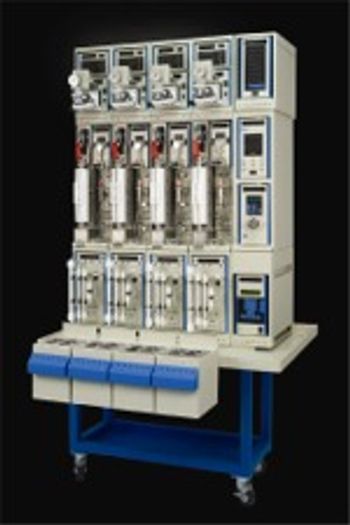
FMS introduces the only known "Total Solution" Sample Prep system available that combines 3 systems in 1 economical package. The Total Prep performs the entire extraction, sample clean-up and concentration for six samples in less than a few hours, thus producing high recoveries and excellent precision for all analysts.
E-Separation Solutions
The answers to the following reader questions about degassing mobile phase solvents were supplied by LCGC's "LC Troubleshooting" columnist John Dolan.
E-Separation Solutions
The introduction of new silica-based media in the last four years, that are stable to either acidic or basic conditions, provides the chemists more flexibility in choosing mobile phase conditions.
LCGC Europe eNews
Operators of the Agilent 6410 triple quadrupole liquid chromatography–mass spectrometer (LC–MS) system look set to benefit from a collaboration between the National Laboratory Service (NLS) and Agilent Technologies. The two will collaborate to launch an environmental training programme...
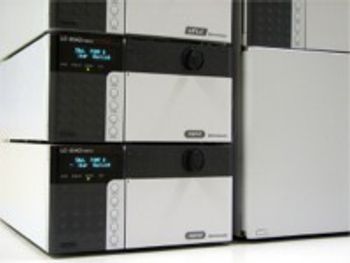
The Shimadzu prominence Nano is a nano-flow LC system comprising of the LC-20ADnano nano solvent delivery module, the FCV nano-low channel selection valve, the Nano-Assist control software and other prominence units.
LCGC Europe eNews
This year JASCO celebrates its 50th anniversary in the analytical instrumentation market and the company's celebrations conclude with Jasco Europe, a subsidiary of Jasco Corporation, moving into its new facilities in Cremella (Italy) in November 2008...

images
The Column
Smoke Signals Kaj Petersen Simple Differentiation of Black Tea Samples Using a Chemometric Approach Antonietta Gledhill News All the news for November 2008 Incognito Method "Non"-Specifications! Frustrated by the lack of detail in the way that methods are specified, Incognito draws up some criteria for properly specifying instrument or method parameters and discusses some of the inaccuracies that he has come across Market Trends and Analysis Market Profile: Capillary Electrophoresis Glenn Cudiamat Q&A The Column's Janet Kelsey spoke with Marco Koenen and Ed Ledford of Zoex about the increasing popularity of multidimensional gas chromatography over conventional GC and where Zoex fits into this new trend.
Proxeon (Odense, Denmark) announced completeion of a project to integrate the company?s EASY-nLC system software with Thermo Fisher Scientific?s (Waltham, Massachusetts) Xcalibur software.
Researchers from the University of Córdoba (Córdoba, Spain) studied the use of simultaneous liquid-liquid microextraction and methylation along with headspace gas chromatography-mass spectrometry to determine nine haloacetic acids in drinking water.
Thermo Fisher Scientific (Waltham, Massachusetts) has opened a new facility in Reinach, Switzerland, near Basel, to support pharmaceutical and chemical companies in Switzerland near the French and German borders.
A research group from Aristotle University of Thessaloniki (Thesaloniki, Greece) analyzed royal jelly, an important bee product, fortified with nine pesticides.
Celebrations for JASCO's 50th anniversary in the analytical instrumentation market will conclude with Jasco Europe, a subsidiary of Jasco Corporation, moving into its new facilities in Cremella, Italy in November 2008.
Teledyne Tekmar Company (Mason, OH), a subsidiary of Teledyne Technologies Incorporated, has partnered with Sun Analytical Instruments. Sun Analytical Instruments will be responsible for managing sales for Tekmar?s analytical instruments in Indiana, Kentucky, Michigan, Ohio, Western Pennsylvania and West Virginia.
Varian Inc. (Walnut Creek, CA) and Flora Research Laboratories (Grants Pass, OR) have formed an alliance to advance the understanding and implementation of LC-MS solutions for complex dietary supplement analysis.