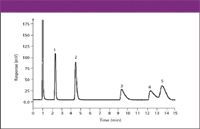
The authors evaluate the performance of multiplexed 96-lane CE with laser-induced fluorescence detection for high-throughput separation–based assays using fluorescein isothiocyanate as a model compound and fluorescein as an internal standard.


The authors evaluate the performance of multiplexed 96-lane CE with laser-induced fluorescence detection for high-throughput separation–based assays using fluorescein isothiocyanate as a model compound and fluorescein as an internal standard.

SEC analysis of proteins. (Tosoh Biosep LLC)

The Death Cap mushroom is the cause of most mushroom-related poisonings in the world. The author has developed a highly efficient, sensitive CE technique that toxicologists and forensic analysts can use to determine the poisonous peptides in body fluids of affected patients.

In this article, the authors review recent developments in the research of whole-column-imaging detection for capillary electrophoresis (CE). Whole-column-imaging detection was developed for capillary isoelectric focusing, for which it proved to be an ideal detector. Several whole-column-imaging detectors -- including refractive index gradient imaging, UV-absorption imaging, and fluorescence imaging detectors -- have been studied. The capillary isoelectric focusing UV-absorption imaging technique even has been commercialized. The development of whole-column-imaging detection itself facilitates CE studies in many directions such as in electrophoretic dynamics within narrow channels, new separation modes, and two-dimensional separations. Whole-column-imaging detection also finds application in capillary zone electrophoresis.

This month's "Directions in Discovery" gives a brief overview of turbulent- flow liquid chromatography, a technique for fast separations. Two examples demonstrate the use of the technology for high-throughput bioanalytical separations in drug discovery.