



LCGC Europe
This column discusses the similarities and differences between the validation approaches for analytical methods for QC product analysis and bioanalysis.
LCGC Europe
This column discusses the similarities and differences between the validation approaches for analytical methods for QC product analysis and bioanalysis.

LCGC North America
ERLIC is a new technique that shows promise as an alternative or complementary technique for both enrichment and separation of these posttranslationally-modified peptides.

LCGC North America
The authors examine MS-based methods to search for protein biomarkers of prion diseases from plasma samples.

LCGC North America
Guest authors show how mixed modes can be used successfully in the optimization of protein purification, and discuss how various experimental parameters can be used to regulate the binding of proteins to mixed-mode sorbents.

LCGC Europe
Microextraction by packed sorbent (MEPS) is a new technique in sample preparation that can be connected on-line to gas chromatography (GC) or liquid chromatography (LC) without any modifications.

The Application Notebook
A highly sensitive analytical method for the analysis of tamsulosin in human plasma has been developed for use in bioanalytical studies. The solid-phase extraction (SPE) and UPLC–MS–MS methodologies are described, as well as performance against validation parameters.

LCGC Europe
Technological changes affecting how we access information - both in the depth of knowledge we can access and the speed - leads to some observations about electronic versus print media. First, anything committed to public view must be of high scholarly order, often serving as a prime resource for equations and things we can't or won't remember. Second, once words have been printed, the value of the meaning they impart decreases as new understanding takes shape.
LCGC Europe
Cytosine (chemical name 4-amino-2-hydroxypyrimidine) is a pyrimidine derivative with a hetereocyclic aromatic ring and two substituents (amine and keto groups) attached and is a polar compound of significant biological and pharmaceutical interest. In response to the intended use of bulk cytosine as a raw material in pharmaceutical manufacturing, a method for the determination of the purity of cytosine was developed.

LCGC North America
Part III concludes the print version of our three-part series, "A Mass Spectrometry Primer," with the glossary to follow in a fourth and final installment.

LCGC North America
While the "Validation Viewpoint" column has focused on conventional and recombinant pharmaceutical products, and at times, bioanalytical methods, we have just begun to think about method validation as it relates to -omics type studies.

LCGC North America
This installment of SPP will compare and contrast the various types of polymeric and non-polymeric sorbents. The major advantages or polymeric sorbents will be discussed, and some applications will illustrate the versatility of polymeric SPE.

LCGC Europe
The combination of reversed-phase high performance liquid chromatography (RP-HPLC), atmospheric pressure ionization (API), mass spectrometry (MS) and tandem mass spectrometry (MS/MS) is ideal for determining and characterizing analytes in complex biological matrices. This review looks at the importance of parameters such as hydrophobicity, ionization properties, molecular mass and, partially, the molecular structure resulting from applied LC–MS–MS systems in analytical laboratories. The use of these parameters to investigate biomolecules and their unambiguous identification is also described.
LCGC Europe
The combination of reversed-phase high performance liquid chromatography (RP-HPLC), atmospheric pressure ionization (API), mass spectrometry (MS) and tandem mass spectrometry (MS/MS) is ideal for determining and characterizing analytes in complex biological matrices. This review looks at the importance of parameters such as hydrophobicity, ionization properties, molecular mass and, partially, the molecular structure resulting from applied LC–MS–MS systems in analytical laboratories. The use of these parameters to investigate biomolecules and their unambiguous identification is also described.

Special Issues
The use of mass spectrometry (MS) in clinical diagnosis goes back to the early 1970s with the application of gas chromatography (GC)–MS to the determination of a variety of biologically significant molecules. Because GC requires a certain level of analyte volatility, and since most biologically active molecules are polar, thermolabile, and involatile, elaborate extraction and derivatization protocols needed to be devised to make GC–MS useful for the analysis of clinically relevant samples. To make sample analysis less difficult by MS there had been a significant amount of R&D invested over several decades aimed at coupling high performance liquid chromatography (HPLC) with MS since HPLC is a much better separation technology than GC for polar thermolabile biologically relevant molecules. This coupling was not without significant challenges; most of the LC–MS coupling techniques that evolved during the 1970s and 1980s were not very successful, and many of those that enjoyed some widespread..

LCGC Europe
Microemulsion liquid chromatography (MELC) is a recent development offering reduced sample preparation times for complex samples and generic separation conditions applicable to a wide range of solutes. This article introduces the concepts of MELC and discusses the possible benefits and future applications.

LCGC Europe
The 25th anniversary of the Montreux LC–MS symposium will be held at the Montreux Music and Convention Centre, Montreux, Switzerland from 12–14 November 2008.
LCGC Europe
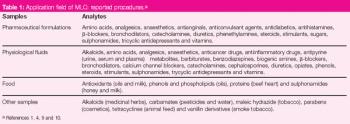
Micellar liquid chromatography (MLC) is a reversed-phase liquid chromatographic mode with a solution of surfactant forming micelles as the mobile phase. The interaction of solutes with the stationary phase coated with surfactant monomers, combined with the increased solubilization capability of micelles, have profound implications with regard to retention, selectivity and efficiency. Practical steps that a chromatographer involved in MLC should consider when developing an analytical procedure are described, including mobile phase preparation, column conditioning and cleaning.

LCGC Europe
Metabolomics resource; Agilent updates electronic notebook; On-line chromatography training; Add-on PC ports

LCGC Europe
Herbs and their extracts are currently being used for preventive and therapeutic goals. Consequently, the identification and quality control of these natural products is becoming increasingly important. Fingerprint chromatography is accepted as an appropriate identification and quality evaluation technique for medicinal herbs. This article reviews the development procedure of a fingerprint and different ways to handle the fingerprint data.

LCGC Europe
Capillary electrophoresis (CE) is increasingly being used in vaccine analysis. Applications include vaccine quantification, purity assessment, process monitoring, characterization and nucleic acid analysis. CE has been used because it offers advantages over other techniques. Vaccine manufacturers such as Sanofi-Aventis, Merck and Wyeth are actively investigating the use of CE for vaccine analysis. While CE can be considered a mature technique, its application to vaccine release and characterization has been limited. It is difficult to ascertain if its use is expanding because there are still a small amount of publications, but given the inherent advantages of CE and the need for better analytical techniques in vaccine analysis, the application must be growing. This article illustrates some of the uses of CE in vaccine analysis.

LCGC Europe
SCM-4 - The 4th International Symposium on the Separation and Characterization of Natural and Synthetic Macromolecules

LCGC North America
Michael Balogh begins a three-part overview series, answering questions about mass spectrometers, their use and capabilities, and including links to more detailed further reading in readily available articles written for the nonspecialist.

LCGC North America
A synopsis of our work detailing the use of chemometric response surface methodology (RSM) in two capillary electrophoresis (CE) studies is described.
LCGC North America
A very useful construct in engineering and analytical chemistry is the concept of a time-invariant linear system. The properties of the system (as for a mathematical function) are defined by a relationship between the response and the excitation, and ...