

LCGC North America
This new column explains the essentials of key methods in separation science. This month: hydrophilic interaction chromatography.
LCGC North America
This new column explains the essentials of key methods in separation science. This month: hydrophilic interaction chromatography.

The Application Notebook
According to law enforcement and health officials, "bath salts" are powerful synthetic stimulants, designed to be comparable in effect to cocaine or methamphetamine, carrying similar risks. Unlike cocaine or methamphetamine, these stimulants are currently legal in many parts of the United States and available at a low cost in many convenience stores and head shops.
LCGC North America
What challenges occur when using hydrophilic interaction liquid chromatography (HILIC), and what options are available for analysis?

E-Separation Solutions
Click here to view the complete e-Separation Solutions newsletter from February 4, 2011.
E-Separation Solutions
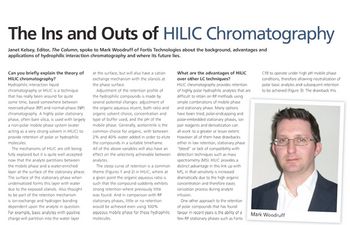
LCGC's The Column editor, Janet Kelsey, spoke to Mark Woodruff of Fortis Technologies about the background, advantages, and applications of hydrophilic interaction chromatography and where its future lies.

The Column
Mark Woodruff of Fortis Technologies talks about the background, advantages and applications of hydrophilic interaction chromatography and where its future lies.

The Application Notebook
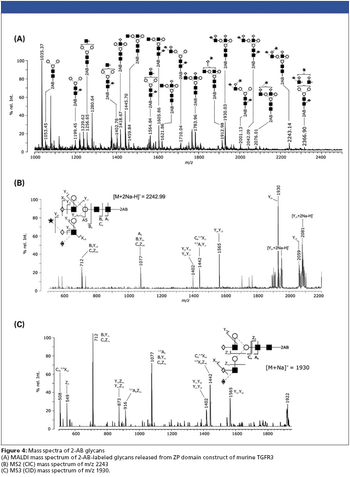
Site-specific analysis of protein glycosylation has become a very important issue in pharmaceutical/biotech industries, requiring specific analytical tools and methodologies.
The Application Notebook
Glycosylation is one of the most common forms of post-translational modification of eukaryotic proteins. Glycosylated proteins (glycoproteins) make up the majority of human proteins.

The Column
The separation of polar and hydrophilic compounds can be a challenge. Hydrophilic interaction liquid chromatography has proven to be a solid alternative for such applications.

E-Separation Solutions
The separation of mixtures of polar and hydrophilic compounds can be a significant challenge.
The thorough characterization of glycosylation is a major quality parameter in the production of biotherapeutics. Hydrophilic interaction chromatography (HILIC) is a well-recognized technique that effectively separates and quantifies isolated glycans...

LCGC North America
Experimental data are presented to help understand HPLC column retention in a way that should make column selection and method development proceed faster when initial results with C18 columns are disappointing.

The Application Notebook
The analysis of melamine in milk and other food products became urgent when first the pet food, and later the milk scandal were discovered in the U.S. and China.

The Application Notebook
Separation of polar compounds by conventional reverse phase chromatography can be challenging due to their poor retention. Other HPLC approaches include normal phase chromatography (NPC) and its variation, hydrophilic interaction chromatography (HILIC).
An Empirical Evaluation of HILIC and Monolithic Columns for Supercritical Fluid Chromatography (SFC) Applications - Thar Apps Note

The Application Notebook
Since melamine and its metabolites are extremely polar compounds, they serve as very good candidates for HILIC chromatography. Simultaneous and fast determination and confirmation of melamine and cyanuric acid along with two other compounds using a novel amino bonded phase in HILIC mode coupled with a complete solutions approach is presented.

Special Issues
A structured, general purpose approach to method development for bioanalytical hydrophilic interaction chromatography–tandem mass spectrometry (HILIC–MS-MS) applications is described.
Researchers from Amgen (Thousand Oaks, California) examined the separation mechanism in the analysis of polar and basic hydrazines using hydrophilic interaction liquid chromatography (HILIC) with alcohol rather than acetonitrile as a weak eluent.
John Dolan?s recommendation for Session 1120, ?HILIC- Fundamentals and New Applications,? was presided over by Olujide T. Akinbo of Butler University. The session focused on innovations and breakthroughs in HILIC.
E-Separation Solutions
Melamine is an organic base and a trimer of cyanamide, with a 1,3,5- triazine skeleton.

The Application Notebook
The analysis of anions and cations is critical during drug development and related QC. Measure both the API and the counterion in a single run.

The Application Notebook
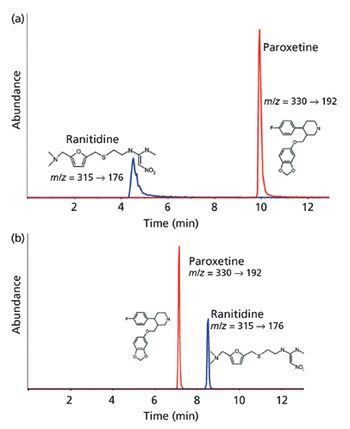
The analysis of polar compounds in support of clinical and preclinical pharmacokinetic studies requires an analytical methodology capable of achieving ultra-low detection and quantification limits. The high sensitivity afforded by coupling HPLC with tandem mass spectrometry (MS-MS) has made it the technique of choice in this environment, but it is subject to the following limitations when reversed phase liquid chromatography (RPLC) is used:
The Column
The differences between retention of polar-ionic compounds on silica hydride-based and hydrophilic interaction liquid chromatography (HILIC) stationary phases are discussed. The retention capabilities of a number of silica hydride columns are reviewed, including their ability to operate in the reversed-phase mode. A means of differentiating between the two types of materials based upon their retenion modes is suggested.
E-Separation Solutions
Phenomenex