




E-Separation Solutions
Click here to view the complete E-Separation Solutions newsletter from March 20, 2014.
E-Separation Solutions
Click here to view the complete E-Separation Solutions newsletter from March 20, 2014.

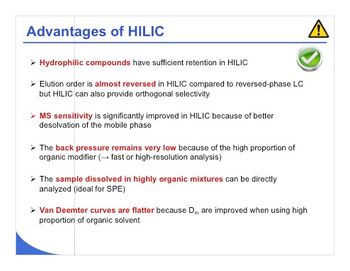
This article, transcribed from an LCGC web seminar presented on January 29, 2013, by Davy Guillarme of the University of Geneva and the University of Lyon, explains how HILIC works and provides keys to using the technique effectively.
A Critical Evaluation of Hydrophilic-Interaction Chromatography (HILIC)

LCGC North America
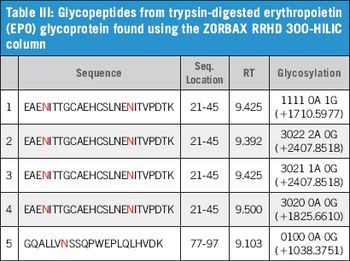
The modern usage and specific applications of HILIC for two other major classes of analytes - glycopeptides and glycoproteins - are discussed.
LCGC North America
Answers to common questions about HILIC, and an overview of its application to biopharmaceutical analysis.
Special Issues
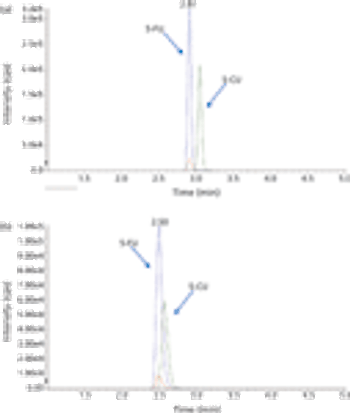
5-Fluorouracil (5-FU) is a low-molecular-weight anticancer drug in clinical use for several solid tumors in humans. Currently, the most widely used methodology for 5-FU quantitation is liquid chromatography–tandem mass spectrometry (LC–MS-MS) with either liquid–liquid extraction (LLE), protein precipitation, or a combination of both as sample cleanup procedures.
The Column
The rising interest in HILIC can be demonstrated by the growing number of publications and applications over the last 10 years. Applications range from food and nutrition, to cosmetics, pharmaceuticals, and bioanalysis.
The Application Notebook
EMD Millipore
The Application Notebook
Agilent Technologies Inc.
LCGC Europe eNews
Davy Guillarme discussed the possibilities and limitations of HILIC in a recent web seminar. Here, he answers common questions about the method.
LCGC Europe eNews
Click here to view the full European E-newsletter from 15 August.
The Application Notebook
Agilent Technologies, Inc
LCGC North America
Davy Guillarme discussed the possibilities and limitations of HILIC in a recent web seminar. Here, he answers common questions about the method.
E-Separation Solutions
Click here to view the complete E-Separation Solutions newsletter from May 23, 2013.

Special Issues
Hydrophilic interaction liquid chromatography (HILIC) has recently become more important, particularly for the analysis of polar drugs, metabolites and biologically relevant compounds in glycomics, proteomics, metabolomics and clinical analysis. HILIC makes it possible to increase the retention of polar compounds, achieve orthogonal selectivity and increase mass spectrometry (MS) sensitivity, compared with reversed-phase liquid chromatography. This article discusses the advantages and limitations of HILIC in a variety of practical applications in the pharmaceutical industry.
LCGC Europe
The aim of this work was to find the optimal conditions to achieve sufficient limits of detection (LOD) that would permit the detection of neurotransmitters by LC–MS–MS in biological samples. An optimized HILIC–ESI–MS–MS system for the analysis of the 12 selected compounds was proposed.
E-Separation Solutions
The Technical Department at Crawford Scientific are regularly asked for analytical conditions or applications in the hydrophilic interaction liquid chromatography (HILIC) mode. Here?s a short primer on what you need to understand about this separation mode from a practical perspective, using some of the questions that we regularly get asked.
The Column
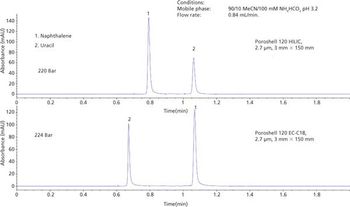
Reversed-phase HPLC analysis of histamine has been a challenge in the past due to the high polarity and poor retention. HILIC (hydrophilic interaction chromatography) offers a potential solution because of high polar analyte retention without the need of strong ion-pair reagents, which are not compatible with mass spectrometry (MS) detection and can cause signal suppression.
The Application Notebook
Agilent Technologies

LCGC Europe eNews
Hydrophilic interaction chromatography (HILIC) is an alternative separation technique for highly polar analytes that are weakly retained in reversed-phase high performance liquid chromatography (HPLC). Participants in this HILIC Technology Forum are William Long of Agilent Technologies, Phil Koerner and Carl Sanchez of Phenomenex, and Nicole M. Cotta of Waters Corporation.
E-Separation Solutions
Click here to view the complete E-Separation Solutions newsletter from November 20, 2012.
E-Separation Solutions
Hydrophilic interaction chromatography (HILIC) is an alternative separation technique for highly polar analytes that are weakly retained in reversed-phase high performance liquid chromatography (HPLC). Participants in this HILIC Technology Forum are William Long of Agilent Technologies, Phil Koerner and Carl Sanchez of Phenomenex, and Nicole M. Cotta of Waters Corp.
Special Issues
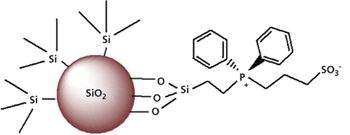
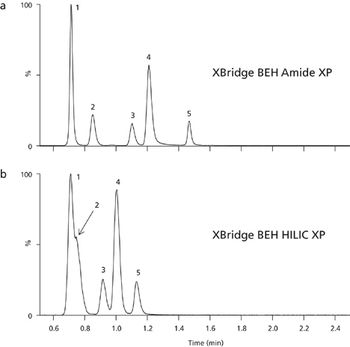
Some of the newer hydrophilic interaction liquid chromatography (HILIC) columns are reviewed, and experiments performed to categorize columns for optimized performance.

The Column
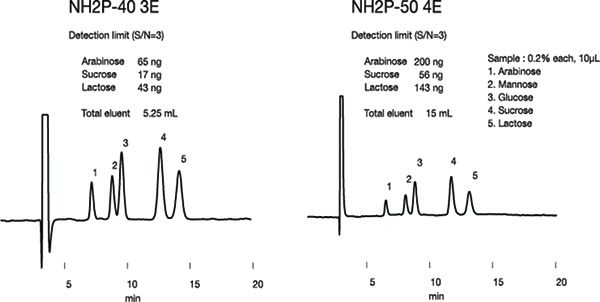
A comparison of polymer- and silica-based stationary phases used in hydrophilic interaction chromatography (HILIC) for saccharide analysis.
The Application Notebook
Waters Corporation