





Slides to accompany the vidcast interview from Pittcon 2011 with Luigi Mondello, Professor, Analytical Chemistry, School of Pharmacy, University of Messina
Slides to accompany the vidcast interview from Pittcon 2011 with Luigi Mondello, Professor, Analytical Chemistry, School of Pharmacy, University of Messina
E-Separation Solutions
Slides to accompany the vidcast interview from Pittcon 2011 with Luigi Mondello, Professor, Analytical Chemistry, School of Pharmacy, University of Messina

Luigi Mondello, University of Messina
The Application Notebook
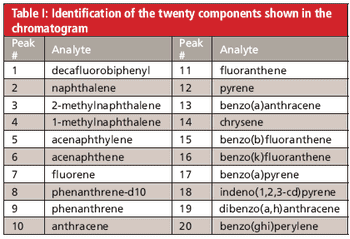
The QuEChERS method of food sample preparation was used in conjunction with comprehensive two-dimensional gas chromatography time-of-flight mass spectrometry (GCxGC–TOFMS) to successfully identify PAH contaminants spiked in liquid commercial infant formula.
The Application Notebook
LECO Application Note

The Column
In this study, comprehensive 2D gas chromatography-mass spectrometry with electron impact and chemical ionization was used to characterize silylated fatty alcohol alkoxylates.

LCGC Europe
Exploring the use of GCxGC-FID as a technique for qualitative and quantitative analysis of perfumes
The Column
The GC×GC-7 symposium ran concurrently with this year?s ISCC in Riva del Garda, Italy. Speaking with The Column, Philip Marriott of the Australian Centre for Research on Separation Science, RMIT, Melbourne, Australia, said it ?offered the most comprehensive and thorough GCxGC programme yet assembled.?

The Application Notebook
Comprehensive two dimensional gas chromatography–mass spectrometry is a powerful method to identify target analytes in complex matrices. An example is shown of identification of pesticides in citrus oil.

The Column
Coelutions using one dimensional chromatography are often observed in flavour and fragrance analysis.
Special Issues
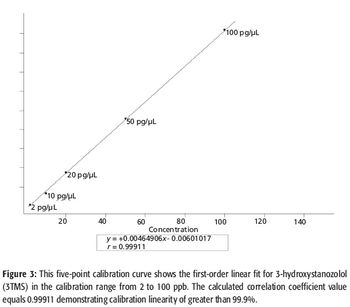
The misuse of androgenic anabolic steroids in sports was banned in 1976 by the International Olympic Committee and global sports community. The illegal use of anabolic steroids has reached disturbing levels worldwide. This worldwide problem is fueled partially by an ever-increasing demand for better athletic performance. The World Anti-Doping Agency has formulated strict guidelines for minimum allowable concentrations of exogenous anabolic steroids and their metabolites. The standard test methods for doping control are analyzed in urine samples with trimethyl-silyl derivatization. Urine is a complex and difficult biological matrix. This research shows the advantages of using comprehensive two-dimensional gas chromatography–time-of-flight-mass spectrometry (GCÃ-GC–TOF-MS) and illustrates the capability of GCÃ-GC-TOF-MS to be an effective instrumental option for antidoping control screening.

LCGC Europe
In this article, the combination of SPME with GCxGC and GCxGC–TOF-MS is discussed using mixtures of solvents as example analytes

Retention Times of 209 PCB Congeners Using GCxGC-TOFMS - LECO apps note
LCGC Europe
Demonstrating the suitability of a new wax stationary phase for GCxGC analysis of essential oils

Design of a FID/MS Splitting for MS Detection in The First and Second Dimension of a Multidimensional GC–MS System
E-Separation Solutions
Why is thermal modulation more widely discussed than flow modulation in comprehensive multidimensional gas chromatography?

LCGC Europe
This article discusses the unique properties of ILs and their potential impact as GC stationary phases.

The Application Notebook
Smokeless tobacco can contain thousands of analytes, making it an extremely difficult matrix for identification of pesticide residues.

LCGC North America
Guest columnists explore how ionic liquids can be tweaked to mimic the popular stationary phases of today.
Non-Derivatized Drugs in Urine by Automated SPME GCxGC-TOFMS-LECO Application Note
The Application Notebook
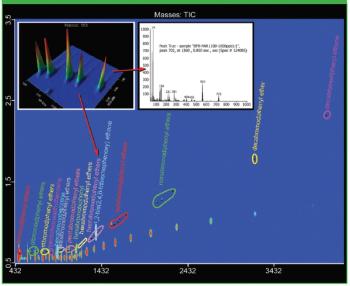
Polybrominated diphenyl ethers (PBDE) are persistent environmental contaminants that are being extensively studied by environmental researchers worldwide. Their potential for toxicological impacts on humans and wildlife has made them a focal point of regulatory agencies. Their widespread use as flame retardants in electronics, household furniture, and many other building materials has lead to a need for analysis of many different sample matrices, including very complex environmental samples.
LCGC Europe
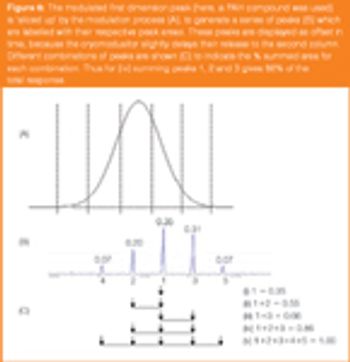
The interpretation of comprehensive two-dimensional gas chromatography (GCÃ-GC) based on the modulation ratio (MR) concept encompasses method implementation, ideas on quantitative measurement and how modulation phase affects GCÃ-GC.
E-Separation Solutions
We spoke to Marco Koenen and Ed Ledford of Zoex about the rising popularity of multidimenional gas chromatography.

LCGC Europe
Differential flow modulation is an inexpensive way to perform GCÃ-GC separations which has been attracting growing attention recently. Differential flow modulation uses high carrier gas flow rates in the second dimension column so it is widely thought that this rules out direct coupling with mass spectrometry. However direct coupled GCÃ-GC-QPMS using differential flow modulation is reported here for the first time using an unmodified mass spectrometer comprising a dual inlet turbomolecular pump and fast scanning quadrupole mass analyser. The suitability of the approach for characterization of essential oils is demonstrated.