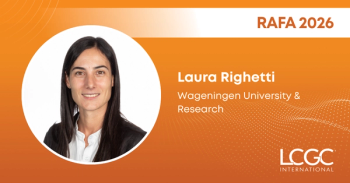
Laura Righetti explains why quantification, not instrumentation, still keeps mass spectrometry imaging (MSI) out of routine food safety testing.
Antonio Ferracane discusses moving to minimal sample preparation for PAH analysis, and why matrix-matched calibration can replace cleanup steps.
In this interview from the recent ASMS conference, Antonio Ferracane, a tenure-track researcher at the University of Messina, Italy, discussed the work done by the Chromaleont and the Messina Institute of Technology research groups, together with Dr. Alessia Arena, Prof. Mariosimone Zoccali, Prof. Peter Tranchida, under the direction of Prof. Luigi Mondello, on trace analysis of polycyclic aromatic hydrocarbons, or PAHs, in food and environmental samples.1 PAHs are persistent pollutants formed mainly through incomplete combustion of fuel, wood, and organic matter, and are of concern for their carcinogenic and mutagenic properties.
In this interview clip, Ferracane discusses:
The team combined two complementary techniques. The first, cryogenic zone compression, is a chromatographic approach that compresses the eluting GC peak, narrowing it from roughly six seconds to one or two seconds. This increases signal intensity by an average of around 15-fold and improves signal-to-noise ratio. The second, a pseudo multiple reaction monitoring mode, addresses the fact that PAHs' multi-ring structures resist fragmentation under conventional high-energy conditions. Instead, the same ion is monitored in the first and third quadrupoles, while very low collision energy in the second quadrupole strips away interference from co-eluting isobaric compounds rather than fragmenting the target ion.
The conversation also covers the lab's shift toward minimal sample preparation. For matrices such as extra virgin olive oil, PAHs are extracted directly with acetonitrile and analyzed without a cleanup step, with matrix-matched calibration compensating for matrix effects. Ferracane explains that every additional preparation step introduces potential error and can cause loss of target analytes through adsorption onto cleanup materials, so omitting cleanup can improve recovery, accuracy, and precision while reducing solvent use and improving the method's environmental footprint. Cleanup, he notes, is not mandatory under official methods provided validation in real matrices demonstrates reliable performance.
Looking ahead, Ferracane identifies the main remaining challenges as expanding the limited list of PAHs currently regulated in EU food legislation, where only a handful carry defined limits, and persuading regulators to adopt simpler, higher-throughput methods for monitoring food, air, and fuel-related pollutants.
For all parts of Ferracane’s interview, please click the links below: