


News|Videos|October 8, 2026
Where GLP-1 Peptides Go Missing: Protecting Recovery From Vial to Column
Advertisement
Episodes in this series


This segment shifts from separation strategy to a more practical concern: how sample handling and instrument hardware choices can silently distort peptide analysis results. Sam Whitmarsh asks Nitish Sharma how his lab optimizes chromatographic systems and sample handling to ensure that observed peaks reflect the true sample rather than artifacts introduced by a suboptimal setup. Sharma ties the mobile-phase pH selection back to the peptide's pI value, and explains the role of the high performance liquid chromatography (HPLC) index—a measure of hydrophobicity—in determining how much organic solvent is needed in both the mobile phase and diluent. Because GLP-1 analogs carry long carbon chains that add hydrophobicity to the peptide backbone, getting this ratio right is essential for sharp, well-separated peaks. He also recommends wide-pore, 300-angstrom columns for better stationary-phase interaction and retention.
Sharma raises a less obvious risk: peptide loss to plastic and glass surfaces during handling, since many peptides are zwitterionic and prone to nonspecific adsorption onto tubing, vials, and even plastic-lined tubes. His practical fix is to use appropriate ionic buffers in the diluent—such as dilute sodium chloride or acetate—and, where possible, to mimic the peptide's own formulation buffer, since it has typically already been optimized by formulators to stabilize the molecule.
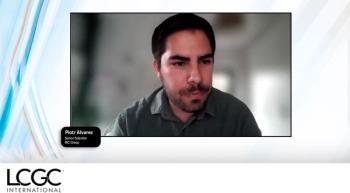
Piotr Alvarez adds a hardware-focused perspective, describing a head-to-head comparison his team ran between inert and non-inert column housings for a GLP-1 hydrophilic interaction liquid chromatography (HILIC) method. The non-inert hardware showed substantially lower recovery, a finding with real consequences, Alvarez notes, since if recovery loss is visible at the active pharmaceutical ingredient (API) level, smaller impurity peaks could be masked or missed entirely. He also flags that peptides tend to degrade on-column at elevated temperatures, meaning method developers must balance column temperature against mobile-phase pH, and separately verify whether that degradation risk changes with inert vs. standard hardware.
Advertisement
Related to this article
Piotr Alvarez explains how his lab uses 2D-LC to enable MS compatibility with legacy methods and to confirm peak purity through orthogonal separation.

How can analysts resolve impurities that differ by a single mass unit? Experts discuss deamidation, racemization, HRMS, and 2D-LC for GLP-1 peptides.
The panel walks through confirming peptide identity–from HRMS and LC–MS/MS sequencing to amino acid analysis and D/L-isomer verification.

Tony Edge explains how SPE optimization improves oligonucleotide LC–MS data.
Nitish Sharma and Piotr Alvarez compare reversed-phase separations of small molecules vs. peptides, from pI value and hydrophobicity to impurity profiles.
Meet the expert panel exploring the challenges involved in GLP-1 analysis in this LCGC International Peer Exchange®.

The 2026 Gulf Coast Conference (GCC) will be held at the Moody Gardens Convention Center in Galveston, Texas, from October 12–15.
Henri B. Kagan and Kenso Soai win 2026 Nobel Prize in Chemistry for explaining molecular handedness
Advertisement
Advertisement
Trending on LCGC International
1
Automated GC-MS/MS Method Tackles Oil Phthalates
2
2D-LC and Orthogonal Separation in Practice for GLP-1 Analysis
3
Highlights from the 55th International Symposium on High-Performance Liquid Phase Separations and Related Techniques (HPLC 2026)
4
Challenges and Solutions in Oligonucleotide Analysis, Part V: Troubles with Phosphorothioate Oligonucleotides
5