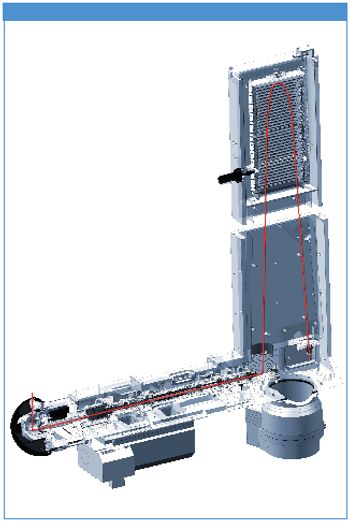
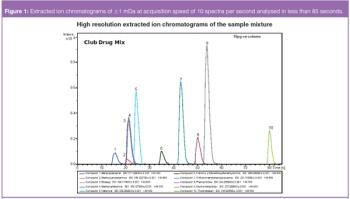
In the pharmaceutical industry the increased efficiency brought about by new fast chromatography methods needs to be matched by commensurate mass spec capabilities. maXis UHR-TOF is the instrument of choice to keep up with fastest chromatography.

In the pharmaceutical industry the increased efficiency brought about by new fast chromatography methods needs to be matched by commensurate mass spec capabilities. maXis UHR-TOF is the instrument of choice to keep up with fastest chromatography.

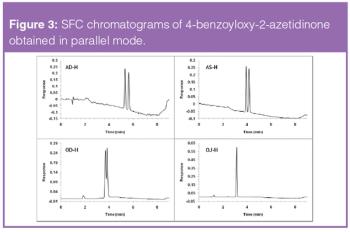
According to the FDA policy statement, developing stereoisomeric drugs, each enantiomer should be evaluated.1 As a result, the pharmaceutical industry has escalated its emphasis on the generation of enantiomerically pure compounds before undertaking pharmacokinetic, metabolic, physiological and toxicological evaluations.2 Chiral chromatography, especially SFC, is the most widely used technique for obtaining mg to multigrams of pure enantiomers in drug discovery. In SFC, a combination of supercritical CO2 and polar organic solvent(s), most commonly alcohol, are used as the mobile phase. Because of the higher diffusivity and lower viscosity of supercritical fluid, SFC often provides a 3–8-fold faster separation than normal-phase HPLC. For chiral purification, SFC also offers significant cost savings by reducing organic solvent usage and removal as well as the time and energy required post-purification. As SFC instrumentation continues to improve, SFC has gradually overtaken HPLC as the first choice..

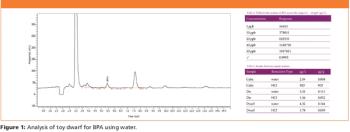
The analysis of Bisphenol A using UCT Enviro-Clean® C18 cartridges and UCT Selectra® Phenyl columns using LC–MS-MS is discussed.

This application note describes a rapid UHPLC method for the separation of Sulforhodamine 101 (Texas Red®) and its three water-soluble derivatives using a column packed with Thermo Scientific Hypersil GOLD™ 1.9 μm particles.

A critical part of research and quality control analysis of proteins involves verifying the primary and secondary structure of a protein.

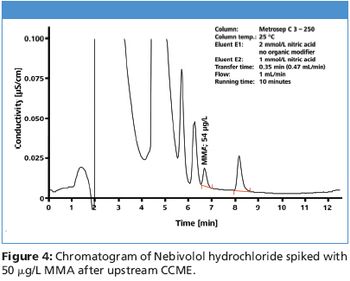
The analytical challenge treated in the present work consists in determining sub-ppb concentrations of low-molecular-weight amines in the presence of strongly retained cationic drugs by using ion chromatography (IC) with upstream inline coupled-column matrix elimination (CCME).

Oils for foods and cooking are derived from oilseeds like canola, soybeans, corn, flax, and cotton.

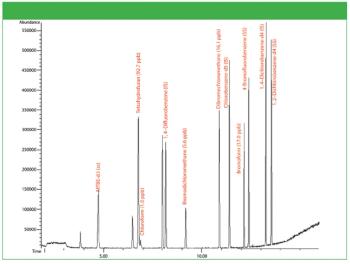
The U.S. EPA Office of Groundwater and Drinking Water released Method 524.3, "Measurement of Purgeable Organic Compounds in Water by Capillary Column Gas Chromatography/Mass Spectrometry, Version 1.0," in the Federal Register on August 3rd, 2009 (1, 2).

BPA or bisphenol A has become well know over the past year as concerns for its effect on human health and well being have been raised. The concerns over BPA in plastics began with baby bottles and spread to include other types of bottles and toys.

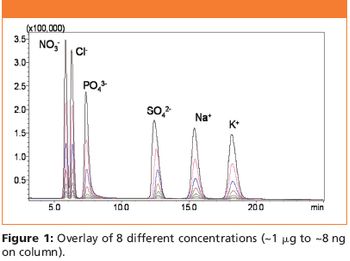
Dedicated instrumentation, multiple columns and time-consuming changeovers are required in order to measure both anions and cations with ion chromatography.

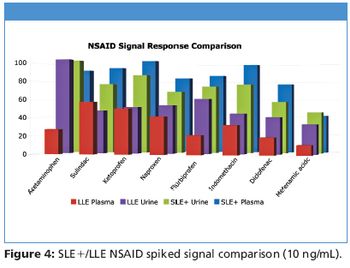
Traditional liquid-liquid extraction (LLE) can provide very clean extract. However, in many cases lower recoveries, labor-intensive liquid handling issues, and difficulty with automation can limit the success of LLE in sample preparation.

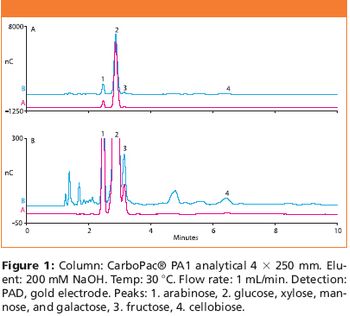
Corn stover is the above-ground portion of the plant minus the kernels and it accounts for a large percentage of the global supply of lignocelluosic biomass available as feedstock for fermentation systems used for biofuel production.

As global interest in alternate fuel sources increases, many laboratories are researching effective ways to test, develop, and produce fuel from renewable energy sources.

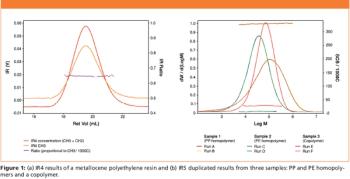
The analysis of the molar mass distribution of polyethylene and polypropylene resins by GPC/SEC has always been considered a demanding task because of the requirement of high temperature operation for dissolution and complex hardware design, which often results in high maintenance cost, in particular related to the autosampler/injector and detector units, and in other problematic and consuming tasks such as solvent handling added to column fragility, sample degradation, or detector sensitivity–stability.

The Epitomizeâ„¢ CSP-1C chiral stationary phase uses cellulose tris-(3,5-dimethylphenylcarbamate) as the chiral receptor and is offered in a variety of particle sizes including 1.7, 3, 5, 10, 20, 50, 100, and 300 microns.

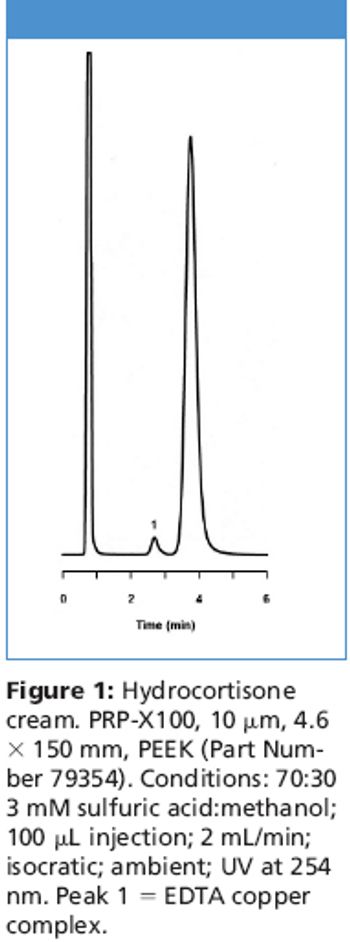
Acidic mobile phases have found widespread applications in the reversed-phase HPLC separation of many important pharmaceutical and environmental compounds.

Pickering Laboratories specializes in the manufacturing of cation-exchange columns and eluants for amino acid analysis.

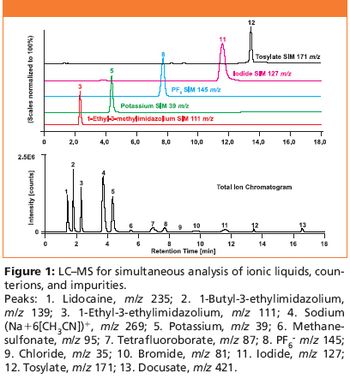
The term ionic liquid refers to organic salts with relatively low melting points (below 100 °C) that usually consist of an organic cation or anion and a counterion, in either organic or inorganic form.

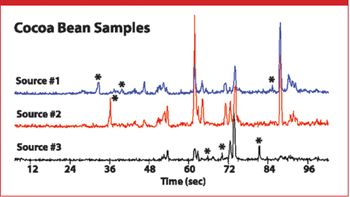
Solid phase microextraction (SPME) was used to generate volatile and semivolatile compound profiles of raw materials used in the production of chocolate products.

In many solution studies of lignin the need to invoke association and aggregation phenomena has become apparent.

Hamilton Company is best known for manufacturing precision fluid measuring products, including syringes for HPLC and GC.

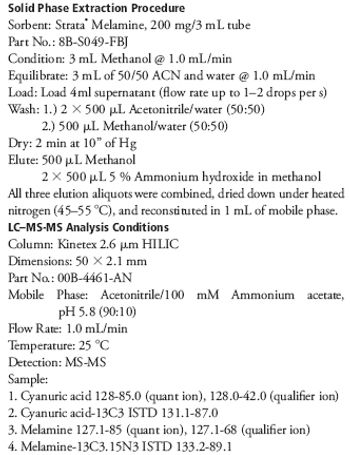
The presence of both melamine and cyanuric acid in concentrations greater than 2 μg/mL results in the crystallization of the two compounds, forming the toxic, water-insoluble melamine cyanurate complex.

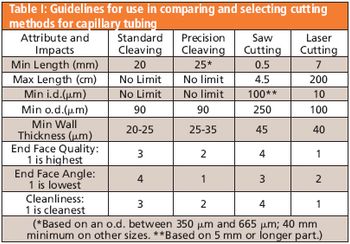
Various techniques exist for cutting capillary tubing. In this note we revisit these methods and provide guidelines for selecting the most appropriate method.

Due to their high toxicity and carcinogenicity, aflatoxins are of major concern for food producers, the food processing industry, and consumers.

In the pharmaceutical industry the increased efficiency brought about by new fast chromatography methods needs to be matched by commensurate mass spec capabilities. maXis UHR-TOF is the instrument of choice to keep up with fastest chromatography.

Smokeless tobacco can contain thousands of analytes, making it an extremely difficult matrix for identification of pesticide residues.

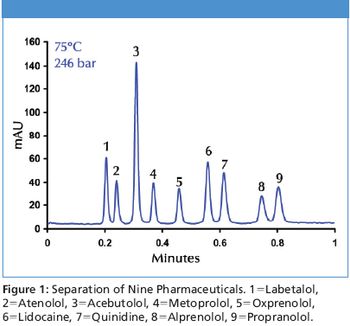
In this application note we examine the effect of temperature on a sub-2 µm zirconia-based phase for the analysis of nine common pharmaceuticals.

This study uses the challenging analysis of a complex, multi-organ peptide digest of Caenorhabditis elegans (C. elegans) to compare the performance of a novel linear ion trap mass spectrometer and a quadrupole time-of-flight (Q-TOF) mass spectrometer.

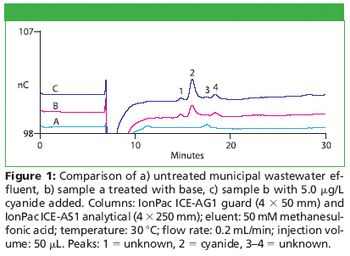
Cyanide, an environmental contaminant, can cause serious health effects including goiters, hypothyroidism, and some neuromuscular diseases.

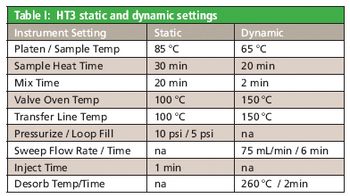
EPA Method 8260 provides for the analysis of volatile organic compounds (VOC) in various solid waste matrices.