Application Notes: Pharmaceuticals

i4-575614-1417780563080.jpg

Paracetamol is a major ingredient in numerous medications due to its analgesic and antipyretic properties. During its synthesis (Figure 1), a total of ten process-related impurities are observed. Several HPLC applications have been developed for the monitoring of these impurities (1, 2), including the European Pharmacopoeia which has adopted an isocratic HPLC method using a silica-based C8 column with 5 μm particle size, requiring a run time of 45 min (3). By using a gradient method and standard HPLC instrumentation, the analysis can be reduced to 7 min (4).

i1-547963-1408670471828.jpg

Pharmaceutical actives and impurities often contain sulfur in the form of a sulfone or sulfoxide group. Both groups have dipole moments, adding a hydrophilic character to compounds containing these functional groups. The analysis of hydrophilic compounds on traditional alkyl columns (e.g. C18) can be problematic, since alkyl columns depend on hydrophobic interactions for retention. Since the sulfone and sulfoxide groups contain π-π bonds, the biphenyl column's ability to undergo π-π interactions makes it an excellent choice when increased retention or selectivity of compounds containing these groups is desired. To demonstrate the selectivity of the biphenyl phase towards aromatic compounds containing sulfur groups, a set of target compounds was selected and analyzed on C18, phenyl, and biphenyl columns.

i4-547965-1408670466668.jpg

Several common birth control formulations contain both drospirenone and ethinyl estradiol. A highly selective and sensitive analytical method for the analysis of drospirenone in human plasma has been developed for use in bioequivalence studies. The solid-phase extraction (SPE) and UPLC®–MS–MS methodologies are described as well as performance against validation parameters.

i4-547972-1408670451415.jpg

The analysis of polar compounds in support of clinical and preclinical pharmacokinetic studies requires an analytical methodology capable of achieving ultra-low detection and quantification limits. The high sensitivity afforded by coupling HPLC with tandem mass spectrometry (MS-MS) has made it the technique of choice in this environment, but it is subject to the following limitations when reversed phase liquid chromatography (RPLC) is used:

i1-547880-1408670608464.jpg

The United States Pharmacopeia (USP) has implemented a revised method for the determination of residual solvents, chapter 467; this revision has brought the methodology of USP 467 into close alignment with European Pharmacopeia (EP) method 2.4.24. The USP and EP determination of class 1 and class 2 residual solvents is performed with static headspace (HS) sample introduction and gas chromatography (GC) with flame ionization detection (FID); class 3 has flexibility in the technique, however, it is often included in the HS analysis.

i1-547879-1416914488847.jpg

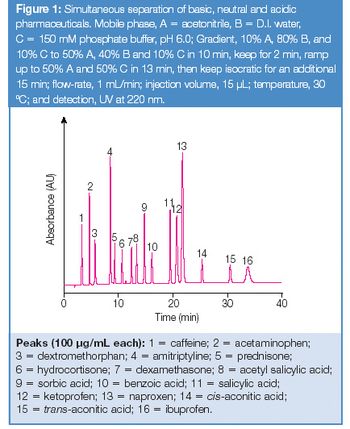
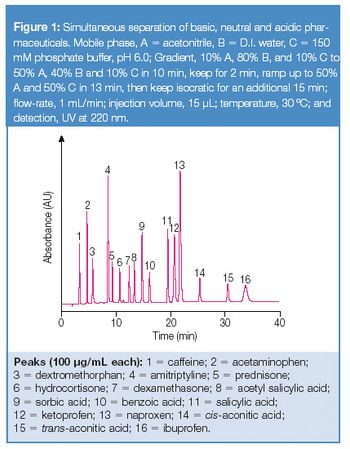
The QC for the pharmaceutical industry is based on methods developed on a variety of columns. At Orochem, we have attempted to address method development utilizing unique chemistries such as the OROSIL C18 to analyze a wide range of acidic, basic, and neutral compounds. Data is presented on a few representative compounds and unique separation criteria with their associated chromatograms.

The tandem use of liquid chromatography and mass spectrometry has become the principal mode of pharmaceutical analysis, especially for high throughput analysis employed in DMPK studies. Rapid analytical data generation is pivotal during these early stages of drug discovery.