Application Notes: Pharmaceuticals

i4-601822-1408649303082.jpg

The new ultrafleXtremeâ„¢ exceeds all current expectations of MALDI-TOF/TOF technology: A proprietary kHz smartbeam-IIâ„¢ MALDI laser integrated with a novel FlashDetectorâ„¢ and re-engineerd electronics makes it the only MALDI-TOF/TOF on the market to provide kHz acquisition in MS and MS-MS modes. It generates a new level of data quality in applications such as LC-MALDI proteomics, high resolution tissue imaging based biomarker discovery or Top-Down Sequencing.
i1-601831-1408649261632.jpg

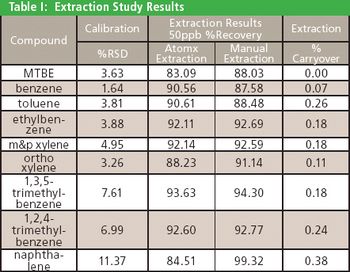
In U.S. EPA Method 5035 there are two collection options for samples containing high levels of volatile organic compounds (VOCs). The first involves collecting a bulk soil sample in the field. In the lab, the bulk soil is dispersed in a water miscible solvent. Next, an aliquot of the solution is added to 5 mL of water and finally, the sample is purged. The second option is to collect a 5 g soil sample and add it to a pre-weighed vial containing a prescribed amount of water miscible solvent. An aliquot is then purged. Both of these processes are time consuming and have the potential to introduce human error both in the field and in the laboratory.

i1_t-601848-1408649188224.gif

Polynuclear aromatic hydrocarbons (PAHs) are carcinogenic condensed ring aromatic compounds widely found as trace pollutants in waters, wastes, air particulates, soil, and foods. PAHs can be monitored routinely using HPLC with a combination of UV and fluorescence detection as prescribed in EPA methods 550.1, 610, and 8310. Conventional HPLC analysis of 19 PAHs typically requires 20 min and uses 25 mL of acetonitrile. However, there is a continual drive to improve productivity and reduce solvent consumption and waste in chemical analysis. Using ultra high pressure LC (UHPLC) with sub-2 μm particle-size columns, we demonstrate a 3-fold improvement in throughput and a 90% reduction of mobile phase solvent in the determination of 19 PAHs.

i1-601845-1408649197535.jpg

Iodine is an essential nutrient in seawater, seafood, and iodine-enriched foods, such as iodized table salt. The most common forms of iodine in the diet are iodide and iodate, with additional iodo-organic compounds providing a small fraction of the bio-available iodine. Iodine deficiency affects thyroid hormone production and leads to developmental diseases, goiter, and paralysis (1).

i4-601843-1408649201648.jpg

Morphine is an effective pain-relieving drug that is primarily metabolized into morphine-3-glucuronide (M3G) and morphine-6-glucuronide (M6G). The highly potent M6G may have adverse effects, such as respiratory depression and renal failure, if accumulated in the body. As morphine abuse continues to affect modern society, an effective method must be established to analyse morphine and its structurally related compounds in biological fluid samples. In this work, a UPLC–MS-MS method was developed to separate six morphine-related compounds on a 2.1 Ã- 100 mm, 1.8 μm ACQUITY UPLC HSS T3 column in a single run using an ACQUITY UPLC system connected to a fast-scanning triple-quadrupole MS detector (TQD). The method achieved adequate retention of these very polar compounds by reversed-phase (RP) chromatography in an 8-min total run time.

i1-601826-1408649284581.jpg

Over the past 15 years, little has changed for the commercial environmental laboratory's ability to automate U.S. EPA Method 8260 for water and soil purge and trap analysis. As work loads have increased, reporting levels have decreased due to MS sensitivity improvements. However, it has become increasingly difficult for laboratories to run at high levels of productivity due to autosampler reliability, carryover, and internal standard reproducibility challenges. Each of these issues has been addressed in a new Centurion WS autosampler (see Figure 1) designed specifically for the commercial environmental laboratory.

i1-601850-1408649183726.jpg

Since the introduction of high-performance liquid chromatography (HPLC) nearly 40 years ago, many improvements have been made to column stationary phases to achieve faster, more efficient separations. HPLC columns containing superficially porous (sometimes called fused-core) particles have recently gained increasing attention. Though this technology is not entirely new, it has been improved to the point where rapid, highly efficient separations can be achieved for some applications.

i1-601838-1417780039021.jpg

Illegal drug use worldwide is at an all time high. Forensic laboratories are seeing increased sample loads creating an immediate need for fast and accurate analysis to positively identify confiscated materials in criminal investigations. This application highlights the value of gas chromatography with time-of-flight mass spectrometry (GC-TOFMS) for drug testing in forensic laboratories. A method was developed to successfully identify twenty drugs of abuse in 4.5 min. This GC-TOFMS method shows good chromatographic peak shape for even the most challenging drug analytes; even the peak shapes for amphetamine and methamphetamine were exceptional considering they were analyzed underivatized. The total ion chromatogram (TIC) for the twenty drug analytes is shown in Figure 1.

i1-601828-1408649273246.jpg

Synthetic fused silica capillary tubing is a vital component in many scientific techniques. The general perception is that most laboratory glass products are fragile and easy to break. The opposite is true of fused silica capillary; with its protective coating it is both strong and durable when handled properly.

i1-601851-1408649181738.jpg

Salt formation is a critical aspect in drug development (1) and HPLC is an important tool for determination of pharmaceutical counterions. Reversed-phase columns often fail to retain very hydrophilic counterions. Ion chromatography (IC) is preferred for selective and sensitive screening of cationic and anionic pharmaceutical counterions (2), usually with multiple runs. Positive and negative counterions can be separated simultaneously using a zwitterionic HILIC column using an evaporative light scattering detector (3). However, the zwitterionic column method has limitations: 1) limited to HILIC mode; 2) ions are retained as salts rather than via ion-exchange, making method development difficult; and 3) the method is not suitable for simultaneous separation of acidic, basic, and neutral analytes.

i1-601824-1408649288770.jpg

D-Mannose-6-phosphate (M-6-P) is a terminal monosaccharide of some asparagine-linked (N-linked) oligosaccharides and is also part of an important intermediate in N-linked oligosaccharide biosynthesis. Some lysosomal glycoproteins require M-6-P terminated oligosaccharides for proper targeting and function. Lack of M-6-P or genetic defects in its synthesis or subsequent processing can result in a variety of diseases.

i1-601823-1408649293659.jpg

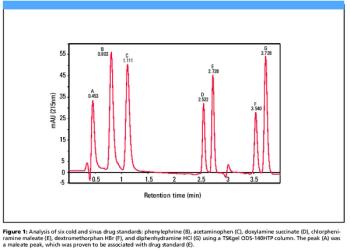
Since the USA Patriot Act* has been enacted, many pharmaceutical companies have reformulated their over the counter (OTC) drug products with phenylephrine (a nasal decongestant) as a substitute for pseudoephedrine. Phenylephrine comes as a tablet, a liquid, or a dissolving strip to take orally - all as a treatment for cold symptoms (1). Besides phenylephrine, most pharmaceutical formulations for common cold and sinus medications often contain multiple active ingredients to treat different types of symptoms in addition to numerous excipients. From an analytical perspective, the challenge is to develop chromatographic conditions that allow quantitative analysis of a variety of excipients that vary widely in hydrophobic properties.

i2-581402-1408660976586.gif

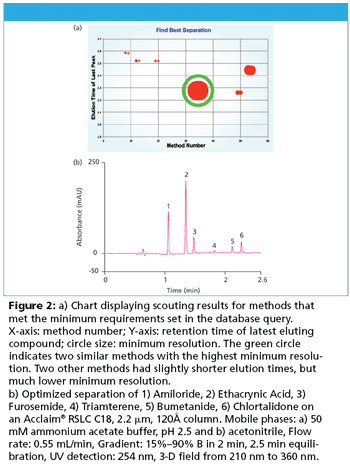
In HPLC method development, screening of various para-meters such as stationary phase, eluents, and temperatures is conducted to find optimal resolution. However, method development can be a time consuming and inefficient process. UHPLC technology can be applied to significantly shorten both the analysis and development times. Here we describe an integrated and ultrafast automated method scouting solution that provides fast and efficient method development processes.

i2-581401-1408660980260.gif

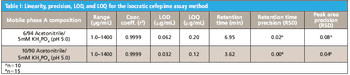
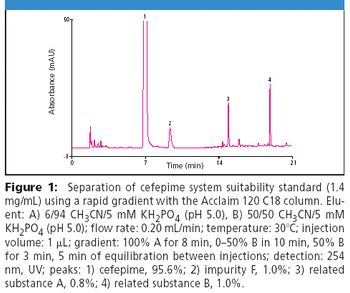
Development of cephalosporin antibiotics has led to compounds with a broad spectrum of activity against both Gram-positive and Gram-negative bacteria with low toxicity profiles. Cefepime, a fourth-generation cephalosporin, is a commonly prescribed broad spectrum antibiotic with improved activity against Gram-negative bacteria compared to other commercially available cephalosporins (1). Despite extensive research on this class of drugs, quantitative analysis and purity assays remain problematic (2).

i2-581403-1408660972772.gif

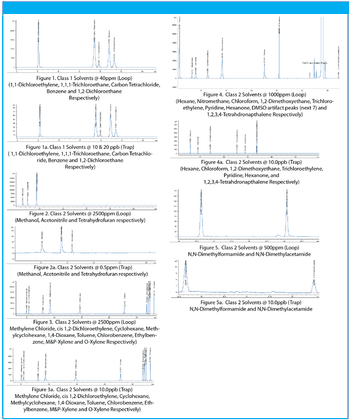
Residual solvents in pharmaceuticals are defined as volatile organic chemicals that are used or produced in the manufacture of drug substances, excipients or in the preparation of drug products. Because residual solvents do not provide therapeutic benefits, they should be removed, to the extent possible. Drug products should contain no higher levels of residual solvents than can be supported by safety data. Looking forward to the implementation of a revised USP <467> method, Teledyne Tekmar evaluated the new protocol, therefore this application will comply with the procedure and criteria changes set forth in the USP30 NF25, Second Supplement (effective December 1, 2007) and the interim revision announcement. (1)

i3-581404-1408660968902.gif

Heparin Characterization

Heparin is well-known as an anti-coagulant, antithrombotic drug. Chemically, it is a linear polysaccharide that is derived from animal tissues. For some time it has been known that heparin is not a homogeneous substance; rather, it is a heterogeneous mixture of molecules ranging in molar mass from less than 5,000 to more than 30,000 Daltons. Heparin can be chemically or enzymatically depolymerized to obtain low molecular weight (LMW) heparin products, which exhibit an improved pharmacological profile.

i2-581400-1408660982614.gif

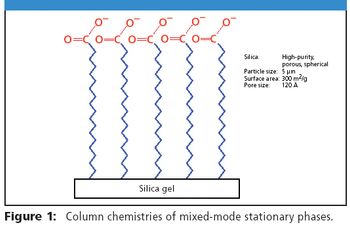
Sample preparation is an essential technique to remove unwanted matrix components prior to LC–MS-MS analysis of drugs in biological fluids. Plasma matrix components whether endogenous (salts, proteins, and phospholipids) or exogenous (dosing vehicles, e.g. PEG 400), can interfere with compounds of interest leading to regions of ion suppression or enhancement. This can lead to inaccurate quantitation and have adverse effects on sensitivity. Mixed-mode SPE provides cleaner extracts as a result of rigorous interference wash steps, afforded by the dual retention mechanism of the sorbents.

The success of evaporative light scattering detection relies on evaporating the eluent without destroying the analyte particle. Where the analyte is non-volatile, evaporator temperatures of 50-100 °C can be used without compound degradation, thus giving maximum sensitivity. However, when compounds have high vapor pressures and the eluent has a high boiling point (e.g. water), detection of semi-volatile compounds is problematic, because the evaporation temperature needs to be set at 30 °C or above in order to evaporate the solvent.

i1-575612-1408667185836.jpg

The separation and quantitation of drug substances and counterions are two important determinations in the pharmaceutical industry (1). Drug substances and counterions are determined by HPLC (often on reversed-phase columns) and by ion chromatography (IC), respectively. IC is the preferred method for selective and sensitive screening of both cationic and anionic pharmaceutical counterions (2). To increase the analysis throughput, it is desirable that for analysis of drug formulation both drug substance and counterions can be determined within a single run. Naproxen is a non-steroidal anti-inflammatory drug commonly used for treating moderate to severe pain, fever, inflammation, and stiffness. Naproxen sodium was approved by the U.S. Food and Drug Administration (FDA) as an over-the-counter drug. No reports were found describing one technique for the simultaneous determinations of both naproxen and the counterion (Na+).

i1-575609-1408667193558.jpg

Sample preparation is an essential technique to remove unwanted matrix components prior to LC–MS-MS analysis of drugs in biological fluids. Plasma matrix components whether endogenous (salts, proteins, and phospholipids) or exogenous (dosing vehicles, e.g. PEG 400), can interfere with compounds of interest leading to regions of ion suppression or enhancement. This can lead to inaccurate quantitation and have adverse effects on sensitivity. Mixed-mode SPE provides cleaner extracts as a result of rigorous interference wash steps, afforded by the dual retention mechanism of the sorbents.

i1-575611-1408667188103.jpg

Cephalosporins contain a four-member β-lactam ring that is inherently strained and prone to hydrolysis and photolysis, limiting stability and leading to degradation products that may be toxic (1). In addition, synthetic byproducts are generated and persist during production of these antibiotics including cefepime. Analysis of cefepime purity is particularly challenging due to the presence of such isomeric synthetic impurities. The Acclaim® 120 C18, 3 μm can be used to meet and exceed the criteria set by the USP for determining related substances and assaying the purity of cefepime.

i4-575617-1408667172824.jpg

In the past decade, supercritical fluid chromatography (SFC) has experienced a striking resurgence and exponential growth in acceptance, particularly in pharmaceutical and chemical laboratories. In SFC, "supercritical" CO2, in combination with one or more polar organic solvents, most commonly alcohols, are used as mobile phase. The polarity of CO2 is similar to that of hexane, and thereby making SFC a normal phase chromatographic technique. SFC has readily lent itself as an attractive complement to reversed phase HPLC (RPLC). For instance, in separating polar compounds that have little retention, and/or selectivity, even with special polar group embedded columns, SFC holds a unique advantage over RPLC due to its normal phase separation mechanism.

i1-575610-1408667190495.jpg

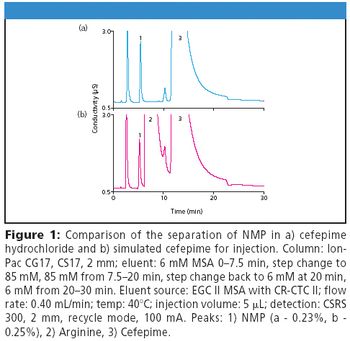
Cefepime is a fourth generation cephalosporin (1). During preparation and storage, cefepime degrades by release of the N-methylpyrrolidine (NMP) side chain and opening of the beta-lactam ring. An NMP concentration increase will directly affect the potency of the active component of the drug. Therefore, it is critical to determine the amount of NMP in cefepime. The US Pharmacopeia (USP) monograph specifies the limit of NMP to <0.3% in cefepime hydrochloride and <1% in cefepime for injection (2,3). The latter is a dry mixture of cefepime hydrochloride and L-arginine. The current USP method uses cation-exchange chromatography with non-suppressed conductivity detection to determine the limit of NMP in cefepime. There are several disadvantages to this method, such as the ~3-4 h time required per injection, a lack of retention time stability for NMP in standard and sample solutions, and a lack of sensitivity. In this paper, we describe an improved method using a hydrophilic, carboxylate-functionalized cation..