


Andrew Anderson, VP of innovation and informatics strategy at ACD/Labs, explores the interplay between human expertise and AI capabilities.

Kate Jones is the Associate Editorial Director at LCGC International/The Column, MJH Life Sciences.
Andrew Anderson, VP of innovation and informatics strategy at ACD/Labs, explores the interplay between human expertise and AI capabilities.

In the fourth part of this roundtable discussion focused on the experiences, challenges, and contributions of women in chromatography, LCGC International spoke to Susanne Boye, Daniela Held, and Claudia Zielke about how best to navigate challenges in chromatography.

Anderson details how ACD/Labs ensures that data are AI-ready and FAIR-compliant across diverse systems common in pharma R&D.
In the third part of this roundtable discussion focused on the experiences, challenges, and contributions of women in chromatography, LCGC International spoke to Susanne Boye, Daniela Held, and Claudia Zielke about how to position yourself for leadership.

In the second part of this roundtable discussion focused on the experiences, challenges, and contributions of women in chromatography, LCGC International spoke to Susanne Boye, Daniela Held, and Claudia Zielke about the best strategies to advance your career in chromatography.

A look at the biggest technical barriers preventing full digital integration
In the first part of this roundtable discussion focused on the experiences, challenges, and contributions of women in chromatography, LCGC International spoke to Susanne Boye, Daniela Held, and Claudia Zielke about their route into separation science.
Andrew Anderson, VP of innovation and informatics strategy at ACD/Labs, talks about how the scientific method is being redefined and the role the AI-digital-physical DMTA cycle plays.

Susanne Boye, Daniela Held, and Claudia Zielke focus on the evolving landscape of chromatography, where flexible empathetic leadership and AI-driven techniques redefine laboratory culture and analytical science.

Susanne Boye, Daniela Held, and Claudia Zielke share their insights on career growth, overcoming challenges, and building supportive networks in STEM fields.

Chip Cody discusses his work in mass spectrometry, including DART ion source innovations and insights on chromatography integration.
To mark Restek’s 40th anniversary, LCGC spoke with Bill Arrowsmith, the company’s head coach and president, about how employee ownership shapes Restek’s culture, drives innovation, and supports its global growth in a rapidly evolving analytical landscape.

Discover how women in chromatography are breaking barriers, fostering community, and inspiring the next generation in STEM through mentorship and courage.
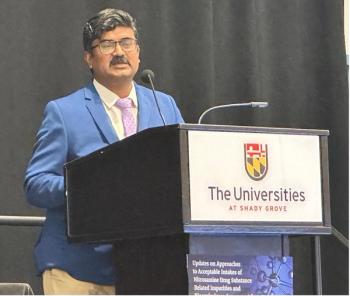
Explore the complexities of GLP-1 impurity detection using HPLC/UHPLC and innovative strategies to enhance analysis and regulatory compliance.
Giulia Mazzoccanti spoke to LCGC International about the development and application of electrostatic repulsion-reversed phase (ERRP) chromatography for peptide separations.

Static and dynamic electrostatic repulsion-reversed phase (ERRP) has been compared for the separation of peptide impurities.
This episode of Behind the Peaks focuses on the importance of sound statistical practices in chromatographic analysis.
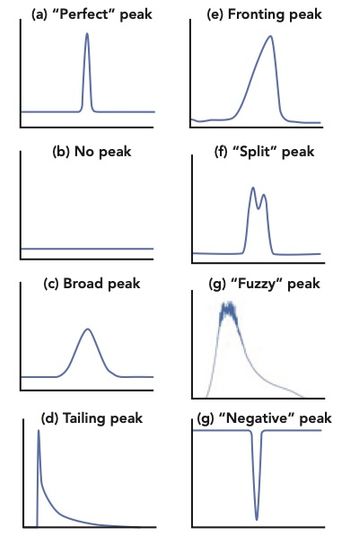
Master LC troubleshooting techniques to optimize your analysis and resolve issues with confidence.

How does liquid chromatography (LC) assist in forensic analysis?

The role of gas chromatography (GC) in forensic analysis is spotlighted.

We explore a core analytical question that every chromatographer faces: How many injections are really enough to achieve both scientific reliability and practical efficiency?

A look at recent advances in pesticide residue analysis across diverse food matrices.

ACD/Labs and Covestro have launched an AI-powered solvent selection tool within the Percepta platform, giving chemists a new data-driven option to reduce environmental impact.
The development of a high-throughput LC–MS/MS method for quantifying 135 pesticides with improved accuracy and robustness is discussed.

A recent study details the development of an LC–MS/MS method for detecting pesticide residues in a challenging matrix, chili powder.

Achieving lasting gender equity in chromatography demands systemic reform, from rethinking promotion criteria and tackling bias in publishing to creating flexible career pathways that retain talent. With the active support of allies and institutions, these changes can build a stronger, fairer, and more innovative scientific community.

Artificial intelligence and machine learning have the potential to reshape the scientific landscape. Yet, as the International Women in Chromatography founders stress, these advances must be grounded in uncompromising data quality and rigorous quality control to ensure reliable, transformative science.

The founders of the International Women in Chromatography group share their diverse career paths, the challenges of balancing motherhood with scientific work, and the systemic barriers women face in advancing within the field.
The International Women in Chromatography group was founded to combat gender disparity in the field, creating a supportive global community that fosters belonging, advocacy, and recognition for women at all career stages. LCGC International spoke with the founders to find out more about the initiative.

In the final part of this roundtable discussion focused on the experiences, challenges, and contributions of Women in Chromatography, Noor Abdulhussain, Lotte Schreuders, and Mimi den Uijl—co-founders of the Sisters in Science initiative—look to the future.