Tony Taylor

Tony Taylor

Tony Taylor is Group Technical Director of Crawford Scientific Group and CHROMacademy. His background is in pharmaceutical R&D and polymer chemistry, but he has spent the past 20 years in training and consulting, working with Crawford Scientific Group clients to ensure they attain the very best analytical science possible. He has trained and consulted with thousands of analytical chemists globally and is passionate about professional development in separation science, developing CHROMacademy as a means to provide high-quality online education to analytical chemists. His current research interests include HPLC column selectivity codification, advanced automated sample preparation, and LC–MS and GC–MS for materials characterization, especially in the field of extractables and leachables analysis.

Articles by Tony Taylor

What if we could make the troubleshooting poster on the laboratory wall come to life? What if we could build an engine which figured out the most likely causes of groups of symptoms and offer these up as a prioritised list for folks to work through and give them supporting information on each problem, why it occurred, how to fix it and, crucially, how to avoid it happening next time?

LCGC4_i3.jpg

Many of us use electron ionization (EI) in gas chromatography–mass spectrometry (GC–MS) without a good understanding of the technique and how we might manipulate the process to give more appropriate results or a better understanding of the analytes under investigation.

There are many aspects of analytical science which abound with myth and legend – but gas chromatography – mass spectrometry (GC-MS), and more specifically the electron ionization (EI) process, stands out as the technique which has given rise to the largest number of ‘urban myths’ and misunderstandings.

LCGC4_i2.gif

There is a bewildering array of stationary-phase choices available for reversed-phase high performance liquid chromatography (HPLC), and even within each phase designation (such as "C18") the selectivity of each phase can vary widely.

LCGC4_i2.gif

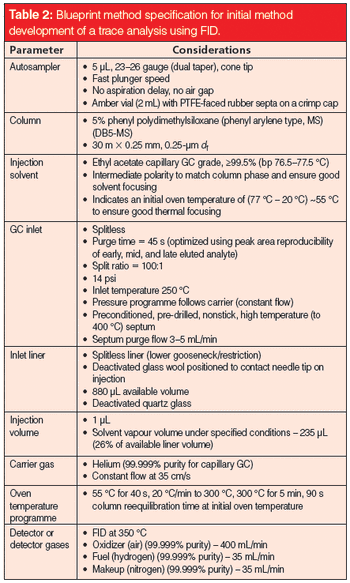
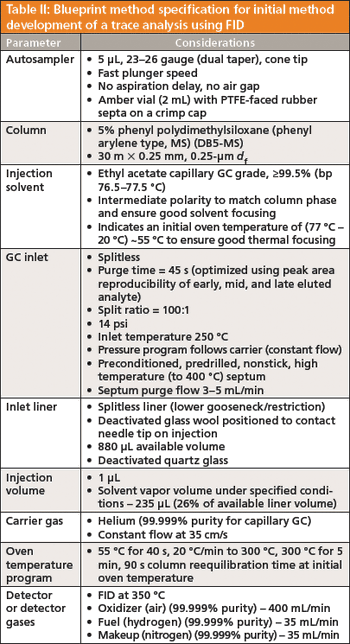
To obtain sensitive, robust, and reproducible gas chromatography (GC) methods, each stage of the chromatographic process needs to be carefully considered and optimized. It is also important to record and report as much detail within the method specification so that the method can be reproduced between operators, instruments, and laboratories. Table I represents a "blueprint" method specification with all of the information that is necessary to faithfully specify and reproduce a split–splitless GC method.

Secondary parameters in the interface and mass analyzer can have a major impact on sensitivity and reproducibility. Here, we examine how and when to consider optimizing these parameters through a study of the working principles of LC–MS analysis.

An overview of the principles and equipment required for scaling analytical separations to the preparative scale and considerations for the scale of analyte required.