When you restart liquid chromatography (LC) instrumentation that was idle during the COVID-19 shutdown, you need to follow a systematic approach. Otherwise, problems may appear in days or weeks following startup.

When you restart liquid chromatography (LC) instrumentation that was idle during the COVID-19 shutdown, you need to follow a systematic approach. Otherwise, problems may appear in days or weeks following startup.

There are still many methods in use that have been developed for use at “room temperature.” With such a method, can one reasonably expect to obtain the same separation in Anchorage, Alaska, as in Mumbai, India?

The hydrophobic subtraction model has been very successful. Nevertheless, the accompanying public database, which has parameters for 750 commercially available columns, is an underutilized column characterization tool. Here is some guidance on how to use both the model and the free database.

How do I know when bioinert liquid chromatography columns, systems, or components are needed for my separations of biomolecules?

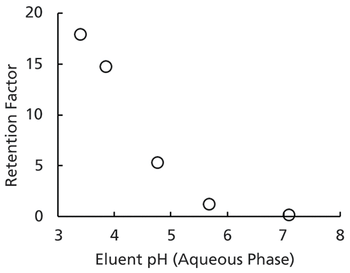
In situ measurements of the mobile-phase pH before and after the column help to rationalize the effects of mismatch in pH and concentration between the mobile phase and sample buffer mismatch in reversed-phase LC separations.

We return to the important topic of buffers, this time focusing on what happens when there is a mismatch between the mobile-phase buffer pH and the pH that the sample is buffered at.

A deeper theoretical understanding the relationship between peak area and flow rate will help analysts diagnose problems when using UV absorbance detection.

Many users have questions about how long LC columns should be re-equilibrated following solvent gradient elution separations. Here we show satisfactory results with short re-equilibration periods, for both reversed-phase and HILIC separations.

In this installment, tips, tricks, and suggestions are provided for best practices in reversed-phase separations, in both 1D and 2D LC, with gradient elution for minimum variations in retention time.

Carefully diluting a sample with weak solvent can mitigate the impact of sample solvent on peak shape in both reversed-phase and HILIC separations, but we need to understand how the choice of sample diluent can affect analyte recovery.

Direct coupling of ion-exchange separations to mass spectrometric (MS) detection is increasingly being used for analyses of molecules ranging from organic acids to proteins. These approaches leverage both the exquisite selectivity of the ion-exchange mode for charge-based separation, and the tremendous power of mass spectrometry for identification of unknowns and trace-level quantitation.

Many analysts have strongly held beliefs about buffer preparation methods, but these positions are not always supported by experimental evidence.

An in-line mixer between the sample injector and column may resolve problems with peak shape caused during sample dilution.

Legacy LC methods seem like they come from a different planet. This month, we look at which conditions to keep, and which ones to let go.

Re-equilibrating a reversed-phase stationary phase following aqueous gradient elution can be achieved much faster than you think.

How many new columns truly offer new selectivity?

In reversed-phase separations, retention generally increases as the fraction of water in the eluent increases. When we encounter situations where retention is too low for an analyte of interest, we tend to use eluents with higher and higher levels of water. But how much water is too much?

We look at problems in LC that can be traced to contaminated solvents or reagents, and how sample solvent effects can lead to poor performance in HILIC

Is an ultraviolet (UV) detector signal good for anything if the analyst is using a mass spectrometer?

An ultraviolet (UV) detector signal can be an excellent source of clues for troubleshooting problems with your LC-even if you are using a mass spectrometer. We also share another good source of clues.

What happens when we inject a sample into the mobile-phase stream? Many LC practitioners are surprised to learn just how serious the effect of the injected sample solvent can be.

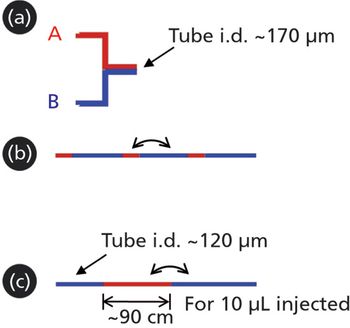
Many LC users are unclear what happens when we combine two (or more) flow streams in LC systems, and when mixers are needed to blend the fluids. This discussion explains why mixers are needed, and when and how you might consider using something other than the default mixer setting.

Much of the conventional wisdom regarding size-phase separations of proteins has been negated thanks to development of superior chemistries and advances in research. In this article, details that the authors have found to be especially beneficial in achieving effective SEC separations are examined.

We examine instances where contaminants are problematic in LC–MS, as well as successful methods to decrease their influence.

For reversed-phase separations of proteins, you must consider pore size,column temperature, and stationary-phase chemistry. Here are some guidelines.

Here, we see how 2D-LC can solve coelution problems that are difficult or impossible to address using peak purity tools or curve resolution methods.

A bad connection between an LC column and the rest of the system can ruin a good separation. New technologies may improve the quality of these connections and the likelihood of establishing a good connection in the first place. Understanding the issues will help you choose the best option for you.

In part II of this series, we explore how curve resolution methods advance purity assessments and illustrate one of the most popular techniques, which adds a powerful tool to the chromatographer’s arsenal.

Certain details related to mobile-phase preparation that can be assumed in reversed-phase LC separations can be much more consequential in HILIC.

Is that peak “pure”? How do I know if there might be something hiding under there? In part I of this series, we explore some of the concepts behind peak purity assessments, describe some tools that are used in commercially available software for these assessments,