

Special Issues
Click the title above to open the LCGC North America December 2016 Corporate Capabilities, Vol 34 No s12, in an interactive PDF format.
Special Issues
Click the title above to open the LCGC North America December 2016 Corporate Capabilities, Vol 34 No s12, in an interactive PDF format.

Special Issues
This study shows that the organic compounds giving rise to the flavor of beverages can be identified by high-capacity sorptive extraction using PDMS probes, wih analysis by thermal desorption–GC–MS.
Special Issues
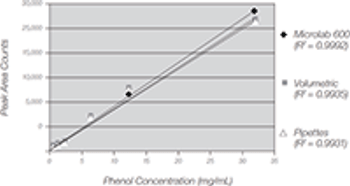
Environmental laboratories analyze customer samples to determine the concentration of contaminants in soil, drinking water, and so on. Frequently these samples are diluted prior to analysis by the ICP-MS. It is critical that these dilutions are accurate and reproducible. In this study we compared the speed, accuracy, and consumable costs for common sample preparation techniques and found that the Microlab 600 is the best option.

Special Issues

Special Issues

Special Issues

Special Issues
Special Issues

Special Issues

Special Issues
Special Issues
Special Issues

Special Issues
Special Issues

Special Issues
Special Issues

Special Issues

Special Issues

Special Issues
Special Issues

Special Issues

Special Issues

Special Issues

Special Issues

Special Issues

Special Issues
Special Issues

Special Issues

Special Issues
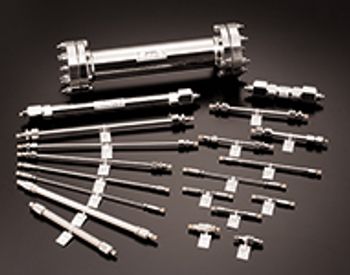
Smaller particle size stationary phases have seen increased use in the modern analytical laboratory due to their ability to exhibit greater resolution while enabling the use of smaller column geometries. Shorter column lengths and narrower bores allow for faster run times and lower flow rates, decreasing laboratory costs in terms of solvent consumption and man-hours needed to run the analyses. This application note examines the effects of smaller particle sizes in various column geometries on size-exclusion chromatography (SEC) methods and the method variables affecting the characterization of antibody products.