

The Application Notebook
Biotage LLC
The Application Notebook
Biotage LLC

The Application Notebook
UCT, LLC

The Column
Charles Wilkins, a professor of chemistry and biochemistry at the University of Arkansas (Fayetteville, Arkansas), has been awarded the 2013 American Chemical Society Division of Analytical Chemistry Award in Chemical Instrumentation, sponsored by the Dow Chemical Company (North Olmsted, Ohio).
LCGC North America
William Farrell, senior principal scientist at Pfizer Inc. (New York, New York) is the winner of the first annual Averica Award. The award will be presented by Jeff Kiplinger, president of Averica (Worcester, Massachusetts), at the SFC 2013 conference in Boston, Massachusetts on July 12.
LCGC North America
Waters (Milford, Massachusetts) recently welcomed the Flavor Research and Education Center within the Food Science and Nutrition Department at the University of Minnesota (Minneapolis, Minnesota) into its Centers of Innovation Program.

LCGC North America
The Basic Training podcast series, providing tutorials, best practices, and podcasts about how to take a product from discovery to development

The LCGC Blog
This month we take a look at the important topic of buffer choice for HPLC separations, how to the choose the correct buffer type and concentration as well as how to avoid variability in retention and selectivity.

Special Issues
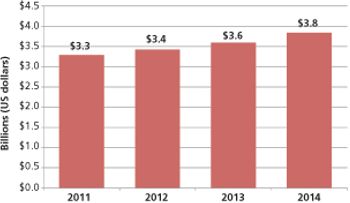
A focused outlook on how laboratory mass spectrometry techniques will fare this year compared to 2012.

Special Issues
We present a brief review of this year's ASMS conference, which took place June 9–13, 2013, in Minneapolis, Minnesota.
LCGC Europe
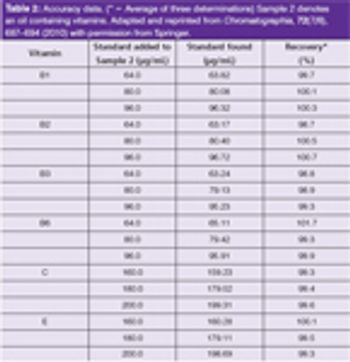
This article discusses the role of CE for vitamin analysis and highlights a number of practical applications.

LCGC Europe
The reasons that make HPLC so ubiquitous; the fundamentals on how we conduct HPLC separations; and a few opportunities with far-reaching impacts in life sciences for separation scientists are discussed in this article.

Special Issues
A look at how the concentration of essential oils in cedar leaves is affected by changes in temperature and the amount of rainfall

Special Issues
The use of electrospray ionization–mass spectrometry for rapid and specific determination of the widely used metal deactivators Irgamet-30 and Irgamet-39 is demonstrated here.

Special Issues
An analytical method for the global profiling of molecular lipids in biological samples, with particular emphasis on the plasmalogen lipids, is described.
LCGC North America
Peter Carr and Davy Guillarme, the 2013 winners of the LCGC Lifetime Achievement and Emerging Leader in Chromatography Awards, respectively, will be honored this fall at the SciX 2013 conference.
LCGC Europe
Click the title above to open the LCGC Europe July 2013 regular issue, Vol 26 No 7, in an interactive PDF format.
LCGC North America
Click the title above to open the LCGC North America July 2013 regular issue, Vol 31 No 7, in an interactive PDF format.
Special Issues
Click the title above to open the July 2013 issue of Current Trends in Mass Spectrometry, Volume 11, Number 3, in an interactive PDF format.
LCGC Europe eNews
The first Uwe D. Neue Award was presented at HPLC 2013 in Amsterdam, the Netherlands, to Joseph Jack Kirkland on June 18, 2013.
LCGC Europe eNews
The 2013 Chromatographic Society Martin Medal was awarded to Gunther Bonn and Frantisek Svec.
The Chinese Instrument and Control Society, together with the Chinese Chromatography Network, organized an event called “Experts Visit the Instrument Manufacturers,†which was held May 20-23, 2013, and focused on research in sample preparation.
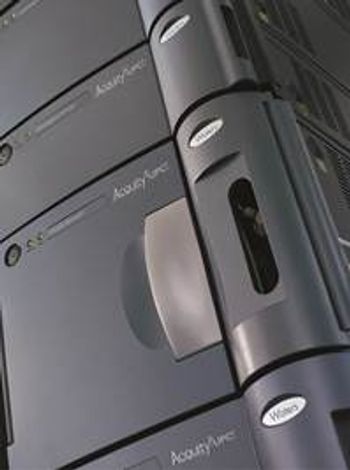
The ACQUITY UPC2 System utilizes a powerful new analytical technique, convergence chromatography, giving you reliability, robustness, selectivity, and throughput never before thought possible. With UPC2 Technology, you?ll change the way you address chromatographic challenges.
LCGC Asia Pacific eNews
Trajan Scientific and Medical (Victoria, Australia) has completed the acquisition of the Chromatography and Liquid Handling businesses of SGE Analytical Science (Ringwood, Victoria, Australia).
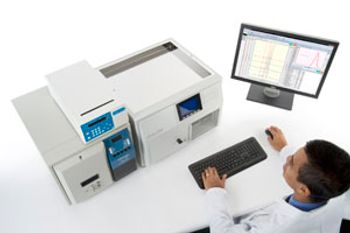
The Viscotek TDAmax sets the standard in advanced GPC/SEC systems. It is a complete solution, suitable for all macromolecular applications, incorporating high sensitivity refractive index, viscometer, and light scattering detectors.
LCGC Asia Pacific eNews
Hong-Yuan Chen, a professor at Nanjing University, gave a presentation on the development of chromatography at the 19th National Chromatography Exhibition, April 1, 2013, in Fuzhou, China.
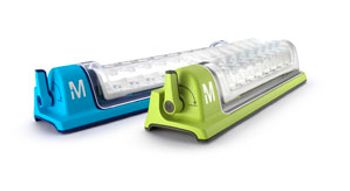
The Samplicity® system provides a higher-throughput, ergonomic alternative to syringe filters for preparing liquid chromatography samples. The vacuum-driven system simultaneously filters up to 8 samples in seconds, including hard-to-filter samples.


The Column
The 2013 Lifetime Achievement in Chromatography Award is granted to Peter W. Carr. Here we chart his career and accomplishments.
The Column
Wine is enjoyed worldwide, with France renowned as a top producer. However, the earliest known biomolecular evidence of grape wine and winemaking has been presented in the Proceedings of the National Academy of Sciences (PNAS)1