

Special Issues
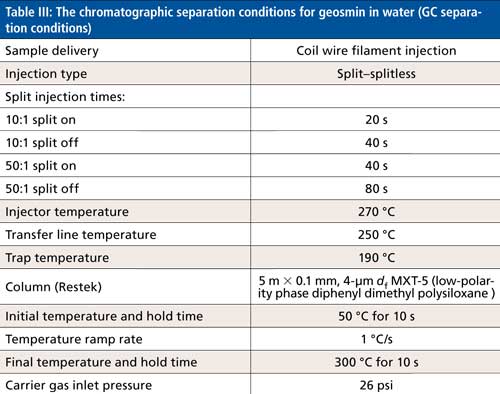
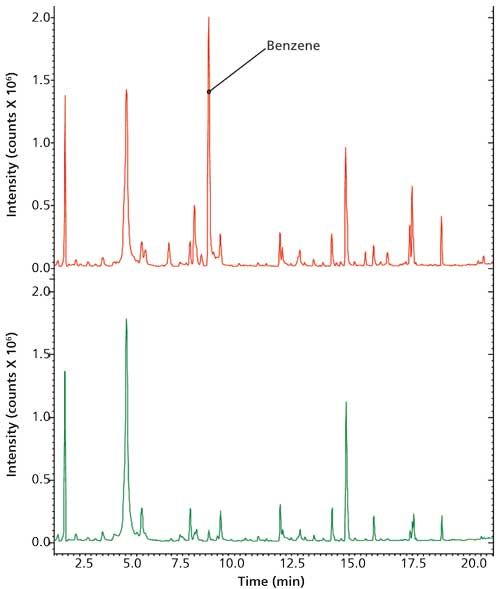
This study focuses on United States Environmental Protection Agency (US EPA) Method 524.3 for volatile organic compounds (VOCs) in water using gas chromatography–mass spectrometry (GC–MS).
Special Issues
This study focuses on United States Environmental Protection Agency (US EPA) Method 524.3 for volatile organic compounds (VOCs) in water using gas chromatography–mass spectrometry (GC–MS).

LCGC North America
This method allows for quick sample preparation of fish samples for the fast analysis of almost 200 targeted contaminants, including PAHs, PCBs, PBDEs, and flame retardants.

LCGC North America
Many "minor" variables in GC–MS analysis can be optimized to improve selectivity or sensitivity.

LCGC North America
A new procedure is proposed that provides identity parameters for headspace-applicable residual solvent Class 1 and Class 2 compounds addressed in the current US Pharmacopeia <467> method.

LCGC North America
This article demonstrates the superiority of the GC-MS approach over spectrophotometry.

LCGC North America
A selective and highly sensitive capillary gas chromatographic-mass spectromic approach has been developed for the detection of PBDEs and PBBs that utilizes dissociative resonance electron capture and selected ion monitoring.

LCGC North America
A novel method that significantly improves the accuracy and reliability of "unknown" compound identification for volatile organic compounds by GC-MS is described.
A GC-MS procedure has been developed, optimized, and applied to characterization of oil binders in paintings.
Researchers at the Universit? di Camerino in Camerino, Italy have developed a new GC-MS and LC-MS technique for the determination of five ink photoinitiator residues: 2-isopropylthioxanthone (ITX), benzophenone, 2-ethylhexyl-4-dimethylaminobenzoate (EHDAB), 1-hydroxycyclohexyl-1-phenyl ketone (IRGACURE 184) and ethyl-4-dimethylaminobenzoate (EDAB) in packaged beverages.

E-Separation Solutions
This month, Chromatography Online's Technology Forum focuses on the topic of Gas Chromatography (GC). Joining us for this discussion is Sky Countryman, GC Product Manager at Phenomenex; Gary Harland, Tandem Quadrupole MS Product Manager at Waters; a Team of Experts from Thermo Fisher Scientific; and Tom Gluodenis and Terry L. Sheehan from Agilent Technologies Life Sciences & Chemical Analysis Group.
The Column
This article presents modified GC-MS method for the analysis of volatile organic compounds by method 8260; this method will dramatically increase instrumental throughput.

LCGC North America
The volatile extraction market consists of three techniques: purge and trap, headspace, and thermal desorption equipment. These systems are often employed as a sampling method for gas chromatography (GC) instrumentation but are also used with IR detectors, electrochemical sensors of electronic noses, and mass spectrometers.

The Column
Negative chemical ionization GC-MS, used in conjunction with automated cold-on-column injection, provides efficient and sensitive quantification of explosive residues for environmental and forensic applications.
The Column
Gas chromatography (GC) coupled to time-of-flight mass spectrometry (TOF-MS) offers unique solutions for various analytical applications including the analysis of food quality, authenticity and safety markers. This article provides a general overview of TOF-MS basic features, highlighting its advantages and limitations compared with GC conventional mass analyzers. Examples of recent results obtained selected food contaminants and flavor components are described illustrate the potential of this recently introduced technique.

Special Issues
Ultrahigh performance liquid chromatography (LC)–time-of-flight mass spectrometry –(TOF-MS) and gas chromatography (GC)–TOF-MS are powerful approaches for screening target compounds and identifying or characterizing nontarget compounds in complex mixtures. The combination of accurate mass data and newly developed software enables truly generic screening methods with TOF-MS, and the confident detection, identification, and confirmation of small molecules in a range of application areas.

The Column
Doping testing is now an accepted fact of sporting life - whether in major international competitions, such as the Olympics, or in regular events at the national level. Athletes who cheat by taking banned substances risk harming their careers and their health. They also bring their country and their sport into disrepute. A reliable and reproducible scientific system for doping testing, backed up by sanctions, helps fight the culture of drugs in sport so that athletes can participate on a level playing field.

LCGC North America
Analytical technologies have been applied to many problems of the modern world, though usually in the domain of the laboratory or to regulate production on the factory floor. However, modern instrumentation can provide valuable information in many other settings as well. Security applications demand sensitive information, accurate information and fast information. These are precisely the kinds of problems that instrumentation has been solving in the research setting for decades. The application of analytical technology to the security of nations, facilities, and people has become an important segment of the industry.

The Column
Gas chromatography-mass spectrometry using a single-quadrupole instrument is the workhorse technique of the environmental lab. It normally falls short for applications that require high mass accuracy. It is shown here that with proper calibration techniques, this technique can indeed readily obtain high mass accuracies to within a few millidaltons and become a powerful tool for unknown compound identification.
LCGC North America
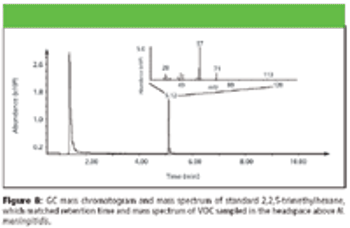
A method for the identification of key volatile organic compound (VOC) markers associated with infection by Neisseria meningitidis bacteria by gas chromatography–mass spectrometry (GC–MS) was developed. Headspace samples of bacterial VOCs were trapped on triple-sorbent bed tubes and then thermally desorbed into a laboratory GC–MS system for separation. Identification was carried out by comparison of GC retention time and electron ionization mass spectra to the National Institute of Standards and Technology (NIST) database. Further confirmation was obtained by GC–MS of known standard chemicals. A total of 75 VOCs were detected, five of which can be considered key VOC markers for Neisseria meningitidis. These peaks were identified as 1,2-dimethylcyclopropane, 2-methylpropanal, methacrolein, N-2-dimethyl-1-propanamine, and 3-methylbutanal by the NIST database.

The author configured a purge-and-trap GC-MS system that simultaneously improved chromatographic resolution and reduced analysis time.