


The Application Notebook
For the analysis of biotherapeutics, size-exclusion and ion-exchange chromatography are typically conducted under native separation conditions, requiring high ionic strength, 100% aqueous eluents.
The Application Notebook
For the analysis of biotherapeutics, size-exclusion and ion-exchange chromatography are typically conducted under native separation conditions, requiring high ionic strength, 100% aqueous eluents.
The Application Notebook
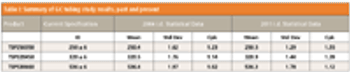
Synthetic fused silica capillary tubing is used in the manufacture of most gas chromatography (GC) columns. In this note, we discuss recent advances in the dimensional control of the most popular tubing sizes.
The Application Notebook
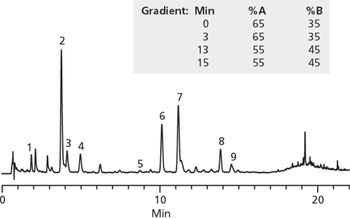
Silymarin, derived from the milk thistle plant, has been used as a natural remedy for the treatment of a number of liver diseases as well as in the protection of the liver from potential toxins. More recently, silymarin has been connected to antitumor promoting activity (1). It is therefore of interest to have available analytical methods for the analysis of silymarin components in various matrices.

The Application Notebook
Various triarylmethane and fluorescent dyes are used in aquaculture as antibacterial, antifungal, and anthelmintic agents for the treatment of fish disease. The FDA has banned the importation of certain fish from several countries due to possible contamination of these food products.
The Application Notebook
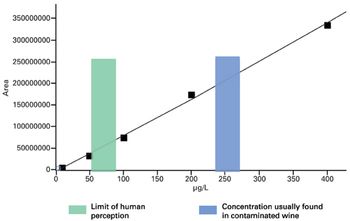
By identifying maturation tracers and molecules commonly responsible for taste defects, gas chromatography–mass spectrometry (GC–MS) augments expert opinion with objective and quantitative information. When using a solid phase micro extraction (SPME) method, GC–MS requires very small sample sizes and a minimum of sample preparation while providing rapid analysis of target molecules. GC–MS can provide an automated technique with repeatable results for detecting all of these compounds.

The Application Notebook
Saccharides are fundamental substances that express various bioactivities and may exist independently or form complexes with proteins or lipids.

The Application Notebook
Blueberries are extracted into acidified methanol and analyzed for anthocyanins with a methanol/formic acid gradient via UHPLC/MS; four different Agilent ZORBAX RRHD stationary phases are quickly evaluated.

The Application Notebook
Resistive glass tubes and plates are designed to guide ions by generating a uniform electric field. PHOTONIS resistive glass products are composed of a proprietary lead silicate glass that has been specially processed to create a resistive layer at the surface. The resistivity can be varied over several orders of magnitude to suit the specific application.
The Application Notebook
Basic compounds often require basic additives in the modifier to improve peak shape and resolution in SFC (1). These additives can be difficult to remove post-purification (2).

The Application Notebook
Since September 2008, 294 000 infants and young children suffered urinary problems as a result of the contamination of melamine in infant milk powder and were hospitalized. This hospitalization was required to treat the symptoms caused by the ingestion of melamine contaminated infant formula and related dairy products. Previously in 2007, pet food, animal feed wheat gluten and other protein-based foods were found to contain residues of melamine and its degradation product cyanuric acid.

The Application Notebook
Forensic laboratories face a daunting task to identify trace amounts of controlled substances in small samples of seized evidence. Unambiguous identification is required to meet the stiff challenge that is sure to be raised in the courtroom. Positive proof is especially difficult to establish if the controlled substance is hidden in a complex food matrix with a high content of sugars, fats, fatty acids, proteins and alkaloids.

The Application Notebook
Penicillins are regulated substances in food for human consumption. The minimum residue limits range from 1 ng/g to as high as 50 ng/g depending on the compound. Because of the complexity of food matrices measuring the level of contaminants requires a total solution composed of sample extraction, sample clean-up, chromatographic separation and detection. In this paper, a solid-phase extraction method with a high performance liquid chromatography tandem mass spectrometry method (HPLC–MS–MS) is shown for the simultaneous determination of six antibiotic residues.

The Application Notebook
EPA Method 8260 is used to determine volatile organic compounds (VOC's) in a variety of matrices including ground and surface waters. This method is commonly used in environmental laboratories where gas chromatography (GC), mass spectrometry (MS) and purge and trap (P&T) technology are used for the analysis and subsequent detection of VOC's.

The Application Notebook
Purge and trap concentration (P&T) along with gas chromatographic analysis is a widely used method for the detection of volatile organic compounds (VOCs). This methodology was developed to achieve the high sensitivity necessary to determine VOCs in drinking water according to EPA Method 524.2. Research is now complete and the EPA currently proposes a revision to this method that may include a revised list of analytes including iodinated trihalomethanes, fuel oxygenates, and Contaminant Candidate List 3. This new method will be 524.3 and may include new parameter optimizations not previously permitted in 524.2 as well as the ability to use selective ion monitoring (SIM) analysis for troublesome compounds.

The Application Notebook
The CUSTODIONâ„¢ solid phase microextraction (SPME) syringe was used to rapidly sample and concentrate volatile organic compounds (VOCs) from water in 5 s. The VOCs were analyzed quickly and reliably in approximately 70 s using the GUARDIONâ„¢ -7 portable capillary gas chromatograph toroidal ion trap mass spectrometer (GC-TMS).