

LCGC Europe
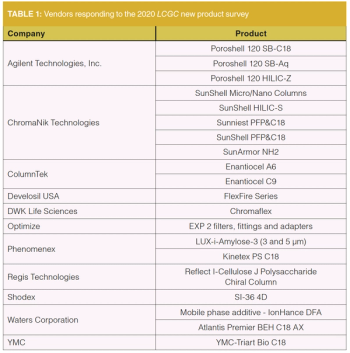
Our annual review of new liquid chromatography (LC) columns and accessories, introduced at Pittcon and other events.
Dr. David S. Bell is currently Lead Consultant and Owner at ASKkPrime, LLC a consulting firm focused in the separation science arena. Dave also serves on the Editorial Advisory Board for LCGC Magazine and is the Editor for the Column Watch series of articles.
Over the past three decades, Dave has worked directly in the chromatography industry, focusing his efforts on the design, development, and application of chromatographic stationary phases to advance gas chromatography, liquid chromatography, sample preparation and related hyphenated techniques.Prior to focusing on chromatography device development and application, he spent a decade immersed in the pharmaceutical industry performing analytical method development and validation employing various forms of chromatography and electrophoresis.
Dave’s main objectives have been to create and promote novel chromatography technologies and to conduct and collaborate on research aimed toward understanding molecular interactions that contribute to retention and selectivity in an array of chromatographic processes. His research results have been presented in hundreds of symposia worldwide, and have resulted in more than 95 peer-reviewed journal and trade magazine articles.His efforts have also contributed to the development and commercialization of numerous products utilized in laboratories worldwide.
Dave’s undergraduate studies in chemistry were completed at the State University of New York at Plattsburgh (SUNY Plattsburgh). He earned his PhD in Chemistry from The Pennsylvania State University (State College, Pennsylvania).
LCGC Europe
Our annual review of new liquid chromatography (LC) columns and accessories, introduced at Pittcon and other events.

LCGC North America
At the 43rd International Symposium on Capillary Chromatography (ISCC 2019) in Fort Worth, Texas, a panel addressed the current challenges and potential future directions in capillary liquid chromatography. How can their vision be achieved?
LCGC Europe
The “State-of-the-Art in Capillary Liquid Chromatography” panel discussion at the 43rd International Symposium on Capillary Chromatography (ISCC 2019) in Fort Worth, Texas, USA, was a thoughtful dialogue on current challenges and potential future directions in the field. The session included a general overview of the current state of the field, key drawbacks preventing widespread use of capillary liquid chromatography (LC) columns, and how these challenges might be overcome. In this article, we highlight some of the common themes that were discussed as part of this panel.

LCGC Europe
The 48th International Symposium on High Performance Liquid Phase Separations and Related Techniques (HPLC 2019), chaired by Alberto Cavazzini and Massimo Morbidelli, was held from 16–20 June in Milan, Italy. This instalment of “Column Watch” covers many of the highlights observed at the symposium.
LCGC North America
With SEC, special care is required to achieve in practice the chromatographic efficiency that is expected from theory.

LCGC Europe
Our annual review of new liquid chromatography (LC) columns and accessories, introduced at Pittcon and other events.
LCGC Europe
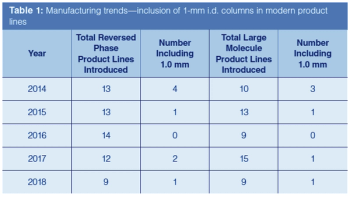
One millimetre internal diameter liquid chromatography columns are available from many manufacturers. In this article, the utility of 1.0-mm internal diameter (i.d.) columns, and the arenas in which they play a relatively strong role, are investigated. Further, the advantages and disadvantages of 1.0 mm diameter columns are contrasted with both larger- and smaller-bore formats.

LCGC Asia Pacific
The 47th International Symposium on High Performance Liquid Phase Separations and Related Techniques (HPLC 2018), chaired by Norman Dovichi, was held from 29 July to 2 August in Washington, D.C., USA. This instalment of “Column Watch” covers some of the highlights observed at the symposium. In addition, trends and perspectives on future developments in HPLC noted from the conference are presented.

LCGC Europe
The 47th International Symposium on High Performance Liquid Phase Separations and Related Techniques (HPLC 2018), chaired by Norman Dovichi, was held from 29 July to 2 August in Washington, D.C., USA. This instalment of “Column Watch” covers some of the highlights observed at the symposium. In addition, trends and perspectives on future developments in HPLC noted from the conference are presented.

LCGC North America
Topics that stood out at HPLC 2018 include advances in large-molecule separations, multidimensional separations, 3D printing, chiral separations, and HILIC. Also, many speakers addressed separation fundamentals, including ways to increase speed, generate higher throughput, and add selectivity.

LCGC Europe
Liquid chromatography–mass spectrometry (LC–MS) has become the preferred analytical technique for many challenging assays based on its selectivity, sensitivity, and broad applicability to compounds of varying polarity. Despite its advantages, the complexity of LC–MS systems often leaves analysts struggling to meet method detection limits. In this instalment of “Column Watch”, several strategies will be discussed to improve method sensitivity through the reduction of contaminants, the careful selection of LC method conditions, and the optimization of MS interface settings. By understanding the relationship between these parameters and ionization efficiency, analysts can enhance their signal-to-noise ratio and realize the hidden potential of their LC–MS.
LCGC Asia Pacific
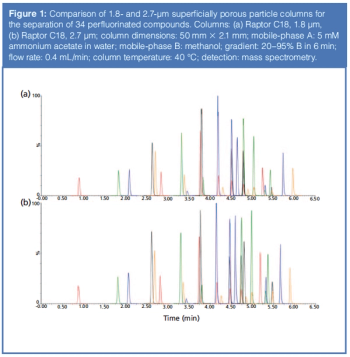
The use of superficially porous particles (SPPs) for modern high performance liquid chromatography (HPLC) is now very common. Initially, SPPs rose as an alternative to sub-2-µm fully porous particles (FPPs). In recent years, many column manufacturers have developed 2-µm and smaller SPP-based products. This article investigates the practical utility of these smaller SPP designs.
LCGC Europe
The use of superficially porous particles (SPPs) for modern high performance liquid chromatography (HPLC) is now very common. Initially, SPPs rose as an alternative to sub-2-µm fully porous particles (FPPs). In recent years, many column manufacturers have developed 2-µm and smaller SPP-based products. This article investigates the practical utility of these smaller SPP designs.
LCGC North America
Many manufacturers now offer columns using superficially porous particles that are 2-µm and smaller. When should you use them?
LCGC North America
What can metal–organic frameworks offer for liquid chromatography?

Special Issues
An introduction to this special issue from the guest editor.

LCGC North America
Our annual review of new liquid chromatography columns and accessories, including columns for reversed-phase, HILIC, chiral, SEC, GPC, ion-exchange, and SFC separations of small and large molecules.

LCGC Europe
Our annual review of new liquid chromatography columns and accessories, introduced at Pittcon and other events.

LCGC Europe
In this extended special feature to celebrate the 30th anniversary edition of LCGC Europe, leading figures from the separation science community explore contemporary trends in separation science and identify possible future developments. We asked key opinion leaders in the field to discuss the current state of the art in liquid chromatography column technology, gas chromatography, sample preparation, and liquid chromatography instruments. They also describe the latest practical developments in supercritical fluid chromatography, 3D printing, capillary electrophoresis, data handling, comprehensive two‑dimensional liquid chromatography, and multidimensional gas chromatography.

LCGC Europe
The 45th International Symposium on High Perfomance Liquid Phase Separations and Related Techniques (HPLC 2017), cochaired by Michal Holc€apek and František Foret, was held 18–22 June in Prague, Czech Republic. This instalment covers some of the highlights observed at the symposium, including advances in large-molecule separations, multidimensional chromatography, and areas of growing application of high performance liquid chromatography (HPLC). In addition, trends and perspectives on future developments in HPLC noted from the conference are presented.
LCGC North America
Topics that stood out at HPLC 2017 include advances in large-molecule separations, multidimensional chromatography, HILIC, and chiral separations.
LCGC Europe
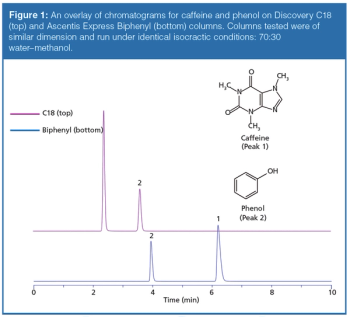
In reversed-phase liquid chromatography (LC), C18 alkyl-based stationary phases have been the favourite of method developers. Phenyl stationary phases are an alternative that are thought to benefit from additional π-π mechanisms. Recently, there has been a growing interest in the use of phases based on the biphenyl moiety. This instalment of “Column Watch” looks at the retention mechanisms of biphenyl phases and contrasts them with those of more-common alkyl phases.
LCGC North America
In biphenyl phases, the surface chemistry often makes it possible to separate compounds not well resolved by C18 or phenyl phases.
LCGC North America
Our annual review of new liquid chromatography (LC) columns and accessories introduced at Pittcon and throughout the previous year.

LCGC Europe
Our annual review of new liquid chromatography (LC) columns and accessories introduced at Pittcon and throughout the previous year.

LCGC Asia Pacific
Interest in chromatography using hydrophilic interaction liquid chromatography (HILIC) has continued to build in recent years. Adoption of the technique has been slowed by experiences of poor reproducibility. In particular, reequilibration times in HILIC have been reported as being exceptionally long as compared to reversed-phase chromatography. In this study, reequilibration times in HILIC for both aqueous–organic gradients and buffer gradients are systematically explored. The results not only promise to improve method development practices, but also provide insight into HILIC retention mechanisms across mechanistically differing polar stationary phases.
LCGC North America
Interest in chromatography using hydrophilic interaction liquid chromatography (HILIC) has continued to build in recent years. Adoption of the technique has been slowed by experiences of poor reproducibility. In particular, re-equilibration times in HILIC have been reported as being exceptionally long as compared to reversed-phase chromatography. In this study, re-equilibration times in HILIC, for both aqueous–organic gradients and buffer gradients are systematically explored. The results not only promise to improve method development practices, but also provide insight into HILIC retention mechanisms across mechanistically differing polar stationary phases.

LCGC Europe
Interest in chromatography using hydrophilic interaction liquid chromatography (HILIC) has continued to build in recent years. Adoption of the technique has been slowed by experiences of poor reproducibility. In particular, reequilibration times in HILIC have been reported as being exceptionally long as compared to reversed-phase chromatography. In this study, reequilibration times in HILIC for both aqueous–organic gradients and buffer gradients are systematically explored. The results not only promise to improve method development practices, but also provide insight into HILIC retention mechanisms across mechanistically differing polar stationary phases.

LCGC Asia Pacific
The 44th International Symposium of High Performance Liquid Phase Separations and Related Techniques (HPLC 2016), chaired by Professor Robert Kennedy, was held 19–24 June in San Francisco, California, USA, at the Marriott San Francisco Marquis. This instalment of “Column Watch” covers some of the highlights observed at the symposium, including stationary-phase developments, particle technology, and areas of growing application of high performance liquid chromatography (HPLC). In addition, trends and perspectives on future developments in HPLC noted from the conference are presented.
LCGC North America
HPLC 2016, chaired by Professor Robert Kennedy, was held June 19–24 in San Francisco, California, at the Marriott San Francisco Marquis. This installment of "Column Watch" covers some of the highlights observed at the symposium including stationary-phase developments, particle technology, and areas of growing application of HPLC. In addition, trends and perspectives on future developments in HPLC noted from the conference are presented.