

LCGC Europe
"In retrospect, we sometimes see the successful return of an earlier idea on the back of great advances in technology."
LCGC Europe
"In retrospect, we sometimes see the successful return of an earlier idea on the back of great advances in technology."

LCGC Europe
"In retrospect, we sometimes see the successful return of an earlier idea on the back of great advances in technology."



LCGC North America
It seems hard to believe that we are already nearing the holidays and the end of 2009. And for many in the world of separation science, after weathering difficult economic conditions, solvent shortages, and more, welcoming in 2010 will be something to look forward to indeed.

LCGC Europe
The 5th National Meeting on Environmental Mass Spectrometry is an environmental mass spectrometry special interest group (EMSSIG) event forming part of the British Mass Spectrometry Society (BMSS) SIG meetings and is scheduled for 24 March 2010. The main theme of the event will be Recent Advances in the Methodology for Environmental and Food Matrix Analysis.
Like neomycin and tobramycin, Gentamicin belongs to the group of aminoglycoside antibiotics. It is manufactured by a fermentation process and the main constituents are gentamicin C1, C1a, C2 and C2a
Sample preparation for instrumental analysis is of crucial importance to the quality of the test results as well as for the speed of the analysis. In liquid chromatography, SPE (solid phase extraction) is a widely used technique for concentrating analytes and for removal of matrix components.
The Pittcon Networking Committee announced the topics for the Conferee Networking Sessions for Pittcon 2010, March 1- 4, at the Orange County Convention Center (Orlando, Florida). These sessions are a networking opportunity for registered conferees with similar interests to get together in an informal setting to brainstorm and share ideas.
LCGC Europe eNews
Eurostat, the statistical office of the European communities, has published the 2009 edition of its Science, Technology and Innovation in Europe report.
LCGC Europe eNews
Acetonitrile supplier, INEOS, has announced a technological breakthrough that the company claims will allow it to significantly improve the security of the global acetonitrile supply.
LCGC Europe eNews
In this application, simple and complex carbohydrates, which are often analyzed by HILIC, are separated on the BEH Amide column and then directly detected with electrospray ionization mass spectrometry (ESI-MS) with no need for derivatization, post-column addition, or metal complexing agents.
I have dedicated this issue to answering the questions that we posed regarding the solid-phase extraction of propranolol from a plasma extract.
LCGC Europe eNews
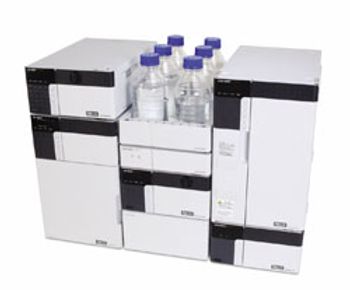
The Shimadzu prominence TOX.I.S. system is based on well-established LC hardware modules. Their patented flow line design and column switching procedure enable pre-treatment of urine samples with a cleaning step, rinsing to remove proteins and other urine components, and transfer of the sample onto the analytical columns for separation.
He N2 Purge Gas Comparison - Teledyne Apps Note
The Column
Unlocking the Doors with TLC Ned Dugan Selectivity: A Liquid Chromatographic 'Weapon of Mass Resolution' Mike Giles and David Keay Application Notes News Chromatography training courses, macabre mummy discoveries, an office expansion into Russia and vitamin C testing are featured in this issue. Market Trends & Analysis Market Profile: Gas Generators Glenn Cudiamat Events and Staff
He N2 Purge Gas Comparison - Teledyne Apps Note
Introducing TharSFC X5?: a Parallel SFC System for Fast Method Development and Optimization - Thar5 Apps Note
Applications on a New Silica Monolithic 2 mm I.D. HPLC Column - EMD Apps Note
LCGC Europe eNews
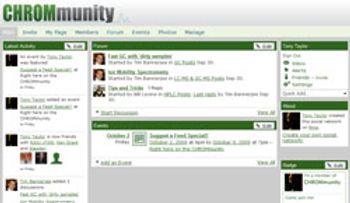
Crawford Scientific and the LC?GC group have launched a unique information exchange and social networking site dedicated to analytical scientists, CHROMmunity...
Shimadzu Scientific Instruments (Columbia, Maryland) updated its existing System GC Program to include the GC-2014 gas chromatograph. In addition, the program now offers new streamlined systems for natural gas, transformer gas, and greenhouse gas analysis, as well as biofuels and biomass feedstock research.

Frank van Geel speaks to Theo Jelink from AkzoNobel about his findings after testing the Meltfit One connecting device from NLISIS Chromatography.

E-Separation Solutions
High performance liquid chromatography (HPLC) continues to be a workhorse technique in analytical laboratories, and ultrahigh-pressure liquid chromatography (UHPLC) is becoming a viable option for chemists looking to decrease solvent use and achieve higher resolution in a shorter time. Participants in this discussion are Roy Eksteen of Tosoh Bioscience LLC, Michael McGinley of Phenomenex, Inc., and Uwe D. Neue of Waters Corporation.

LCGC Europe eNews
Recently, Thermo Fisher Scientific announced the release of an application note describing its analysis of red wine using ultrafast chromatography. Red wine is a good source of antioxidants and is said to contain natural compounds that may be beneficial to human health...
This application note illustrates a high-sensitivity method for the analysis of fluticasone propionate in rat plasma using ACQUITY UPLC and Xevo TQ MS. High sensitivity was achieved using just 375 uL of plasma in a rapid-throughput assay. The rapid data capture of the Xevo TQ MS allowed for the narrow MRM peaks to be accurately defined and quantified.
Determination of BPA in Infant Formula by LC-MS/MS - Thermo LCGC
Rapid, High Resolution Analysis of Aflatoxin Extracts from Peanut Butter Using Kinetex? Core-Shell Technology and Strata® SPE -Phenomenex Apps Note
LCGC Europe eNews
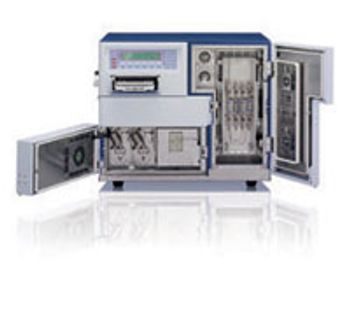
EcoSEC is the new compact, all-in-one GPC/SEC system from Tosoh Bioscience, designed for semi-micro GPC applications. The website www.ecosec.euprovides detailed information about hardware, software and extensive application data...