

High Throughput GPC Analysis of Phenolic Resin Using TSK-GEL SuperHZ Columns-Tosoh Application Note
High Throughput GPC Analysis of Phenolic Resin Using TSK-GEL SuperHZ Columns-Tosoh Application Note
Agilent Technologies, Inc. (Santa Clara, California) announced it has jointly developed a method to detect and identify perfluorinated compounds (PFCs) in water and soil using high-performance liquid chromatography? mass spectrometry (HPLC?MS) with the China National Environmental Monitoring Center (CNEMC).

The Application Notebook
It is no secret that these are tumultuous times we live in. With the economic slowdown, increased dangers abroad, and the recent string of scares involving toxins in everyday foods, there is no shortage of things to worry about in today's world. At LCGC, we've always felt that our Application Notebook is a reflection of not just the recent developments in chromatography and the field of separation science in general, but the world as a whole.
The Pittsburgh Conference released the call for papers for Pittcon 2010, which will be held February 28 to March 5, 2010, at the Orange County Convention Center in Orlando, Florida.
Researchers from Vertox Laboratory, Defence Research and Development Establishment (Gwalior, India) used a liquid-liquid-liquid microextraction technique followed by liquid chromatography?mass spectrometry (LC?MS) to examine alkyl alkylphosphonic acids, which are important environmental markers of nerve agents.
Researchers from Banyu Pharmaceutical Co. (Ibaraki, Japan) used a novel extraction method to prepare drugs in gelatin capsules for analysis by high performance liquid chromatography.
A research group from AlbaNova University Center, Royal Institute of Technology (Stockholm, Sweden) developed an automated method for purifying and desalting proteins before mass spectrometry analysis.
Ion Exchange Analysis of Monoclonal Antibodies on Large Pore TSK-GEL BioAssist Columns-Tosoh Application Note
A research group from NRL Marine Biotoxins, Federal Institute for Risk Assessment (Berlin, Germany) developed a solid-phase extraction (SPE) method for the enrichment and clean-up of lipophilic marine biotoxins from various species of bivalve molluscs and processed shellfish products.
ACD/Labs (Toronto, Canada) announced the release of new software for target analysis of complicated LC?MS and GC?MS datasets, without the tedious and difficult manual interpretation.
Stability of TSK-GEL SuperSW3000 Columns for Analyzing Proteins by SEC-Tosoh Application Note
French scientists have developed a GC?MS method, combined with a triple partition extraction step to reduce the amounts of co-extracted fats, for the determination of pesticides in meat-based baby foods.
Researchers from the Tokyo Institute of Technology (Tokyo, Japan) used thin-layer chromatography (TLC) and high performance liquid chromatography in a study of structures on plant surfaces that provide resistance against herbivores.
Researchers from Univerité de Lyon (Lyon, France) have developed a chromatographic method for distinguishing 100% natural honey from adulterated or impure honey.
Thermo Fisher Scientific (San Jose, California) announced that it has been presented with the ACHEMA 2009 Innovation Award for the category of Laboratory and Analytical Techniques.
Purification of a 13-mer DNA Phosphorothioated Crude Deprotected Oligonucleotide by Strong Anion Exchange Chromatography Using TSKgel DNA- NPR- Tosoh Application Note
Scientists from Henan Normal University (Xinxiang, China) and the University of Science and Technology Beijing (Beijing, China) developed an ultrasound-assisted ionic liquid dispersive liquid-phase microextraction procedure for determining four aromatic amines in water samples.
E-Separation Solutions
For those of you who have not yet had a chance to read Spectroscopy and LCGC?s "Homeland Security" supplement (www.spectroscopyonline.com), Tuesday morning's "Mass Spectrometry in Homeland Protection" session should provide a nice overview of the topic.
Complete Carbamate Testing Solution-Waters Application Note
E-Separation Solutions
Tuesday afternoon's session titled "LC?MS Assessment of Human Metabolism Compliance with "MIST" Guidance" plans to tackle the topic of the key challenges for drug development as a result of the FDA?s MIST guidance.
Rapid and Accurate Simultaneous Quantitation of Low Concentration Amphetamines and Metabolites from Urine using Strata?-X*-C and LC/MS/MS on Gemini C18 -Phenomenex Application Note
Optimization of Wash-Elution Conditions-Phenomenex Application Note
Acetonitrile Shortage-SIELC Technologies Application Note
LCGC North America
Columnist Michael Balogh looks at the questions: Where are we now? What do the early MS innovators see as their legacy? And what can we expect in the future?
E-Separation Solutions
Welcome again, to Day 2 of ASMS 2009. We?re pleased to bring you our continued coverage from Philadelphia, Pennsylvania. ASMS is in full swing, and last night?s hospitality suites were as crowded as ever, as you might imagine. Tonight promises to be another crowded night at the Marriott, but before then, there is a whole day of mass spectrometry-related science.

LCGC Europe
Rising stars interview leading figures in the world of chromatography. Gert Desmet talks to John Knox.
E-Separation Solutions
The call for increased biofuel production will surely be closely followed by a need for improved methods of analysis. The six presentations in this Tuesday morning session will examine various roles of mass spectrometry in biofuels analysis and will cover topics such as biodiesel characterization, metaproteomic analysis of termite microbes relevant to biofuel development, and multiple reaction monitoring of biofuels systems metabolic pathways.

LCGC Europe
United States Pharmacopeia (USP) general chapter 1058 on analytical instrument qualification (AIQ) has finally become official and was released in August 2008 in the first supplement to the USP XXXI.1 This column reviews AIQ and discusses the impact it will have in the regulated chromatography laboratory.

The Application Notebook
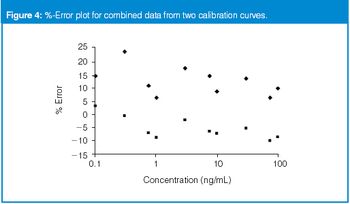
Evaporation-free extraction (no drying down) is highly desirable because of its reduced cost and pollution, higher speed, and less possibility for contamination and conversion. Presented in this article are four types of evaporation-free extraction that are widely applicable. The first one is for the determination of didanosine over the range of 25.02–2502.00 ng/mL by injecting solid-phase extraction (SPE) eluate directly. The second is for the determination of betamethasone phosphate over the range of 2.51–250.60 ng/mL by injecting SPE eluate after pH adjustment. The third is for the determination of sumatriptan over the range of 0.99–99.40 ng/mL based upon SPE with high organic washing and low organic elution. The fourth is based upon automated dilution after protein precipitation for the determination of raloxifene-4'-glucuronide and raloxifene-6-glucuronide over the ranges of 2.02–202.40 ng/mL and 0.40–39.95 ng/mL, respectively.