

Routine HPLC Determination of Aminopyridine Compounds-ESA Application Note
Routine HPLC Determination of Aminopyridine Compounds-ESA Application Note
LCGC Europe eNews
Thermo Fisher Scientific has announced that it will acquire Biolab, a leading provider of analytical instruments, life science consumables and laboratory equipment for scientific, environmental and healthcare markets in Australia and New Zealand.
A study led by cancer researchers at Ohio State University's Comprehensive Cancer Center's Experimental Therapeutics Program.has validated a method for reliably measuring variations in certain proteins that may make good biomarkers in chronic leukemia patients.
Analtech (Newark, Delaware) announced the launch of a web blog dedicated to thin-layer chromatography (TLC).
Thermo Fisher Scientific (Waltham, Massachusetts) has agreed to acquire Biolab, an Australian analytical instruments and life science consumables distributor, for $120 million (US).
Scientists from Brigham Young University (Provo, Utah) and US Synthetic Corporation (Orem, Utah) developed C18, C8, and perfluorinated diamond-based reversed-phase solid-phase extraction (SPE) media.
Researchers from the Research Institute for Chromatography (Kortrijk, Belgium) and AstraZeneca R&D Charnwood (Loughborough, UK) used in-situ derivatization and liquid chromatography?mass spectrometry (LC?MS) to analyze arylamines and aminopyridines, which can be present as potentially genotoxic impurities in pharmaceutical preparations at trace levels.

Special Issues
The authors discuss the use of GC-MS in drug doping testing.
Thermo Fisher Scientific?s (Waltham, Massachusetts) Cambridge, UK, facility has been awarded the Queens Award for Enterprise 2009 in the Outstanding Innovation category for its iCAP 6000 Series inductively couple plasma?optical emission spectrometry (ICP?OES) system.
Nucleotide Bases with Excellent Peak Shapes-Microsolv Application Note

LCGC North America
Without question, the current acetonitrile shortage has become the hottest topic in the chromatography world in recent memory. The influx of shortage-related articles, conservation tips, and even explorations of alternative separations instrumentation has been enormous at LCGC, with many brilliant and innovative ideas being presented to get laboratories through these hard times

Special Issues
The authors discuss analytical methods for lipidomics.
The Chemical Heritage Foundation announced that David and Alice Schwartz, founders of Bio-Rad Laboratories (Hercules, California) will receive the organization?s fourth annual Richard J. Bolte Sr. Award for Supporting Industries.
Comparison Of Fully And Superfically Porous Particle Colums for the Analsys of Basic Compounds-Waters Application Note

Special Issues
The author discusses the use of high-performance mass spectrometry for small molecule and protein applications.
Special Issues
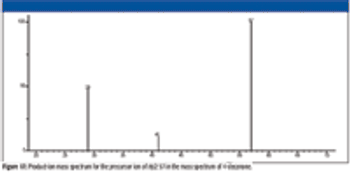
The authors discuss the use of electron ionization to determine a compound's structure.
Researchers from Uppsala University (Uppsala, Sweden) added alkali salts to protein samples in preparation for capillary electrophoresis (CE) analysis of intact proteins.
Malvern Instruments (Southborough, Massachusetts) now provides customer support for Viscotek gel permeation chromatography (GPC)?size exclusion chromatography (SEC), dilute solution viscosity, and light scattering systems in India.
The U.S. Drug Enforcement Administration (DEA) has bought a liquid chromatograph from Waters Corporation (Milford, Massachusetts) to use in forensic chemist training at Virginia?s Special Testing and Research Laboratory.
Acetonitrile shortage? Shodex has developed a new high temperature polymer-based column: 1) High resolution 2) Fast analysis 3) Small consumption of organic solvent: More interesting applications on www.shodex.co.uk

DataApex is an independent software company with expertise in developing and manufacturing chromatography data stations. DataApex's solution combines hardware and software developed in DataApex laboratories with a commitment to providing quality technical support.
LCGC Asia Pacific eNews
Waters and the University of Warwick, Coventry, UK, have signed a collaborative research agreement that is intended to support the growth, development and adoption of novel mass spectrometry (MS) technologies.
LCGC Asia Pacific eNews
The winners of The Queen's Award for Enterprise 2009 have been announced. The Queen's award is Britain's highest accolade for business success and among this year's winners are companies with links to the separation science industry, including Thermo Fisher Scientific and SMI-Labhut.
LCGC Europe eNews
The winners of The Queen's Award for Enterprise 2009 have been announced. The Queen's award is Britain's highest accolade for business success and among this year's winners are companies with links to the separation science industry, including Thermo Fisher Scientific and SMI-Labhut.
Since the shortage in the supply of acetonitrile (ACN) began in late 2008, HPLC users suffer under more and more purchasing problems and higher costs. With our Eluent Savings Handbook we give you a range of practical tips and suggestions to help you deal with the acetonitrile shortage. Act now: Our Eluent Savings Handbook offers specific solutions for saving solvent, which will not only reduce the amount of HPLC eluents you use, but also benefit the environment by reducing waste. Learn more about how to save eluent by slimming methods, by UHPLC, by substitution and more.
LCGC Europe eNews
Waters and the University of Warwick, Coventry, UK, have signed a collaborative research agreement that is intended to support the growth, development and adoption of novel mass spectrometry (MS) technologies.
Knauer provides a range of practical tips and suggestions to help you deal with the acetonitrile shortage. Learn more about how to save eluent by slimming methods, by UHPLC, by substitution and more
A cool way to separate biological compounds is being developed by Japanese researchers. A stationary phase made of ice and water has been used to separate estrogen, amino acid derivatives and poly(oxyethylene) oligomers. Yuiko Tasaki and Tetsuo Okada from the Department of Chemistry at the Tokyo Institute used this phase to achieve a much larger theoretical plate number [(N) = 1,500] than previous ice experiments [N = 250] which allowed these applications.1 This novel stationary phase could be used to provide better separation selectivity for polar groups than silica gel, Okada told LCGC Europe.
For anyone involved in or planning to start process development, characterization and/or validation activities
Glossary of HPLC and LC Separation Terms