All News


In this article, the authors examine the concentration-dependent influence of Na+- and K+ ions on mass spectra of peptides, with human gastrin as a model peptide using LC/ESI–MS as the selected ionization technique.

The authors provide suggestions for the sample pretreatment and analysis of aerosol particles including the use of on-line SFE–LC–GC–MS, GCXGC and LC–MS. Although each technique has its merits, the novel multidimensional systems and those integrating sample pretreatment with the final analysis proved to be valuable tools in aerosol analysis.

This article discusses the development of gel permeation chromatography or size exclusion chromatography as a technique for analysing the molecular weight distributions of polymers. It further highlights the development of columns and hardware for high-resolution characterization of polymers.

The authors look at two types of method modification from a scientific and regulatory standpoint: a change of column and a change in the operating system. Both are difficult to avoid if a method is used for several years.


While some variation in retention is normal, larger changes from run to run are generally indicative of a problem. Here, the auther discusses how the retention time of a peak in an LC separation can be a useful diagnostic tool to identify problems with a separation.


In this first of a two-part installment, John Hinshaw discusses the relative effects that inlet pressures and oven temperatures have on capillary gas chromatography.


In this, the first of a two-part series, the authors provide some background on the PCA method and introduce some of the terminology used by practitioners of the method.

A new sampling method for gas chromatography termed single-drop microextraction (SDME) is described. In this column, SDME is applied to residual solvent analysis, both in manual and automated modes.


The authors describe a method for determining sulfamethazine residue in pork using 100% water in both sample preparation and HPLC separation.

The authors review chromatographic separations of archaeological biomolecules for their analysis using accelerator mass spectrometry or isotope ratio mass spectrometry.

A detailed look at some helpful shortcuts for estimating chromatographic parameters.


Several recently developed technologies are described, along with the ways they can improve the utility and performance of mass spectrometers.


The authors describe a sensible approach for validation and implementation of HPLC IPC assays.

The use of a silica column for HILIC is examined, including mechanistic studies of analyte retention on silica in aqueous-organic mobile phases.


This month'ss guest authors review the application of solid-phase SPME to the analysis of drugs in human plasma.

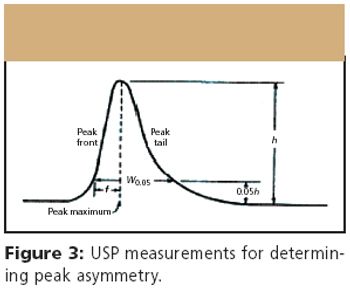
This month's "GC Connections" examines the various ways – and their attendant benefits and drawbacks – with which chromatographers and chromatography data-handling systems locate and measure peaks