

LCGC Europe
See so much more with these new video glasses; Tune into your stress levels; A gadget that won't let you close your wallet!; Interaction using a new dimension; Personalize your identity tag
LCGC Europe
See so much more with these new video glasses; Tune into your stress levels; A gadget that won't let you close your wallet!; Interaction using a new dimension; Personalize your identity tag
LCGC Europe
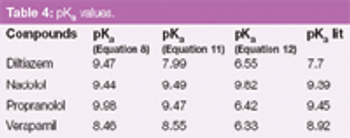
The acid-base constants of the most frequently used antianginals (diltiazem, nadolol, propranolol and verapamil) were determined using capillary zone electrophoresis (CZE). This method is based on measuring the electrophoretic mobility of the solute as a function of pH. The buffer employed was composed of borate-phosphate buffered across the pH range of 3.0–11.2. The acid-base constants were determined by performing linear and non-linear regression on the data obtained. The results were compared with those reported in literature and with those obtained by a spectrophotometric method. After comparison of the values, no significant differences were observed between the three acid-base constants.

LCGC North America
After a 25-year dormant period, chromatography was finally reborn in the first years of the 1930s.

LCGC North America
Waters and Rosetta Biosoftware collaborate; Eksigent reaches Southeast Asia distribution agreement; Phenomenex reaches distribution agreement with Beckman Coulter; The Pittsburgh Conference announces call for papers; Agilent Technologies acquires Stratagene

Special Issues
Here we describe a new compact device for electron-capture dissociation (ECD) analysis of large peptides and posttranslational modifications of proteins, which can be difficult to analyze via conventional dissociation techniques such as collision-induced dissociation (CID). The new compact device realizes ECD in a radio frequency (RF) linear ion trap equipped with a small permanent magnet, which is significantly different than the large and maintenance-intensive superconducting magnet required for conventional ECD in Fourier-transform ion cyclotron resonance mass spectrometers. In addition to its compactness and ease of operation, an additional merit of an RF linear ion trap ECD is that its reaction speed is fast, comparable to CID, enabling data acquisition on the liquid-chromatography (LC) time scale. We interfaced the linear-trap ECD device to a time-of-flight mass spectrometer to obtain ECD spectra of phosphorylated peptides injected into a liquid chromatograph, infused glycopeptides, and intact small..
Special Issues
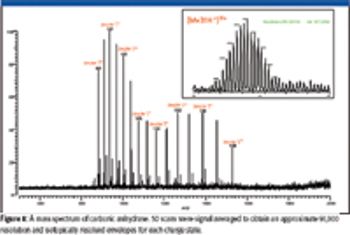
More than 20 years passed after the introduction of Fourier transform–ion cyclotron resonance mass spectrometry (FT-MS) before advancements in electronics and computer technology enabled the development of practical, high-performance instruments. Modern analytical FT-MS instruments rely on sophisticated electronic circuitry and powerful computer software to achieve the dramatic resolving power and mass accuracy typical for the instrumentation. Here, the power of modern hybrid FT-MS instrumentation is discussed by demonstrating the capability of this instrumentation for selected applications such as the analysis of crude oil, intact protein, and fragile noncovalent complex samples.
Special Issues
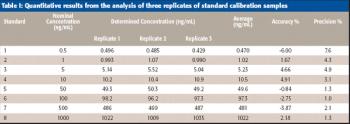
Assay sensitivity is the lowest concentration at which a targeted analyte can be measured and is often limited by chemical background or co-eluting interferences. FAIMS in combination with liquid chromatography (LC) and zero neutral loss tandem MS was used to remove chemical background and co-eluting interferences from the analysis of linoleic acid in cancer cell extracts. Concentration of endogenous linoleic acid was determined from back-calculation of standard calibration samples fortified with deuterium-labeled linoleic acid. No internal standard was used. LC–MS-MS analysis of the cancer cell extracts resulted in an increase in signal-to-noise ratio of 10-fold. The assay sensitivity was increased 10 times over the traditional LC–MS-MS experiment exclusively due to the new FAIMS technology.

Special Issues
Metabolomics is a developing analytical approach that is growing rapidly in importance as a tool to improve diagnosis and treatment of disease, as well as to speed up the drug development process. Unlike genomics or proteomics, which only reveal part of what might be happening in a cell, metabolomic profiling can give an instantaneous snapshot of the entire physiology of that cell. This article describes the challenges associated with metabolomics research and new tools developed to overcome them.
Special Issues
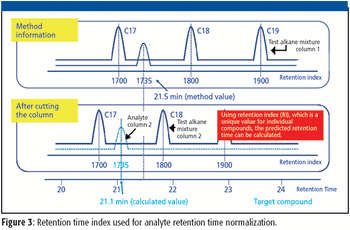
Reproducing analysis conditions is crucial to achieving consistent, accurate results in gas chromatography–mass spectrometry (GC–MS). Valid reproduction demands appropriate application of technique, solid method design, reliable and accurate equipment, and a dedicated team of well-practiced technicians and researchers. But even when all these conditions are met, users can be held back by the more subtle elements in GC–MS operations, such as cutting or changing a column, or setting up the same experiment on different equipment. Even getting the parameters of a test organized so that it can be reproduced elsewhere - in a laboratory across the hall, the country, or the world - can be daunting. Consistent GC–MS results depend upon retention-time reproducibility.
Special Issues
State-of-the-art mass spectrometry (MS) techniques of growing importance to life sciences research now include not just liquid chromatography (LC)–MSn (n = 2–11), but also LC–matrix-assisted laser desorption ionization-time-of-flight (MALDI-TOF), LC-MALDI-TOF-TOF, electrospray ionization (ESI)-TOF, and LC-Fourier transform (FT) MS.
The Column
With the growing need for companies to share their work with global counterparts and contract research organizations, the importance of ISO 17025 compliance to validate quality processes is paramount.
The Column
We all know that when the sample is dissolved in a stronger solvent (stronger than the mobile phase) chromatographic peak distortion can occur.
The Molecular Chirality Research Organization (MCRO) held its annual Molecular Chirality Symposium on May 15-16 at the Tokyo University of Science in Tokyo, Japan.
Daicel Chemical Industries, Ltd. and Groupe Novasep, announced the formation of a strategic technical co-operation aimed at streamlining the use of chiral chromatography for manufacturing late-stage clinical and commercial chiral intermediates and APIs.
E-Separation Solutions
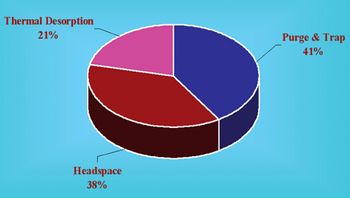
The volatile extraction market consists of three techniques: purge and trap, headspace, and thermal desorption equipment.
Syagen Technology, Inc., announced that it has signed a cross licensing agreement with the joint venture of Applied Biosystems/MDS SCIEX, both analytical instrumentation businesses, to share patent claims covering atmospheric pressure photo-ionization (APPI) and methods of usage.
Waters Corporation and Rosetta Biosoftware recently announced a collaboration to develop interfaces that promote compatibility between software platforms and MS-based systems.
The Column
Time for Scientists to have and image makeover? Zosimus: Is the image portrayed by badly dressed scientists leading to the dwindling number of youngsters joining the world of science? Advantages to High Performance Countercurrent Chromatography David Keay and Ian Janaway Identifying and Characterizing Polymers Using Pyrolysis GC-MS Ute Potyka Q&A: Think Small Michael Balogh, president and co-founder of CoSMoS - the Conference on Small Molecule Science, talks about the rationale behind the annual event. Shaping the Future: Part 2 Ronald Majors News All the news from June 2007. Market Trends & Analysis Glenn Cudiamat reports on the latest global market trends in preparative and process chromatography.

LCGC Asia Pacific
Agilent tours Asia Pacific region; Instrumental analysis exhibition; Joint research and development agreement

LCGC Asia Pacific
Chromatography at the Australian Centre for Research on Separation Science (ACROSS), University of Tasmania; Chromatography at the Australian Wine Research Institute; Separation Science at the University of Western Sydney; Natural product analysis at Charles Sturt University; Chromatography at the Australian Centre for Research on Separation Science (ACROSS), RMIT

Special Issues
Art Caputo, Executive Vice President and President, Waters Business Operations, Waters Corporation
Special Issues
Jose Castro-Perez, Kate Yu, and John Shockcor, Waters Corporation, Milford, MA

LCGC North America
JEOL receives Omega Award; SGE and Australian Proteome Analysis Facility sign agreement; Spark Holland achieves ISO certification; Waters and Northeastern University open laboratory; Eksigent signs Korean distribution agreement
Special Issues
Ed Sprake and Iain Gibb Waters Corporation, Manchester, UK

LCGC Europe
This adjustable spanner tool combines with the ease of use of a pair of pliers.

LCGC Europe
Calibration refers to the process of determining the relation between the output (or response or signal) of a measuring instrument and the value of the input quantity or property. Depending on the univariate or multivariate character of the response (signal) used; either a univariate or a multivariate calibration is performed. The different calibration approaches are summarized in this article.
Special Issues
Antonietta Gledhill Waters Corporation, Manchester, UK

LCGC Europe
Research group: Professor Jane Thomas-Oates, Analytical, Environmental and Atmospheric Chemistry, Department of Chemistry, University of York, York.