

Special Issues
Smiths Detection is part of the global business Smiths Group, a leading developer and manufacturer of advanced technology solutions for civil and military markets worldwide.
Special Issues
Smiths Detection is part of the global business Smiths Group, a leading developer and manufacturer of advanced technology solutions for civil and military markets worldwide.

Special Issues
Congratulations to LCGC North America on 25 illustrious years covering the fields of separation science and analytical instrumentation.
Special Issues
Congratulations LCGC on 25 Years of Great Publishing!
Special Issues
In 1982 when the first issue of LCGC entered the chromatography laboratories, BISCHOFF Chromatography was already 2 years old.

Special Issues
Congratulations on your 25th anniversary, to one of the most recognized journals in the field of analytical science.
Special Issues
LEAP Technologies, Inc. was founded in 1989 by three liquid handling automation veterans. Applying liquid handling to chromatography and mass spectroscopy for a variety of labs was the focus. LEAP started as a one-product company representing a fledgling Swiss company, CTC Analytics. GC applications in environmental labs were the main market. LEAP's expertise was integrating its GC autosampler and the headspace sampler into GC and GC–MS systems. Flexibility and portability were the key to selling these very reliable samplers. A second product line was launched that served tablet dissolution applications in pharmaceutical companies. LEAP applied that know-how and launched the Opt-Diss, a unique fiber optic UV system adaptable to all waterbath testers.
LCGC Europe
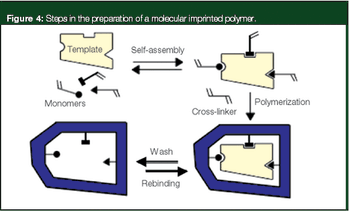
Although the majority of solid-phase extraction (SPE) is performed with conventional bonded silica- and polymeric-phases, difficult and complex samples may require more specialized stationary phases. In this instalment of "Sample Preparation Perspectives", columnist Ron Majors discusses advanced topics such as multimodal SPE, restricted-access media, molecular imprinted polymers, immunoaffinity extraction phases and other class-or compound-specific sorbents. These phases provide additional selectivity and procedures using them can be automated. Representative applications will be presented.

Special Issues
OI Analytical entered the analytical instrument business in 1969. The company's first instruments were designed to measure water quality. A Total Carbon System (TCS) which employed a wet oxidation technique was invented through the efforts of Dr. Alan D. Fredericks, a research scientist at Texas A&M University.

Special Issues
Polymer Laboratories (PL), now a part of Varian, Inc., was founded in 1976 from the Polymer Research Group at Loughborough University in the UK.

Special Issues
PHOTONIS USA (formerly BURLE Electro-Optics) and its predecessor companies (Galileo, RCA, and Phillips) has been a leader for over 30 years.

LCGC Europe
Internet connection finder; Portable keyboard recorder; Global voice translator; HD video camera

Special Issues
Horizon Technology, Inc. was incorporated in July 1992 to develop, manufacture, market, and support an innovative line of automated laboratory products for sample preparation. The initial products automated a new series of solid phase extraction (SPE) methods that have recently been approved by the US EPA. These new SPE methods provide a faster, less expensive, and solvent-reducing alternative to existing sample preparation procedures.

Special Issues
Over seventy years ago, the Laboratory Equipment Corporation introduced the first rapid carbon determinator to the American iron and steel industry. Soon our carbon determinators, resistance furnaces, and sulfur determinators were seen in industrial laboratories across the country, along with the acronym trademark they carried. LECO became synonymous with accurate, dependable instrumentation for the determination of carbon, sulfur, oxygen, nitrogen, and hydrogen in both ferrous and nonferrous industries.

Special Issues
Dr. Dieter Jaenchen founded CAMAG in 1961 near Basel, Switzerland, the heart of the European Pharmaceutical Industry.

Special Issues
The Hamilton Company was founded in the early 1950s by the innovative Clark Hamilton. Clark was the first person to develop a glass syringe that could repeatedly deliver microliter volumes accurately.

Special Issues
A company's 25th Anniversary celebration has always been an important one.

Special Issues
Viscotek – A Full-Service Supplier of GPC Products and Services

Special Issues
Chiral Technologies, Inc. is the worldwide market leader of chiral chromatography products and services.

Special Issues
Biotage AB is a global company specializing in life science research technologies. The company offers products, knowledge, and experience in the areas of analytical, medicinal, and process chemistry.

Special Issues
Orochem Technologies, Inc. is a wholly woman-owned business incorporated eleven years ago in the state of Illinois. Orochem today has a worldwide presence with customers in North America, Europe, and Asia. Orochem has three manufacturing, sales, and marketing facilities around the world

Special Issues
Regis Technologies, Inc. has a long-standing history of collaborating with leading scientists in the development of innovative chromatographic technology.

Special Issues
Congratulations to LCGC North America on their 25th anniversary. LCGC has focused on and reported practical chromatography solutions for scientists and with their extensive readership, has helped Kimble/Kontes reach the right people.

Special Issues
PDR-Chiral evolved from a strong educational background in physics, mathematics, and chemistry, as well as extensive engineering development experience in particle physics (measuring g-factor of positron), astronomy (photon counting spectra-photometers and polarimeters), and defense (active and passive remote sensing suites). We are experts in systems engineering, optimizing all aspects of complex multidisciplinary processes.


Special Issues
Jordi FLP was founded in 1980 for the distinct purpose of providing the highest quality analytical services, polymer-based HPLC columns, and packing media in the industry. As a family-owned company, the Jordi family and the entire staff take pride in the research, production, and delivery of each of our products. We also understand the importance of quality customer care and strive daily to exceed our customers' expectations.

Special Issues
My first contact with HPLC was at Mount Sinai Hospital, where our lab's budget miraculously allowed for a Waters gradient HPLC system.
Special Issues
UCT has spent the past twenty years perfecting our solid phase extraction product line.

Special Issues
The last 25 years have seen profound progress in many areas of scientific discovery.

Special Issues
JASCO Corporation was founded in Japan in 1958 to provide the scientific community with optical spectroscopy products. By the early 1970s JASCO was developing a complete line of separation science instrumentation, including HPLC, SFE/SFC, EC, CE, and Micro-bore chromatography systems.

Special Issues
On behalf of the worldwide Phenomenex team, I would like to congratulate LCGC North America on 25 years of providing chromatographers with pertinent and useful content in the field of separation science. LCGC North America is unique in that it delivers helpful troubleshooting and validation articles as well as special coverage on upcoming technologies. As a member of the LCGC editorial advisory board, I'm proud to participate with a publication that serves as a resource for both new and experienced chromatographers.